Article
20 July 2026
ESSAYS IN HISTORY – HOW SAUDI ARABIA AND PALESTINE ADDRESSED THEIR CURRENCY NEEDS
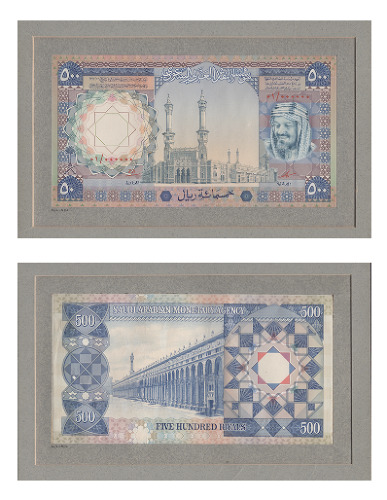
According to the Saudi Central Bank (formerly the Saudi Arabian Monetary Agency), the 500 Riyal note was introduced for the first time during the fourth issue of 1984 “in response to the expansion of cash transactions driven by Saudi Arabia’s economic development”.
As this auction shows, however, there had been plans to introduce such a note eight years earlier in 1976.
Paper currency was first issued in Saudi Arabia in 1961, during the reign of King Saud bin Abdulaziz. Seven years later the same five denominations – 100, 50, 10, 5, and 1 Riyal – comprised the second issue during the reign of King Faisal bin Abdulaziz.
Planning for the third issue, during the reign of King Khalid bin Abdulaziz Al Saud in 1976, had included designs for a 500 Riyal note, and Saudi Arabian Monetary Agency, composite essays for the obverse and reverse are included as highlights here.
Dated 1974, and with the red serial number 01/000000, and Ali and Aziz signatures, the obverse is in blue and multicolour, the central panel featuring an entirely hand-painted image of the Holy Mosque in Mecca, with King Abdul Aziz ibn Sa’ud at right, and geometric patterns at left. The reverse features a hand-painted depiction of the al-Massa wall of the Holy Mosque.
Although the 500 Riyals was never issued, this design was eventually later adopted and used on the highest denomination of the 1976 Third Issue, namely the 100 Riyals.
The essays are mounted on large-format card, as produced, in PCGS holders 66PPQ and 55. Choice about uncirculated and gem uncirculated, the production and artwork is by Thomas De La Rue and of outstanding quality. This is a highly important record and comes with an estimate of £20,000-26,000.
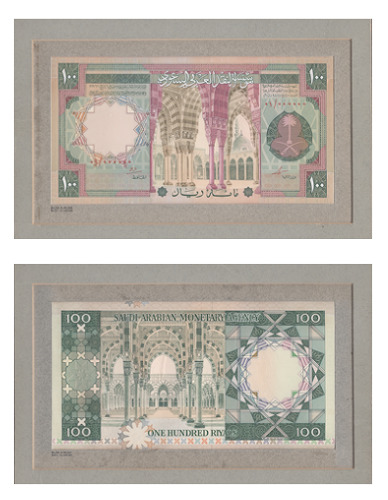
Also in the sale are the obverse and reverse composite essays for the proposed 100 Riyals. Again they are dated 1974, with red serial number 01/000000 and Ali and Aziz signatures.
The obverse is in green, purple, and brown, the central panel an entirely hand-painted image of the Al-Masjid al-Nabawi Mosque in Medina, with coat of arms at right. The reverse is in green and multicolour, showing the interior columns of Al-Masjid al-Nabawi entirely hand-painted. The key features of this design were later used on the 50 Riyals of the 1976 issue.
Mounted on large-format card, in PCGS holders 66PPQ and 63PPQ, this choice uncirculated and gem uncirculated essay is also magnificent in both scale and beauty, and by Thomas De La Rue of the highest quality. It also has an estimate of £20,000-26,000.
Both lots are ex the Abdulqader Khayat Collection.
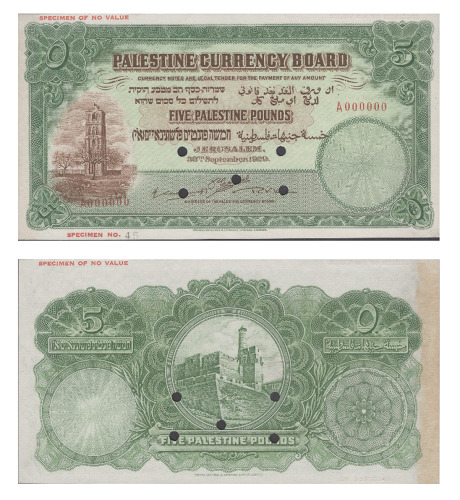
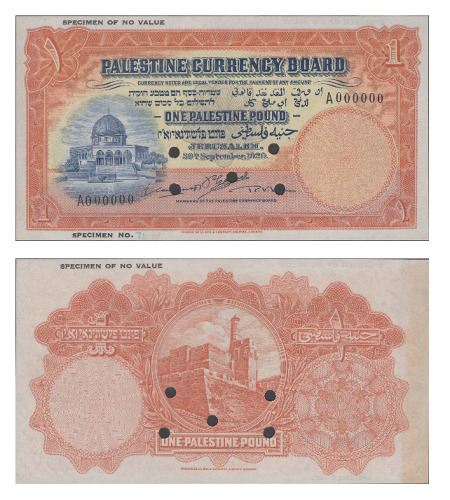
Two further highlights here are the Palestine Currency Board, colour trials for the Palestine £5 and £1, each dated 30 September 1929, with the serial number A000000. Complete with the signatures of Board members Sir John Caulcutt, Sir Percy Ezechiel and Roland Venables Vernon, the £5 is specimen number 45, the £1 specimen number 71.
The obverse of the £5 is in brown and green print, and depicts the Crusader’s Tower in Ramleh at left, the reverse in green print, with five small cancellation holes, and red SPECIMEN OF NO VALUE overprint at upper left. In PMG holder 63, this exceptional note is expected to fetch £18,000-22,000.
The £1 obverse is in blue and orange print, with the Dome of the Rock on the Temple Mount in blue print, and the reverse is entirely in orange print, with five cancellation holes, and black SPECIMEN OF NO VALUE overprint at upper left. Also in PMG holder 63, this seldom-seen colour trial – especially in this colour scheme – is excessively rare and pitched at £15,000-20,000.
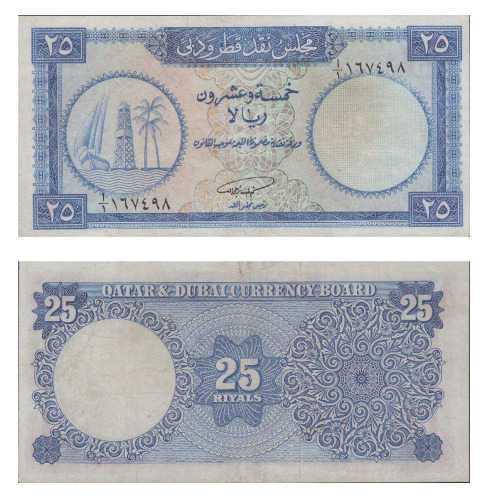
Following Noonans’ recent success in selling rare notes from Qatar, another highlight here is the Qatar & Dubai Currency Board 25 Riyals from 1966, a very fine, presentable example of a rare and iconic note, which is expected to fetch £8,000-12,000.
Share This Page