Article
29 June 2026
THE MEN WHO HELD THE GERMANS BACK DURING THE RETREAT FROM MONS
The Charge of the Light Brigade group of three medals to Sergeant J.W. Wightman previewed in our last newsletter soared over its £6,000-8,000 to take £22,000 hammer in this sale – a worthy bid.
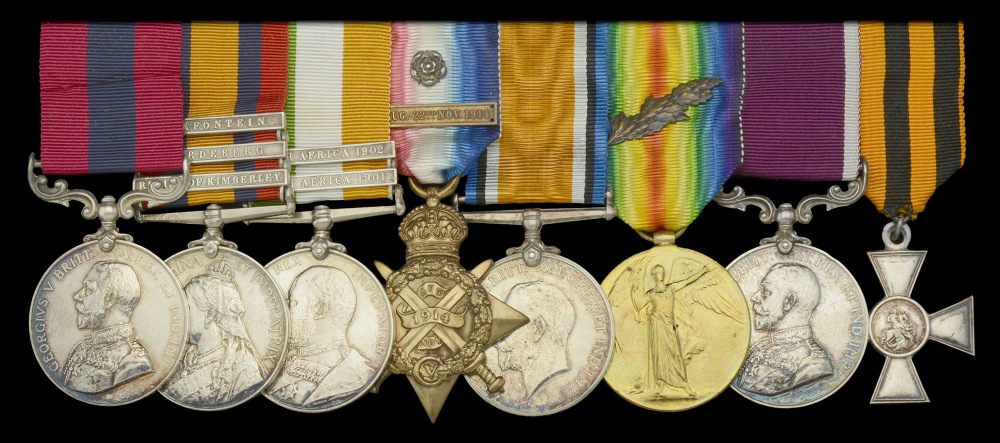
Other medals also went over estimate, including the Distinguished Conduct Medal group of eight awarded to Regimental Sergeant Major A. G. Palmer, 56th Field Company, Royal Engineers, a veteran of the Boer War. Guided at £3,000-4,000, it sold for £7,000.
As with the Light Brigade group, this superb ‘Le Cateau, 26 August 1914’ group recalls an event that was later captured in print, in this case the record of extraordinary feats published in five volumes under the title Deeds That Thrill The Empire.
Palmer won his DCM ‘For gallantry and coolness at Le Cateau on 26th August, in assisting Lieutenant C.G. Martin, Royal Engineers, in the defence of a Post from which Infantry had been driven.’ He was Mentioned In Dispatches in the London Gazette 19 October 1914 and 15 June 1916.
Martin, who won the Distinguished Service Order for his part in the action, went on to win the Victoria Cross at Spanbroek Molen, 12 March 1915.
Albert George Palmer, a harness maker by trade from Hastings in East Sussex, had already served with the Hampshire Isle of Wight Artillery prior to attesting for the Royal Engineers at Parkhurst, Isle of Wight in February 1897. He went on to serve with the 38th Field Company, Royal Engineers during the Second Boer War, and with the 56th Field Company, R.E. on the Western Front from 18 August 1914.
Palmer and Martin’s actions at Le Cateau resulted in two of the earliest gazetted awards for the Great War.
It was during the Retreat from Mons that Martin, at the head of his platoon and with the help of Palmer, captured a German trench and held it until reinforcements arrived. On this occasion he was twice wounded, and invalided home for some months.
It is thanks to Martin’s own record of events that we have a detailed picture of the action and his and Palmer’s parts in it.
“The Le Cateau position ran due East to Caudry and from there it bent South West. The Royal Irish occupied the North of the village.
“A report came in that a Battery of Gunners had been held up by wire and had no wire cutters. I was sent with some cyclists to help them. I met a Battery and asked for information but they knew of no wire, so returned to the village and found the square empty. I collected all the Sappers I could find, about 15 including the CSM [Palmer] and cooks and Officers servants and reported to the Royal Irish HQ. They wanted ammunition taken up to the Regiment. We found their men lining the edge of the village behind a small bank with a field of fire of about 100 yards. Standing up I could see over a mile to the village of Bethancourt. We distributed the ammunition and my men joined the firing line. Quite a lot of bullets were coming over but our line being on the reverse slope we were quite safe.
“The Officer in charge of the Infantry was very nervous and kept saying we ought to retire. I said you can’t, your CO has just sent you up ammunition. I then told him that I would go into one of the houses just behind us and direct the fire of his men. Got up to an attic window and had a wonderful view. I saw a firing line of sorts about a mile away and behind that some dismounted Cavalry and what looked like two Companies of Infantry in close formation. It was obvious that we would soon be attacked so I thought that the more noise we made with our rifles the longer it would be delayed. I passed the word to the men below me to pass the following order along the line-All men to put their sights at 1000yds, Aim straight in front, Load magazines and fire five rounds rapid whenever I blew my whistle.
“The scheme worked well, the Germans took what cover they could find or withdrew a bit. The morale of our men rose, and it was hard to make them wait for the next whistle. We kept up this type of firing with several gaps till about one o’clock when the Germans started shelling us.
“Suddenly as I was pointing out a target the whole house shook and I found myself on the floor rather dazed. The bed, and the back wall of the room, had disappeared with all my kit on it. Just under the window out of which I was looking was a round hole about one foot in diameter and I am sure that the shell must have passed between my legs which were about 2 feet apart. It took me a minute or two to collect myself and get out of the house.
“I opened the front door and found that all the infantry had cleared off and my Sappers wondering what was left of me. I told them to go on firing as hard as they could to pretend that we were still a large force. I lay down next to my Sergeant Major [Palmer] who was rather large, he felt awfully unhappy because a machine gun was firing about 3 inches above him and he could not move. The man on my right lifted his foot for a second and had the heel of his boot taken right off. The Infantry reported that I was dead and that the Germans had captured the village. The Infantry mounted a counter attack and found us instead of the Germans holding the village.
“We stayed till about 3pm and then had an order to retire and slipped away with only one Sapper wounded. I had lost my hat but luckily picked up a soldier’s hat lying in the road that fitted me perfectly. We marched in pouring rain and darkness until we reached Le Catelet; there was no sign of my forage cart which contained all my kit, equipment and my tent.”
Palmer advanced to Temporary Regimental Sergeant Major (entitled to Silver War Badge, and was discharged due to ‘Sickness’, 31 October 1918). The medal group of Brigadier C. G. Martin, V.C., C.B.E., D.S.O. is held by the Royal Engineers Museum.
Share This Page