Article
29 June 2026
FROM £10 MILLION TO £25,0000 – ONLY KNOWN SET OF UK SPECIMEN TREASURY BILLS OF ITS TYPE AMONG A WEALTH OF HIGHLIGHTS
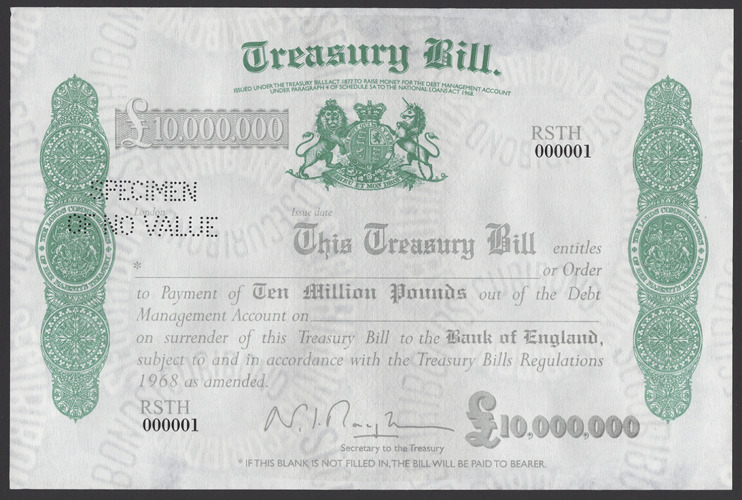
Specimen Treasury Bills are rare enough in themselves – a full set in fine condition is all but unheard of.
This auction includes the only set ever discovered of its type: six UK Treasury bills for the denominations £25,000, £50,000, £500,000, £1,000,000, £5,000,000, and £10,000,000, all with a serial number 000001.
Signed by what appears to be N.I. Raugh or Ralph, and perforated SPECIMEN OF NO VALUE, they also have very beautiful and intricate watermarks spelling out ‘SECURIBOND’ in circular patterns. With evidence of mounting on the reverse, and including some paper pulls, this is an otherwise uncirculated set and is expected to sell for £3,000-£4,0000
From 1798 to 2015, and from the bank of England to the Dardanelles – this is an auction with an extraordinarily eclectic selection of highlights.
Up first is a Bank of England, Abraham Newland, £10, dated 29 October 1798, the serial number 249. Previously split in half, but professionally rejoined, this very fine and excessively rare example is ex the Louis Manzi collection and comes with an estimate of £12,000-16,000.
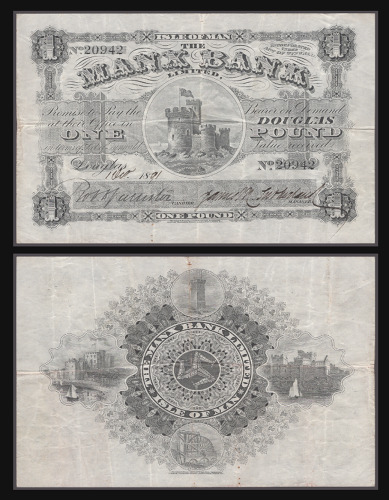
Islands feature strongly in this auction, starting with the Isle of Man. A Manx Bank Limited, £1, dated 1 October 1891, with serial number 20942, carries the Sutherland and Callister signatures on fresh and original paper. This is an exceptional note in good very fine condition, and an incredible example of this classic design. Extremely rare, it has a guide of £8,000-10,000.
The Currency Commission of the Irish Free State came into being under the Currency Act, 1927, the chairman being Joseph Brennan, the Irish economist and later Governor of the Central Bank of Ireland.
Among the more celebrated notes it issued were the Ploughman series, which remained legal tender until 1953. Here a Royal Bank of Ireland, £10 from the series, dated 6 May 1929, has the serial number 01RT000001.
Signed by Brennan and G.A. Stanley, this about uncirculated note is in scarcely believable condition, the only other example of a Royal Bank £10 on the PMG population report is a 25, whereas this one is assessed at 55. The small tear mentioned on the holder is located at the top centre of the note and does not enter into the design, in fact it is barely discernible even under intense scrutiny. The estimate is £8,000-10,000.
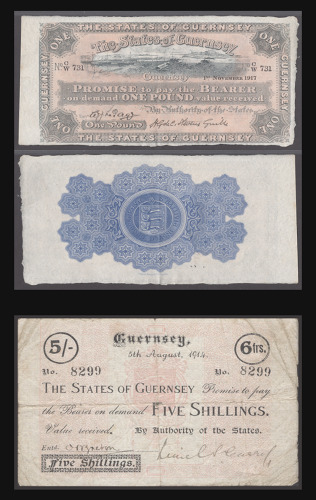
A States of Guernsey, £1, dated 1 November 1917, with serial number C/W 731, carries the Le Page and Stevens-Guille signatures. In PMG holder 58, and choice about uncirculated, this is a superb and well-centred example, on original paper, and very rare. It carries hopes of £7,000-9,000.
Also from Guernsey is a First World War Issue, States of Guernsey 5 Shillings (6 Francs), dated 5 August 1914 – the day after the war broke out. With serial number 8299, and Lionel Slade Carey and Osmond P Breton manuscript signatures, it has the ornate Bailiwick seal at centre. Hard horizontal and vertical folds have led to a small hole at the centre, but this is otherwise a very presentable and very fine example of this incredibly rare emergency issue note. It should sell for £4,000-5,000.
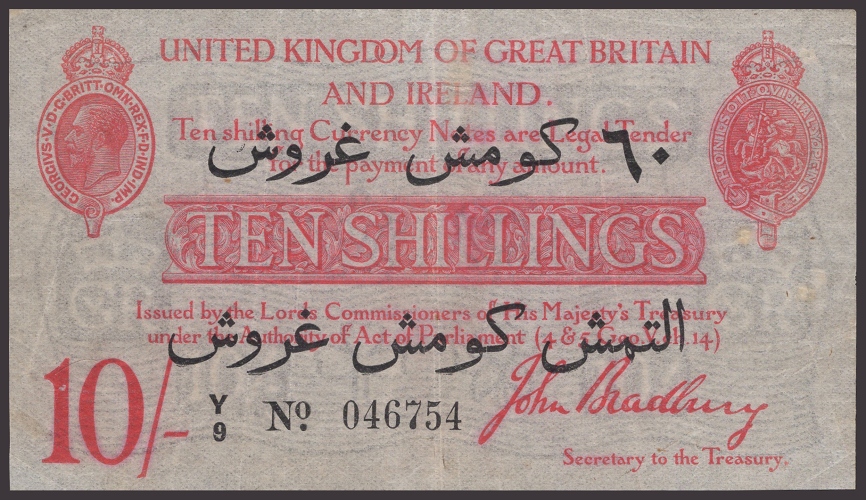
If emergency notes like those from Guernsey were introduced to preserve gold during wartime, other issues were also aimed at the war effort. A Treasury Series, John Bradbury, Dardanelles Campaign Overprint 10 Shillings, dating 1915-16 in this sale is a good example of this. Overprinted with Turkish endorsement, it was created for Troops landing on Gallipoli, hoping to be able to spend it once they reached Constantinople. Issued the day before landing, they were recalled when the forces retreated. With serial number Y/9 046754 and in good very fine condition, it is being sold together with a letter written at the time of issue. The estimate is £1,000-1,400.
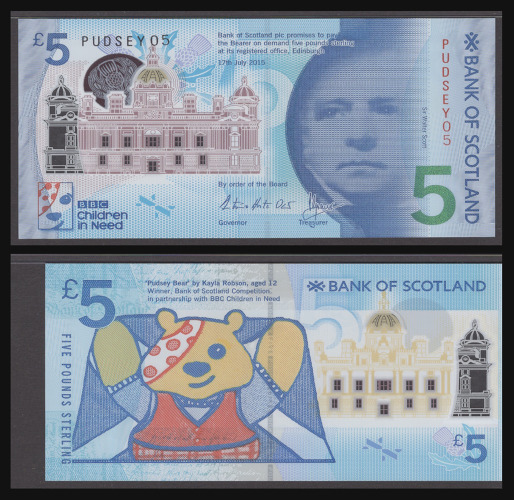
What is thought to be the rarest modern polymer banknote in the world comes in the form of a Bank of Scotland, commemorative £5, dated 17 July 2015. Its serial number, PUDSEY05, provides the clue, as it was created for the ever-popular BBC Children In Need and inspired by its mascot Pudsey Bear. With Horta-Osorio and Grant signatures, and in its original Bank of Scotland folder, this superb gem is uncirculated – one of only 50 such notes produced, and with a very low serial number, as well as an excellent grade. Just one other example is currently graded higher by PMG. The estimate is £5,000-7,000.
Share This Page