Article
5 June 2026
QATARI NOTES MAKE THE GRADE AGAIN IN NOONANS’ CATALOGUE
Currency from Qatar has performed exceptionally at recent sales, and this auction was no different, as two lots led proceedings to take a combined £44,000.
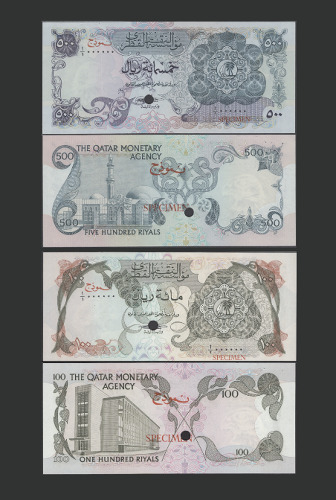
They included a Qatar Monetary Agency, specimen 500 Riyals, ND (1973), serial number A/1 000000. With red SPECIMEN overprints in English and Arabic, and a single cancellation hole, this choice uncirculated note was a rare and beautiful specimen of the highest denomination from the series and in excellent condition, being the joint-highest graded by PMG. It took a mid-estimate £24,000.
The specimen 100 Riyals from the same series, serial number A/1 000000, also with red SPECIMEN overprints in English and Arabic and a single cancellation hole, was an exceptionally rare specimen, and elusive in any grade, as well as being the joint finest known on the PMG population report. It sold on top estimate at £20,000.
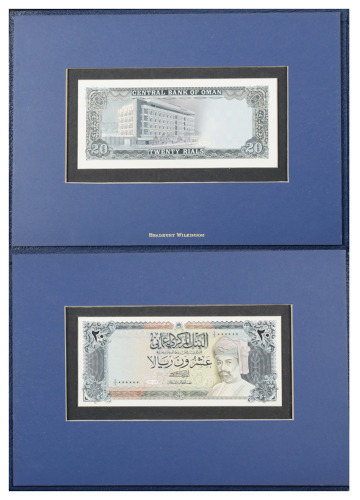
Other highlights included a Central Bank of Oman presentation book by Bradbury Wilkinson containing obverse and reverse designs for an unadopted 20 Rials. Dated 1986, and with serial number A/1 000000, it came in teal and orange, with Sultan Qaboos at right and the Central Bank Head Office building on the reverse. Housed in a blue leather and card album, with gold debossed lettering, as produced, this was a stupendously high-quality pair of essays. Guided at £3,000-4,000, it sold for £11,000.
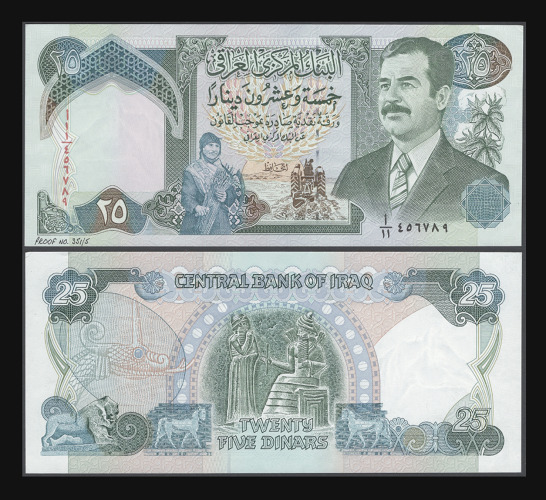
The specimens commissioned from De La Rue by Saddam Hussein, as previewed in the last newsletter, also did well. The invasion of Kuwait and subsequent First Gulf War put paid to any issue, rendering the full set of trial notes in this sale of historic as well as collectable interest.
The fully printed proof for the unadopted 25 Dinars, ND (1990), serial number A/11 456789, which had no signature, and pictured Saddam Hussein at right, with a tractor and female Kurdish wheat farmer at centre, had been pitched at £5,000-7,000, but rose to £10,000.
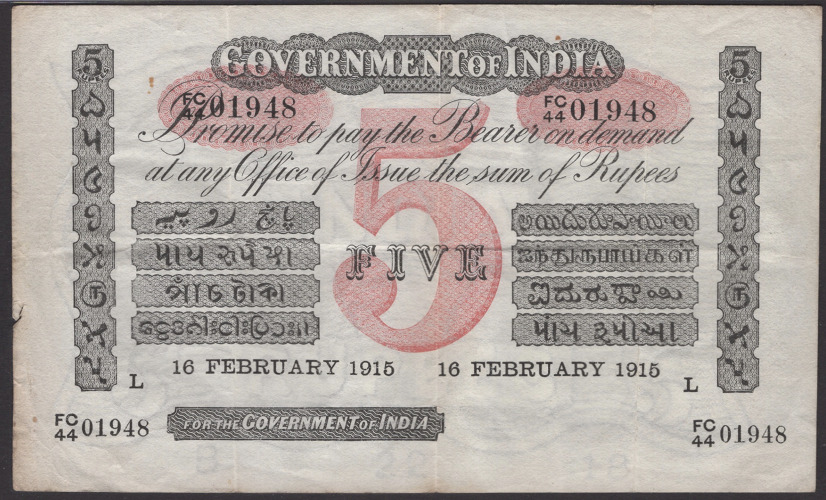
Attracting very keen bidding was an ERROR printing of the Government of India, 5 Rupees from Lahore, dated 16 February 1915. Its remarkable error was the absence of the signature of Moses Mordecai Simeon Gubbay from the lower right. A great Indian rarity, it was estimated at £800-1,200 but soared to £9,000.
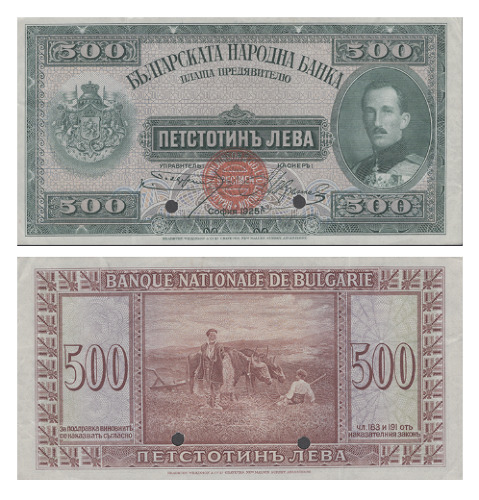
Also going far over its guide was a Bulgarian National Bank, specimen 500 Leva, of 1925. With no serial number, and carrying the Bojadjiev and Venkov signatures, as well as the red Bradbury Wilkinson seal and two cancellation holes, this extremely fine note had hopes of £1,200-1,600, but went for £8,000.
Share This Page