Article
5 June 2026
MEDAL GROUP OF LANCER DEPICTED AT THE HEART OF THE CHARGE OF THE LIGHT BRIGADE COMES TO AUCTION AT NOONANS
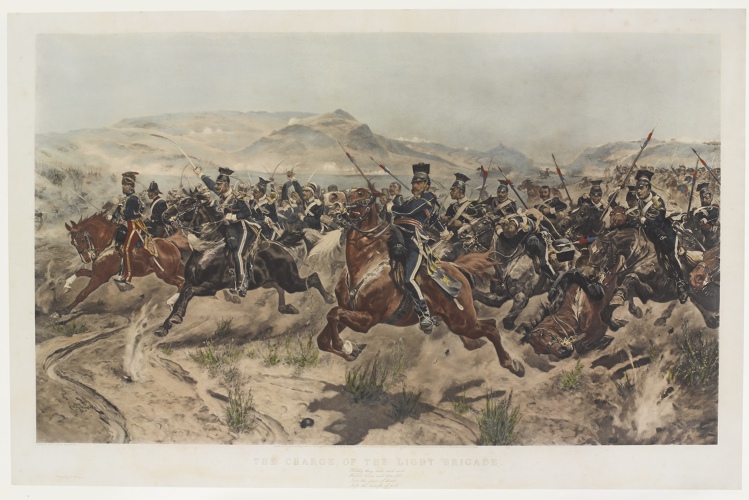
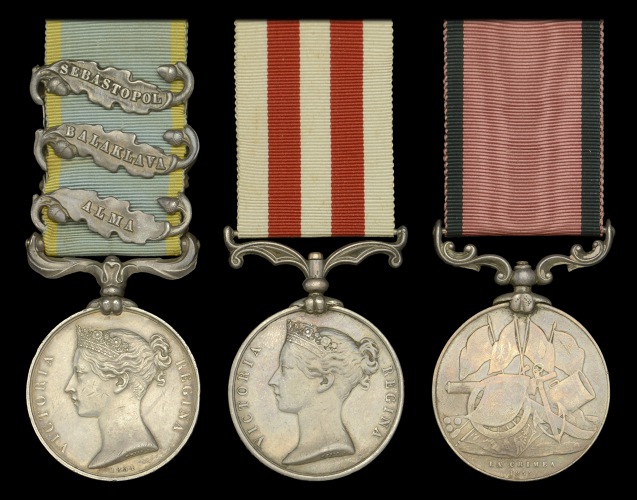
He was the central figure depicted in the Richard Caton Woodville’s celebrated painting of the Charge of the Light Brigade. Now his important group of three medals for the Crimea, Indian Mutiny and Turkish Crimea come to auction in this sale.
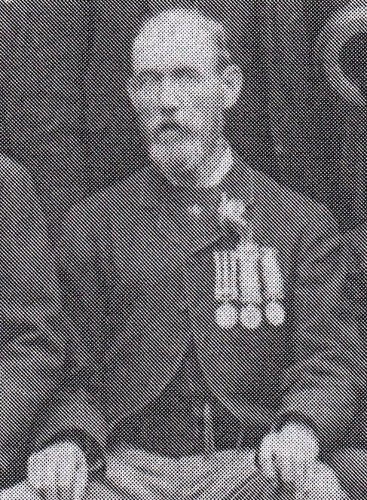
Sergeant James William Wightman (1834-1907) of the 17th Lancers was severely wounded in no fewer than 13 places and taken prisoner during the Charge on 25th October 1854.
Born in York and enlisted in 1852, he found himself at the centre of the Charge of the Light Brigade just two years later. Following his release from capture, he rejoined his regiment in the winter of 1855, fought in the Indian Mutiny, and was promoted to Ensign in the Military Train in 1865. He later became Secretary of the Balaklava Commemoration Society and left one of the finest first-hand accounts of the charge. Wightman spent the rest of his life living in London, and is buried in Brompton Cemetery.
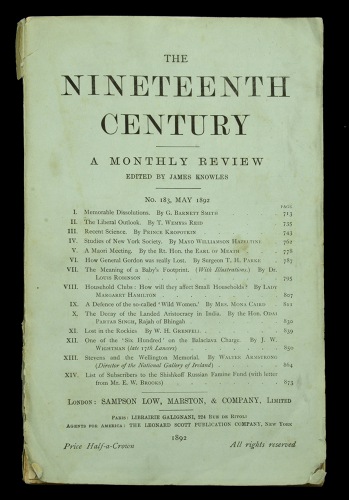
A rare original copy of Wightman’s Balaklava and Russian captivity memoirs will be included with the lot. Published in May 1892, extracts include the following: “And I remember as if it were but yesterday Cardigan’s figure and attitude, as he faced the brigade and in his strong hoarse voice gave the momentous word of command, ‘The brigade will advance! First squadron of 17th Lancers direct! Calm as on parade – calmer indeed by far than his wont on parade – stately, square and erect, master of himself, his brigade, and his noble charger, Cardigan looked the ideal cavalry leader, with his stern firm face and his quiet soldierly bearing. His long military seat was perfection on the thoroughbred chestnut ‘Ronald’ with the ‘white stockings’ on the near hind and fore, which my father, his old riding-master, had broken for him. He was in the full uniform of his old corps, the 11th Hussars, and he wore the pelisse, not slung, but put on like a patrol jacket, its front one blaze of gold lace. His drawn sword was in his hand at the slope and never saw I man fitter to wield the weapon.”
Wightman’s account then provides a vivid picture of the approach to the Charge: “As I have said, he gave the word of command, and then turning his head toward his trumpeter, Britten of the Lancers, he quietly said, ‘Sound the Advance!’ and wheeled his horse, facing the dark mass at the farther end of the valley which we knew to be the enemy. The trumpeter sounded the ‘Walk;’ after a few horse-lengths came the ‘Trot’. I did not hear the ‘Gallop’, but it was sounded. Neither voice nor trumpet, so far as I know, ordered the ‘Charge’.”
“ - We had not broke into the charging pace when poor old Jim Lee, my right-hand man on the flank of the regiment, was all but smashed by a shell; he gave my arm a twitch, as with a strange smile on his worn old face he quietly said, ‘Domino! chum,’ and fell out of the saddle. His old grey mare kept alongside of me for some distance, treading on and tearing out her entrails as she galloped, till at length she dropped with a strange shriek. I have mentioned that my comrade, Peter Marsh, was my left-hand man; next beyond him was Private Dudley. The explosion of a shell had swept down four or five men on Dudley’s left, and I heard him ask Marsh if he had noticed ‘what a hole that b_ shell made on his left front’. ‘Hold your foul-mouthed tongue,’ answered Peter, ‘swearing like a blackguard, when you may be knocked into eternity next minute!’ Just then I got a musket-bullet through my right knee, and another in the shin, and my horse had three bullet wounds in the neck. Man and horse were bleeding so fast that Marsh begged me to fall out; but I would not, pointing out that in a few minutes we must be into them, and so I sent my spurs well home, and faced it out with my comrades. It was about this time that Sergeant Talbot had his head clean carried off by a round shot, yet for about thirty yards further the headless body kept the saddle, the lance at the charge firmly gripped under the right arm. My narrative may seem barren of incidents of the charge, but amid the crash of shells and the whistle of bullets, the cheers and the dying cries of comrades, the sense of personal danger, the pain of wounds, and the consuming passion to reach an enemy, he must be an exceptional man who is cool enough and curious enough to be looking serenely about him for what painters call ‘local colour’. I had a good deal of ‘local colour’ myself, but it was running down the leg of my overalls from my wounded knee.
“Well, we were nearly out of it at last, and close on those cursed guns. Cardigan was still straight in front of me, steady as a church but now his sword was in the air; he turned in his saddle for an instant, and shouted his final command, ‘Steady! steady! Close in!’ immediately afterwards there crashed into us a regular volley from the Russian cannon. I saw Captain White go down and Cardigan disappear into the smoke. A moment more and I was within it myself. A shell burst right over my head with a hellish crash that all but stunned me. Immediately after I felt my horse under me take a tremendous leap into the air. What he jumped I never saw or knew; the smoke was so thick I could not see my arm’s length around me.
“Through the dense veil I heard noises of fighting and slaughter, but saw no obstacle, no adversary, no gun or gunner, and, in short, was through and beyond the Russian battery before I knew for certain that I had reached it.
“I then found that none of my comrades were close to me; there was no longer any semblance of a line. No man of the Lancers was on my right, a group was a little way on my left. Lord Cardigan must have increased his distance during or after passing through the battery, for I now saw him some way ahead, alone in the midst of a knot of Cossacks. At this moment Lieutenant Maxse, his Lordship’s aide-de-camp, came back out of the tussle, and crossed my front as I was riding forward. I saw that he was badly wounded; and he called to me, ‘For God’s sake, Lancer, don’t ride over me! See where Lord Cardigan is’, pointing to him, ‘rally on him!’
“I was hurrying on to support the brigade commander, when a Cossack came at me and sent his lance into my right thigh. I went for him, but he bolted; I overtook him, drove my lance into his back and unhorsed him just in front of two Russian guns which were in possession of Sergeant-Majors Lincoln and Smith, of the 13th Light Dragoons, and other men of the Brigade. When pursuing the Cossack I noticed Colonel Mayow deal very cleverly with a big Russian cavalry officer. He tipped off his shako with the point of his sword, and then laid his head right open with the old cut seven.”
Further details of the bloody encounter are followed by Wightman’s very enlightening account of his experiences as a P.O.W. in the Russian interior, and mention amongst other things a visit by the Grand Dukes Nicholas and Michael, and General Liprandi. He also reveals some useful information on Captain Nolan and Lord Raglan’s famous order.
See Roy Dutton’s Forgotten Heroes - The Charge of the Light Brigade for further details. Lawrence Crider’s In Search of the Light Brigade gives extensive biographical details of Wightman and his family with many photographs, details of his grave in Brompton Cemetery, and full transcript of his account of the Charge, etc.
The group, estimated at £6,000-8,000, includes a Crimea medal 1854-56, with three clasps, for Alma, Balaklava and Sebastopol (J. W. Wightman 17th Lancers); an Indian Mutiny medal 1857-59 (Serjt. Jas. Wightman, 17th Lancers.); and a Turkish Crimea medal 1855, of Sardinian issue (J. W. Wightman. 17th Lancers).
The group is being sold with a photograph of Caton Woodville’s celebrated painting of the 17th Lancers at Balaklava which gives Wightman the most prominent central position (it is now the property of the National Army Museum, whose kind permission allows us to include it in this preview).
Share This Page