Article
5 June 2026
EXTRAORDINARY DETECTORIST FINDS AND A LAVISH GIFT FROM THE SHAH BRING HIGH HOPES
A wealth of detectorist discoveries can be found among the highlights of this two-day sale on 23-24 June, as well as items with Royal connections.
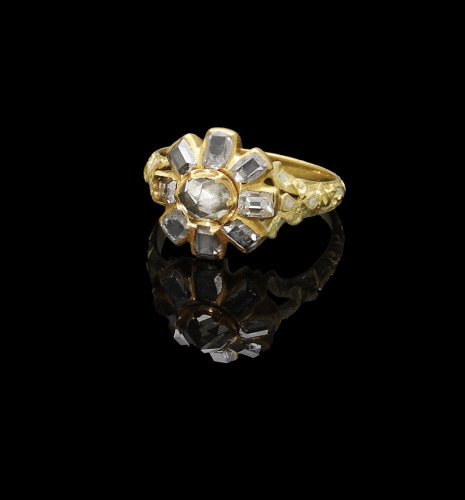
One of the stand-out lots is The Evesham Diamond Ring, a late 16th - early 17th diamond and enamel ring, discovered in the parish of Wormington, near Evesham, Gloucestershire, in November 2024, now disclaimed as Treasure, and expected to fetch £15,000-20,000.
It has a flowerhead bezel composed of a cluster of eight ‘hogback’ diamonds around a central rose-cut diamond. The underside of the bezel is decorated with a flowerhead in turquoise and white enamel, between shoulders with applied quatrefoil flowerheads to a scroll and foliate engraved band.
“Early 17th century baroque taste required grand rings to make an impression,” said Noonans’ Head of Jewellery, Frances Noble. “Fashions in diamond rings moved away from solitaires towards groups of small stones arranged in decorative patterns: rosettes, pansies, crosses, fleur-de-lys, etc. Two similar examples include the portrait of Queen Isabelle of Spain, by Rodrigo de Villandrando, c.1620, in the Museo del Prado, Madrid, and the portrait of Elizabeth van de Aa, by Thomas de Keyser, 1628, in the Musée de l’Hotel Sandelin, Saint-Omer, France.”
Who was the ring's original owner? The discovery site, Wormington, near Evesham, is situated four miles from Broadway on the London to Worcester road.
“We cannot be sure of previous ownership, but as a very fine – and valuable – ring. it is likely to have been the property of someone of considerable wealth and status, possibly even Royal status. Two important manor houses, extant in the 16th century, were situated within five miles of Wormington, both with fascinating history,” Frances Noble explained.
The first, Snowshill Manor, was given by Henry VIll to Catherine Parr upon their marriage in 1543. The estate passed to Francis Bulstrode MP, and in 1561 was purchased by Henry Willoughby. The second, to the west, is Wickhamford Manor, originally belonging to the Abbey at Evesham. Seized during the Dissolution of the Monasteries, in 1562 Elizabeth I granted it to Thomas Throckmorton, MP.
In 1594 Wickhamford Manor was purchased by Sir Samuel Sandys (d.1623), MP. son of the Archbishop of York. The Sandys family already owned Ombersley Court, north of Worcester. Samuel Sandys was married to Mercy Culpepper, the daughter of Thomas Culpepper, once a friend of Henry VIll (executed for his attempted seduction of Queen Catherine Howard). Samuel and Mercy are interred together in a grand marble tomb with effigies, in the church of St. John the Baptist, Wickhamford.
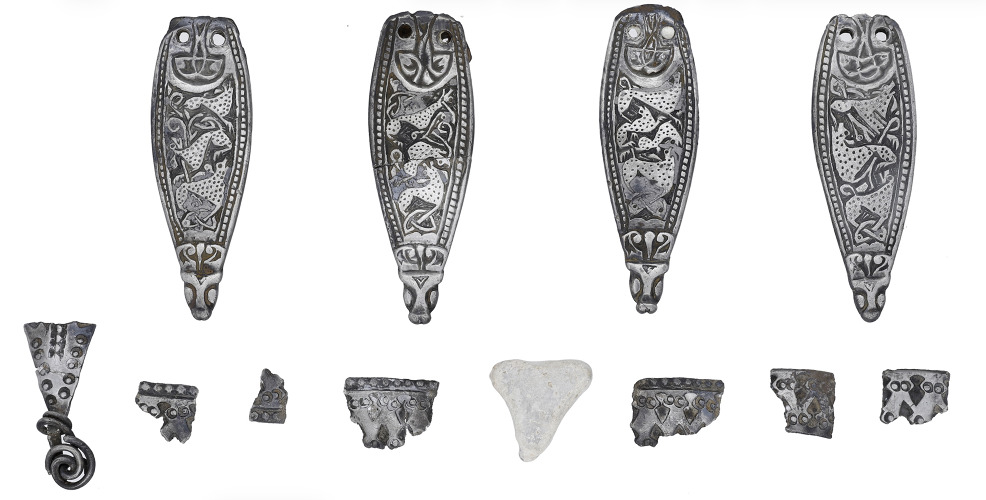
Another rare detectorist find in this sale is the Allerdale silver Viking Hoard. Dating to the late 9th - early 10th century, it comprises four Anglo-Saxon lanceolate silver strap ends (belt fittings) in the Trewhiddle style together with seven fragments of a Viking silver bracelet and a lead gaming piece.
The strap ends are of Thomas class Ala which indicate a date between 840 and 920 AD. Each strap end is incised on the upper surface with three or four beasts with curling tails and speckled bodies. The estimate is £5,000-6,000.
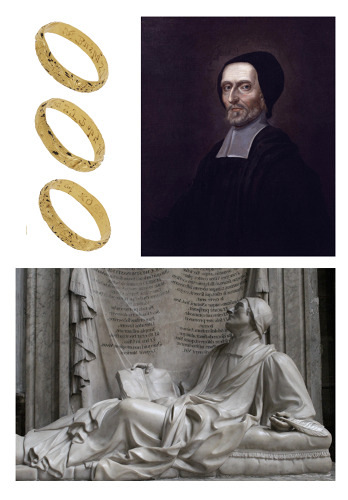
Another find with historical interest is a late 17th century gold memorial ring for Dr Richard Busby, 1695, found near Catforth, in Lancashire in 2024, and now disclaimed as Treasure. The gold band with engraved floral detail to the exterior has a memento mori skull motif to the front, and traces of black enamel throughout. The interior is inscribed in italic script Ri Busby STP ob 5 Ap 95 aet 89 and bears a double struck maker’s mark ‘G’ within a shield punch.
Born in 1606 in Lincolnshire, Richard Busby was educated as a King’s Scholar at Westminster School and Christchurch College, Oxford, before returning to his alma mater, Westminster School, as headmaster in 1638.
He was an unapologetic Royalist who is said to have publicly prayed for King Charles I on the day of his execution, but he nonetheless survived the turbulence of the Commonwealth and the Restoration unscathed.
Remarkably, he served as headmaster of Westminster school for 55 years. Students of his who went on to achieve public acclaim included the philosopher John Locke, the architect Christopher Wren, the poet, translator and playwright Robert Dryden, the composer Henry Purcell and the physicist Robert Hooke. Locke, Hooke and Wren were founding members of the Royal Society.
Interred in Westminster Abbey, Busby's tomb is inscribed: "Lastly whatever fame the School of Westminster boasts, and whatever advantages mankind shall reap from thence, is principally owing to Busby and will be owing to him in all ages.”
The memorial ring is expected to sell for £2,000-3,000.
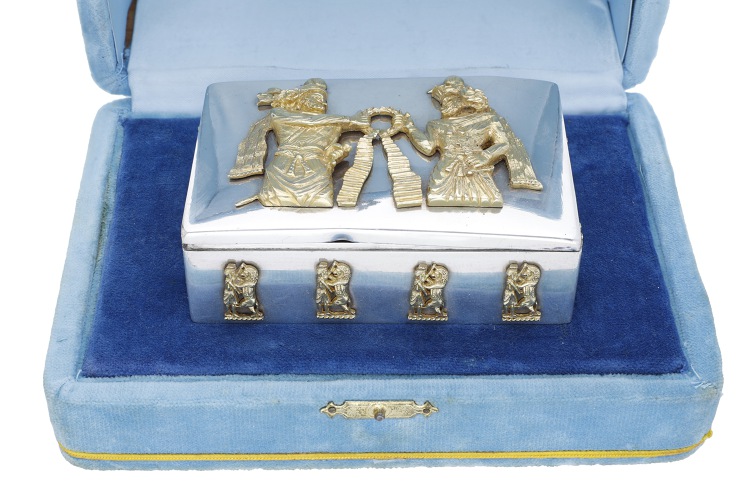
Interesting pieces with royal connections in the sale are led by a silver and 18ct gold mounted presentation cigarette case and cover, circa 197l, relating to the 2500-year celebration of the founding of the Persian Empire. It was presented to Lord Edmund Ironside as a gift from His Imperial Majesty Mohammad Reza Shah Pahlavi at a lavish three-day celebration held in Persepolis in October 1971, commemorating the founding of the Achaemenid Empire by Cyrus the Great.
Lord Ironside’s father, General Lord William Edmund Ironside, and Mohammad Reza’s father, Reza Shah Pahlavi, the former Shah, had long been friends.
General Lord William Edmund Ironside GCB, CMG, DSO (1880-1959) played a pivotal role in Iranian history as the architect behind the rise of Reza Khan (later Reza Shah Pahlavi) who founded the Pahlavi dynasty. Between October 1920 and February 1921 Ironside commanded the North Persia Force, a British unit tasked with protecting British interests and blocking Soviet incursions into northern Iran.
Ironside was instrumental in promoting Reza Khan to lead the Persian Cossack Brigade and preventing a Russian Bolshevik takeover. His involvement helped ensure a stable, anti-communist government in Tehran after the British withdrawal at the end of 192l.
The silver presentation cigarette case – consigned via direct family descent – is applied with cast 18ct gold Sassanian figures. Contained in a blue fitted velvet-lined presentation case, with accompanying hand annotated presentation card, it has a guide of £6,000-8,000.
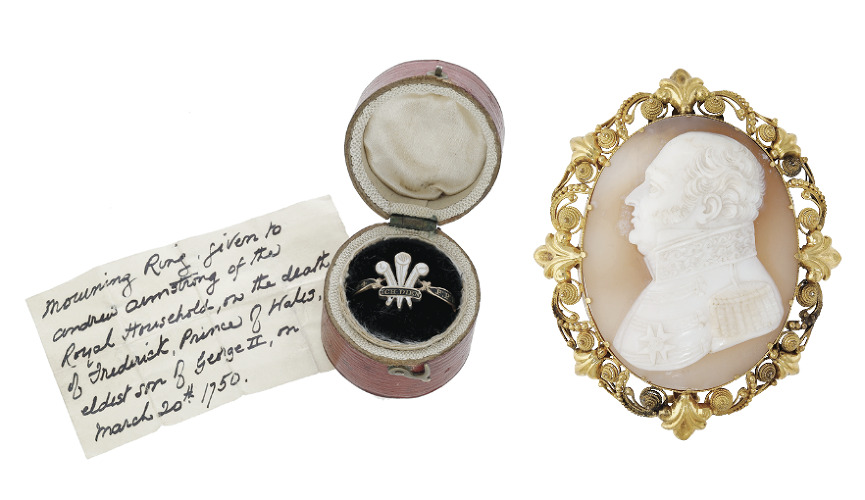
Two further pieces have connections with the British Royal family. The first is a mourning ring for Frederick, Prince of Wales, heir apparent to George Il and father of George III. The Prince of Wales’s feathers in white enamel and overlaid with motto Ich Dien in black enamel is affixed to a black enamel band reading F.P:W: / OB:20IMAR / 1750 / Æ:44. Mounted in silver and gold, and cased with a label to underside reading 8 and Armstrong, it is accompanied by a handwritten note reading Mourning ring, given to Andrew Armstrong of the Royal Household, on the death of Frederick, Prince of Wales, eldest son of George Il, on March 20th 1750 [Julian calendar] - 175l in the later Gregorian calendar. The estimate is £2,000-3,000.
A shell cameo brooch, c.1820-1830, depicts Prince Frederick, Duke of York & Albany (1763-1827), carved in profile, in military uniform, and wearing the badge of The Order of the St Esprit. By family repute it is thought to have been the property of the Carey family of Guernsey. The second son of King George Ill and the younger brother of George IV, Prince Frederick, Duke of York and Albany was a soldier by profession and served as Commander-in-Chief of the British Army during the Napoleonic Wars. From 1820 until his death, he was the heir presumptive to his elder brother, King George IV, but predeceased him. He is famously remembered in popular culture as the inspiration for the nursery rhyme The Grand Old Duke of York. The cameo is estimated at £800-1,000.
Share This Page