Article
14 May 2026
HOW DRAMATIC AIRSHIP REPAIR 2,000 FEET OVER THE CHANNEL LED TO WHAT IS THOUGHT TO BE THE FIRST EVER D.S.M. AWARDS
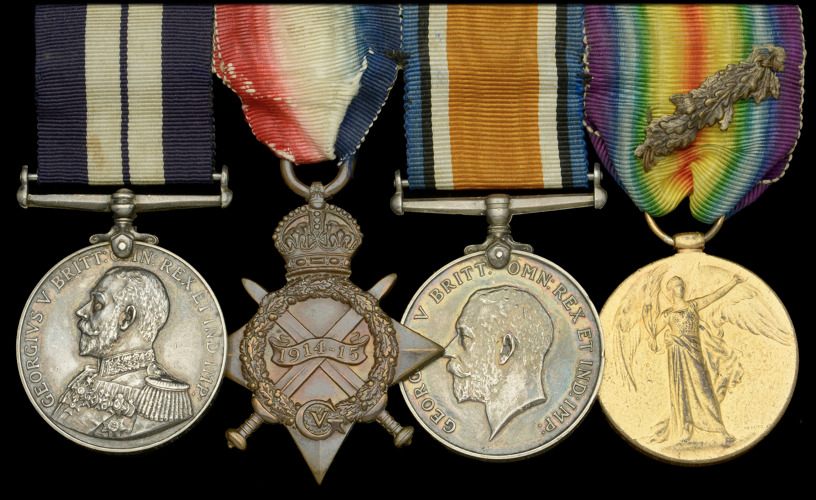
A dramatic rescue repair of an airship over the Channel in the early days of the Great War led to what is thought to be the earliest awards of the Distinguished Service Medal. One of the two awarded on that occasion appears in this sale among a group of four with an estimate of £8,000-10,000.
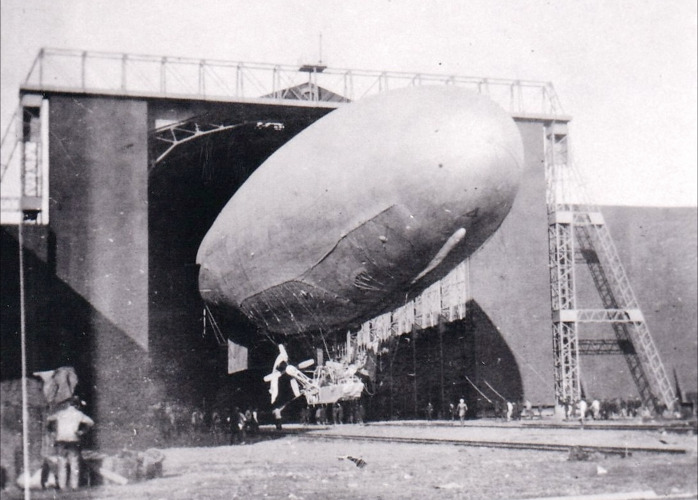
His Majesty’s Airship No.4, one of only three in full working order at the time, was escorting the British Expeditionary Force across the Straits of Dover on 13 August 1914, just nine days after war broke out. The Secretary of the Admiralty’s report explained what happened: “On one occasion it became necessary to change a propeller-blade. The captain feared he would have to descend for this purpose, but two of the crew immediately volunteered to carry out this difficult task in the air, and climbing out onto the bracket carrying the propellor shafting, they completed the hazardous work two thousand feet above the sea.”
That heroic repair work was undertaken by Petty Officer Herbert George Cook and Engine Room Artificer W. F. Shaw, both of whom would later receive the D.S.M. for their actions.
“By the time their work was complete, darkness had fallen, and No. 4 had drifted across the Channel to Belgium, where gun flashes were observed below. On their eventual return to Kingsnorth, No. 4’s skipper, Captain J. N. Fletcher, later confided to his crew that he had prepared to destroy the airship’s papers, soaking them in petrol.”
It was not the first peril that No. 4 had faced since the war began – nor would it be the last extraordinary feat of this nature carried out by Cook.
On the very first night of the war, Airships Nos. 3 and 4 carried out a reconnaissance flight over the southern portion of the North Sea, and No. 4 came under the fire from territorial detachments at the mouth of the Thames on returning to Kingsnorth. The soldiers in question thought she was a German airship bent on observation of the dockyard at Chatham.
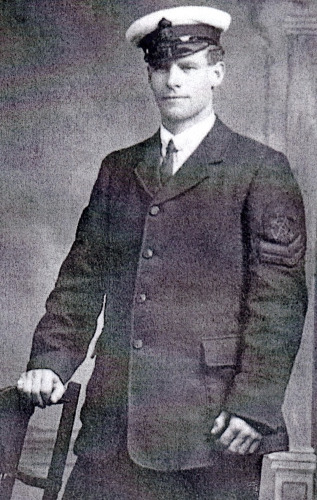
Herbert George Cook was born in Woking, Surrey on 17 August 1888, and entered the Royal Navy as a Boy 2nd Class in May 1904.
Having attended an airship course at Farnborough and qualified as a coxswain, he was advanced to Petty Officer and posted to R.N.A.S. Kingsnorth on the Hoo Peninsula in Kent, where he joined the crew of H.M.’s airship No. 4.
By the outbreak of hostilities in August 1914, R.N.A.S. Farnborough was fully established but Kingsnorth was still being developed. Between them they could muster a total of seven airships, Nos. 2, 3 and 4, and the four ex-army ships christened ‘Beta’, ‘Gamma’, ‘Delta’ and ‘Eta’, but of these only three were in flying condition.
In October 1914, Cook was drafted to Vickers at Barrow-on-Furness, where he was appointed coxswain to H.M. Airship No. 6, then under construction. In the interim, he was tasked with rigging new airships. Meanwhile, No. 4 had undergone a major refit and he rejoined her for trials in November 1915. Thus ensued a protracted period on instructional duties at R.N.A.S. Howden in East Yorkshire. Here, under fellow airship pioneer Commander E. A. D. Masterman, R.N., he helped train later rigid airship coxswains. On one occasion, in December 1916, he ‘ploughed a twelve-inch furrow’ across Howden’s field after being caught by a sudden down draught whilst landing.
In January 1917, Cook was appointed a Warrant Officer and transferred to the officer’s section. And with British-made rigid airships coming online, he was appointed Trials Coxswain of H.M. Airship No. 9, also known as ‘Silver Queen’. It was in a similar capacity that he oversaw the trial flights of several more British rigid airships, often in the face of challenging teething problems. He was mentioned in despatches.
On the formation of the Royal Air Force in April 1918, Cook was commissioned as a 2nd Lieutenant and posted to Short’s Airship Works at Cardington, where he was appointed Chief Coxswain of the R. 31.
On her second flight, on 31 October 1918, in an incident reminiscent of his earlier D.S.M.-winning exploits, he was again called upon to take drastic action. About two hours into the flight, and on making a turn, R. 31’s upper tail fin collapsed onto the starboard fin and elevator. All her control surfaces locked solid, as she drifted with the wind at an altitude of 2,000 feet. Cook immediately collected a party of volunteers and climbed out onto the shattered framework, securing the collapsed structure to the hull. Having then disconnected the cables from the broken rudder and port elevator, it was possible to free up the controls of the bottom rudder and port elevator and restart her engines. On glancing down as he climbed back inboard, Cook had a good view of Reading.
However, the outcome of his next emergency situation was less happy. Whilst examining R. 31’s rigging and gas bags at the top of her hull, he was overcome by escaping hydrogen and fell to the keel. He was seriously injured and hospitalised, but a subsequent medical report recommended his return to duty. Judging by the swathe of positive entries on his service record, it’s easy to see why, for he had ‘acquired exceptional rigid airship knowledge and experience’.
Duly re-mustered at the experimental air station at R.A.F. Pulham, ‘for civilian airship trials, on detached duty’, Cook joined a team of experts in working on the construction of masts for airship mooring purposes. Before long, Pulham boasted half a dozen such masts, but following the R. 38 airship disaster in August 1921, the R.A.F.’s interest in airships dwindled.
Nonetheless, ongoing work for a civilian airship programme continued, in which Cook played a significant role. Hence his work on the R. 33 in the early-to-mid 1920s. On the night of 16-17 April 1925, in a gale force storm, the arm on R. 33’s mooring mast broke, and she drifted helplessly with her ‘anchor watch’ crew aboard. Cook and his fellow officers rushed to the mooring mast to assess the damage, and, at length, R. 33 was coaxed safely back to Pulham.
Meanwhile, Britain’s giant R. 100 and R. 101 airships were taking shape, their proposed routes to Canada and India requiring the construction of several overseas mooring masts. One such was needed in Ismailia, and that brief was handed to Cook in the summer of 1927.
Back home, and having been promoted to Flight Lieutenant, he returned to his duties as ‘Tower Officer’ at Cardington, but he was not present at the time of the R. 101 disaster in October 1930, having been admitted to hospital with an ulcer. He was placed on the Retired List in 1932 and settled in North Yorkshire, where he died in January 1970.
The group is being sold with a named Dorking Cycling Club bronze medal (H. G. Cook S.C.C.U. 50 miles 2-34-34 1914); an R.N.A.S. Boxing silver medal (R.N.A.S. Boxing Contest 29.11.17), and a naval button converted for use as a locket; together with copied research, including a lengthy biography from the Cross & Cockade magazine.
Share This Page