Article
24 April 2026
HE REMAINED AT HIS POST WOUNDED – AND FORGOTTEN BY HIS COMMANDING OFFICER – AS THE SHIP BENEATH HIM SCUTTLED
Control of the English Channel and southern North Sea was vital to the Allied war effort in 1918; threatening it was Imperial German Navy at port in Zeebrugge on the north coast of Belgium.
To neutralise that threat, the British decided to raid the port and block it, trapping the German navy by sinking obsolete ships in the Bruges-Ostend canal entrance.
Previous attempts to achieve a similar outcome had failed, but as the U-boats continued to take their toll, the Admiralty looked once more at the possibilities.
An initial attempt on 2 April 1918 had to be abandoned after a change in wind direction rendered impossible the laying of a smokescreen to protect the approaching ships. Three weeks later an initially more successful operation resulted in two of the three block ships being scuttled in the narrowest part of the canal and severe damage to the mole and viaduct leading to the German garrison.
However, it later became clear that the block ships had been sunk in the wrong place, and within days U-boats were able to use the canal at high tide.
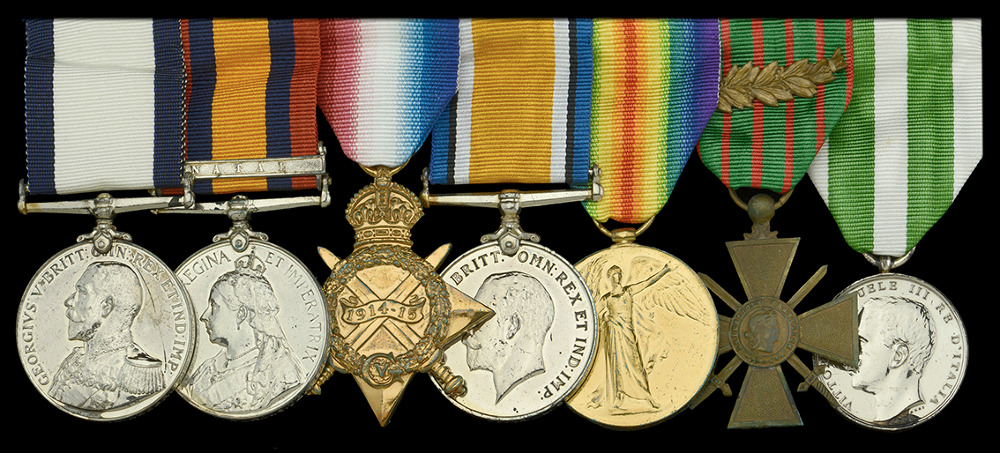
This was the backdrop against which Leading Seaman Albert Oscar Davis, of the Royal Navy, earned his Conspicuous Gallantry Medal, which has just sold as part of his group of seven at Noonans, above estimate at £11,000. The group also included the Croix de Guerre 1914-1917, with bronze palme, and the Messina Earthquake medal in silver from 1908.
By the time Davis found himself at the heart of the action in Zeebrugge, he had already completed almost 22 years in the Royal Navy, joining as a Boy 2nd Class in June 1896 at the age of 15.
Rising to Able Seaman a year later, he served off South Africa in H.M.S. Terpsichore from April 1901, qualifying for the ‘Cape Colony’ and ‘South Africa 1901’ clasps. His service record states that he was invalided from Terpsichore in April 1904 and ‘sent home by mail steamer’.
Joining the cruiser Duncan in August 1908, Davis went on to qualify for the Messina Earthquake Medal prior to being discharged ashore ‘time expired’ at the end of 1910. But he quickly rejoined via the Royal Fleet Reserve, being appointed a Leading Seaman in June 1911.
A Leading Seaman in the cruiser Lancaster on the outbreak of hostilities in August 1914, he remained likewise employed until coming ashore in July 1915, followed by further seagoing service in the sloop Zinnia from November 1915 to November 1917. The latter period witnessed Zinnia carrying out several attacks on U-boats off the Irish coast and elsewhere, in addition to enacting valuable rescue work, including assistance lent to the torpedoed Q-ship Pargust in June 1917.
Davis next served aboard the cruiser Iphigenia, when she was scuttled as a blockship in the Bruges canal during the famous Zeebrugge raid.
His original recommendation states: “This man remained at his station by the hand wheel in Iphigenia, armed with a box of ammonal and detonators with which it was intended to destroy the guns, until after the cutter had left. The Commanding Officer of Iphigenia had previously told him that he would tell him when to destroy his gun but overlooked it and left the ship after firing the mines. Davis bravely remained at his post until the ship sank under him, when he jumped into the water and swam to the boats.”
The London Gazette of 28 August 1918 announced of his French Croix de Guerre: “For services in the operations against Zeebrugge and Ostend.”
Unusually the recommendation for his C.G.M. omits mention of the fact that he received gunshot wounds and a fractured humerus, an omission put right on his service record (TNA ADM188/322 refers). He was also awarded an annuity of £10. Davis, who was invalided in August 1919, later served in the Merchant Navy and settled in Australia.
The group was sold with a quantity of original documentation, including a British Ministry of Pensions letter referring to the recipient’s pensionable disabilities as ‘gunshot wound head and right arm, deafness and nasal obstruction’ (dated 10 May 1950), and other related correspondence.
Share This Page