Article
24 April 2026
NOT ONE, BUT TWO ARMADA VICTORIES… AND OTHER TRIUMPHS THAT INSPIRED THE STRIKING OF MEDALS
Military victories have long inspired medallists, and this auction provides a broad range of examples recalling notable events.
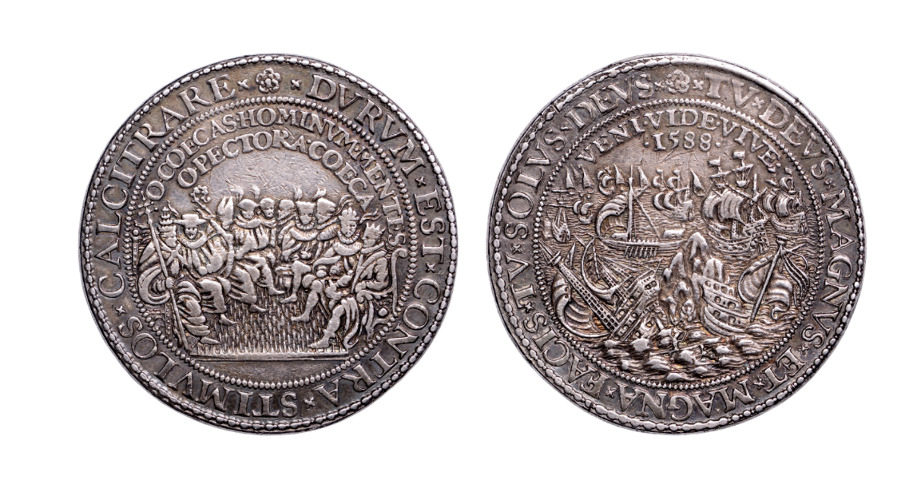
The defeat of the Spanish Armada in 1588 must rank as one of the most celebrated of English victories, and is marked by a medal offered here. Less well known was the second attempt at a Spanish invasion just eight years later, which also ended in defeat for Philip II – an event also marked here by a medal.
The obverse of the unsigned silver medal, by G. van Bijlaer, marking the 1588 attempt shows Philip II and other Catholic heads of Church and State seated, blindfolded, with their feet on a spiked floor. The reverse depicts a fleet of ships, with two in the foreground sinking. At 52mm in diameter, it has some light wear to the high points, but is otherwise very fine and very rare and estimated at £3,000-4,000.
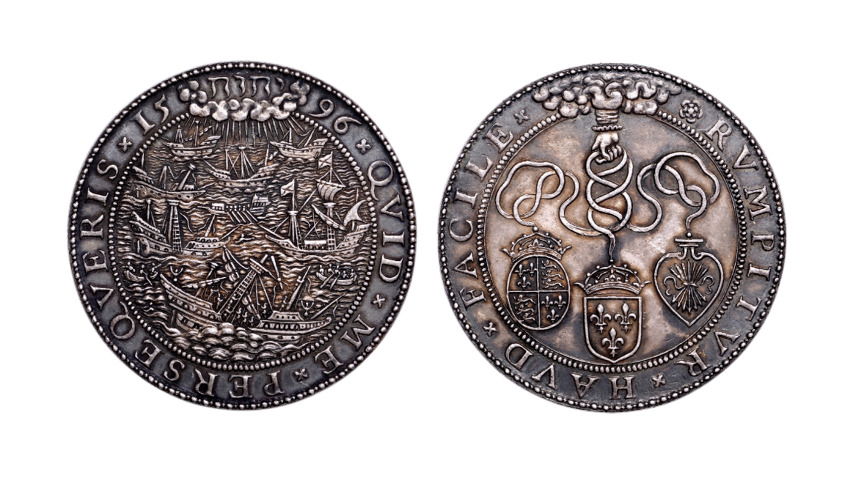
The Second Spanish Armada, also known as the Spanish Armada of 1596, took place during the Anglo-Spanish War and was prompted by the desire for revenge after the English sacked Cádiz in 1596, during which the Spanish burned their own fleet to prevent its capture.
Philip II ordered an attempt to invade England or Ireland as a means of helping Irish rebels against the English crown, thereby opening a new front in the war and diverting English troops away from fighting in France and the Netherlands.
As with the first Armada, conditions at sea proved fatal. Before it had left Spanish waters, storms struck the fleet off Cape Finisterre, inflicting so much damage on the Armada that its ships were forced to return to their home ports. Instead of a successful invasion, the Spanish suffered the loss of nearly 5,000 men in the storm or from disease, and the loss of 38 ships. Such were the losses that they contributed significantly to the bankruptcy of the Spanish kingdom at the time.
This sale presents a silver medal marking the Defeat of the Second Spanish Armada, 1596. Also by G. van Bijlaer and unsigned, the obverse shows a hand issued from heaven holding a cord connecting the shields of England, France and a heart bearing the arrows of the United Provinces. The reverse depicts the Armada in distress, with the word Jehovah in Hebrew above in a radiant sky. At 51mm, this extremely fine and attractively toned medal has a guide of £3,000-3,600.
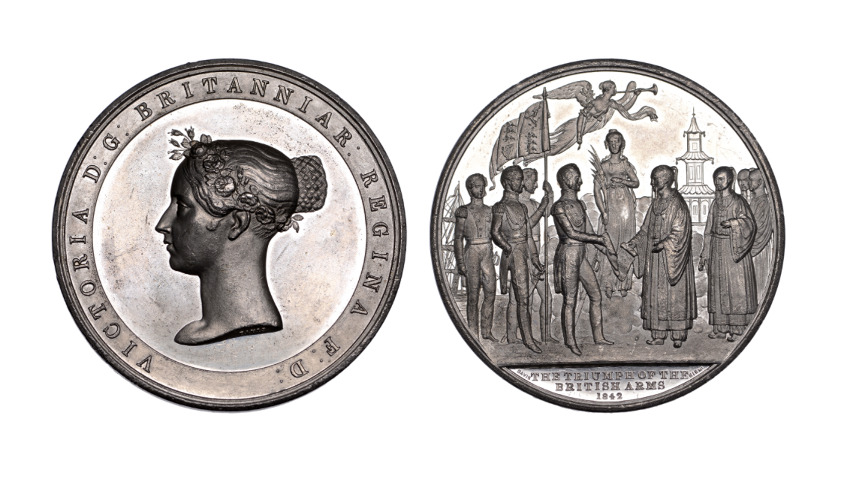
Other military victories celebrated by the striking of medals in this auction include an 1842 example struck for the Treaty of Nanking, which brought to an end the First Opium War between the British and the Chinese, and ceded the island of Hong Kong to the British, in whose hands it remained until 1997.
The treaty was signed aboard HMS Cornwallis by representatives of Queen Victoria and the Qing Emperor. However, the inequitable terms of the treaty failed to bring peace and resolve the opium trade dispute, the resulting Second Opium War breaking out in 1856.
The white metal medal by J. Davis, shows the bust of the young Queen Victoria left to the obverse, with British and Chinese delegations greeting each other to the reverse, with Fame flying above, and a pagoda in the background. Measuring 64mm in diameter, the medal has much bloom, is extremely fine and extremely rare. The estimate is £3,000-4,000.
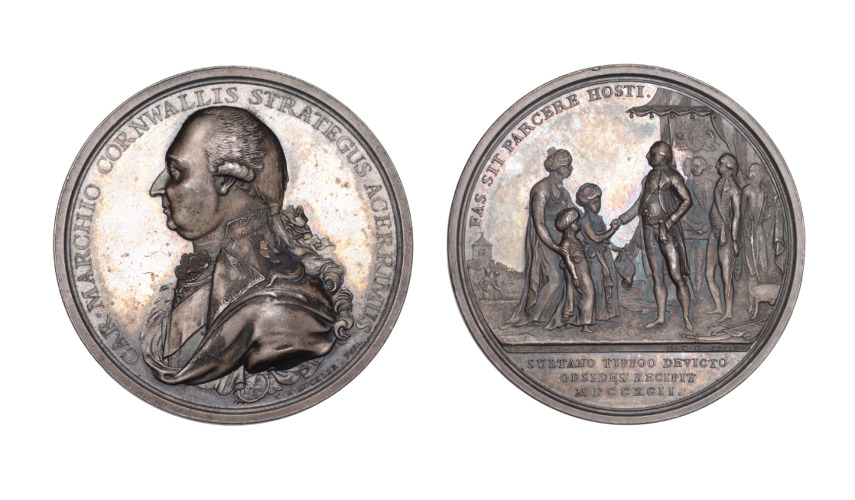
The Defeat of Tipu Sultan in 1792 in the third Anglo-Mysore war also inspired a medal series. The Marquis Cornwallis, who led the British forces, was helped by the Mahrattas and the Nizam of Hyderabad, in defeating Tipu, the Sultan of Mysore, who had taken a stand against the rule of the East India Company.
Cornwallis made Tipu surrender half of his possessions in addition to paying an indemnity and surrendering his two sons as hostages. The sons arrived at Cornwallis’ camp on 27 February 1792.
This auction offers two medals relating to this: one silver (£2,000-26,000), the other gilt bronze (£1,000-1,500). Designed by C.H. Küchler, they show the uniformed bust of the Marquis Cornwallis left, with the reverse depicting Cornwallis receiving the sons of Sultan Tipu as hostages. It is thought that medals with the error date 1793 were struck first; the dies then being corrected to 1792, further examples were later struck.
Share This Page