Article
1 April 2026
HE LED THE 59TH INTO THE BREACH AT ST SEBASTIAN UNDER WELLINGTON AND PAID THE ULTIMATE PRICE
For drama, gallantry, courage and sacrifice, few can equal the endeavours of Brevet Major Francis Scott, 2nd Battalion, 59th (Nottinghamshire) Regiment, during the storming of St Sebastian on 31 August 1813.
A letter from Major-General Robinson to General Ross (Colonel of the 59th), dated St. Sebastian 5 September 1813, conveys the depth of that impression:
“I should feel myself unworthy having such a Regiment as the 59th under my command were I to omit mentioning to you as its Colonel its conspicuous conduct in the assault of the breach. Nothing could exceed the intrepidity of the Regiment; it rushed forward cheering and gained the top of the breach under a fire that threatened the destruction of the whole party. I cannot do justice to the subject, but hope I have said enough to convince you the that the 59th Regiment is an ornament to the British Army.”
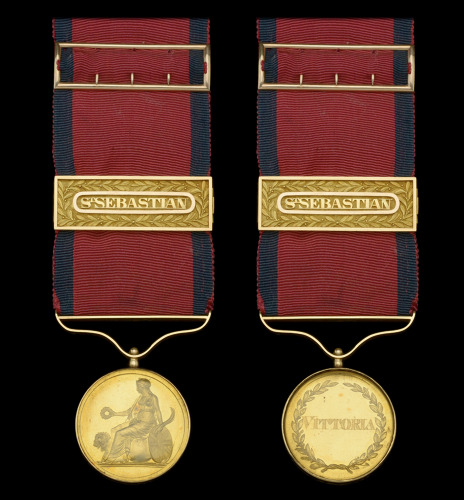
This auction offered The Field Officer’s Gold Medal for Vittoria and clasp for St Sebastian awarded to Brevet Major Francis Scott. It sold above top estimate at £22,000.
Scott had received his brevet for Vittoria upon the death of his two senior officers, and was killed as he led the main body of the 59th, cheering, up into the breach during the storming of St Sebastian.
Appointed Lieutenant in the 59th Foot on 7 October 1803, he was promoted Captain on 2 June 1808. He served in the Peninsula from September 1812, arriving at Cadiz just after the siege had been raised.
Scott was given the Brevet of Major having assumed command of the regiment at the battle of Vittoria on 21 June 1813, following the deaths in action of his two superior officers, and commanded it at the storming of St Sebastian.
Vittoria came a few months after Napoleon’s disastrous campaign in Russia in 1812, which had cost him his best troops. The French were now retreating across Eastern Europe in disarray, and this gave Wellington and the Spanish the confidence to launch a new offensive and in spring 1813 the 2/59th along with other units sailed to Lisbon to bolster the forces massing there for the big offensive.
Reaching Lisbon, the 59th set out upon a 21-day march along the banks of the River Douro and then marched quickly across Northern Spain.
Joseph Bonaparte, the Emperor’s brother and usurper of the Spanish throne, moved in to confront Wellington with 60,000 men. On the morning of 21 June 1813, 70,000 British and Spanish troops met Joseph Bonaparte’s 58,000 at Vittoria.
Between both forces ran the River Zadorra which Wellington intended to cross where a bridge lay at a village called Gamarra Mayor which was held by the French. He first needed to secure the village and bridge, and sent in Robinson’s brigade consisting of the 59th, 4th and 47th regiments to take the village and secure a crossing point for the main army.
The French were unable to hold back the brigade as it swarmed into the village, and inevitably broke rank and scattered. As the brigade chased down the fleeing French and pressed on to take the bridge a dozen cannons opened fire on them from the French side of the river. This checked the brigade’s advance and forced them to retreat allowing the French to come back across and re-occupy the bridge. The British and French found themselves at a stalemate with the British occupying the village but the French occupying the bridge.
The fight for the bridge had cost the entire brigade 500 men of whom 160 were from the 2/59th, including Lieutenant Colonel Fane, who surviving the bullet to the head at Corunna was hit in the thigh by a cannon ball and died a few days later.
Vittoria was the victory Wellington needed to gain a foothold in Spain and secure his position there. Following the battle the 59th’s division was sent south to pursue the French who fell back to the medieval fortress of San Sebastian.
With a small French army holed up in the fortress, Wellington decided to lay siege in a manner similar to Badajoz and Cuidad Rodrigo in early 1812. Fearing the repercussions of these sieges, when the British troops, eventually breaking through after months of entrenchment, went on a rampage of loot, murder and drunkenness, Wellington wanted a quick siege to prevent any frustrations from boiling over.
The British first attacked the island of Santa Clara and took the monastery of San Bartolomeo to establish batteries from which they could bombard the fortress walls and bring them crumbling down, forming a breach into which Wellington could pour his infantry.
Learning from his lessons during Badajoz and Cuidad Rodrigo, Wellington ordered a proper siege train to be brought up by boat with proper siege guns instead or regular artillery pieces and outdated Spanish cannons. This was also to be the first siege conducted with the newly established Corps of Sappers and Miners who had been created following the previous sieges where infantry had to dig all entrenchment systems.
As San Sebastian was on the coast, Wellington planned to attack on the morning of 31 August as he could guarantee the tide would be out and the men could assault a third wall. At 11am he sent in the Forlorn Hope, a group of volunteers who would be the first to attack the fortress. The survival rate of the Forlorn Hope was minimal as these were the men to take the brunt of any traps, such as mines exploding and also test the fire power of the defenders.
Robinson’s brigade consisting of the 2/59th, the 1/4th and 2/47th, was chosen to attack the main breach and attacked in two columns. The Forlorn Hope had already attacked the main breach and had been slaughtered to the last man by the mines hidden within the rubble. This meant, however that Robinson’s brigade only had to deal with defenders on the walls and escaladed the breach.
Reaching the top of the breach, however, the brigade realised there was an inner wall from behind which the defenders were pouring heavy fire into the breach where the British troops were bottle-necked. To make matters worse, between the breach in the main wall and the wall behind it was a 30-foot drop lined with chevaux de frise, blocks of wood with sharpened logs, and sword blades hammered in to snag, cut and maim troops.
Robinson’s brigade was left with very little option but to navigate their way either side of the breach across a narrow wall faced with heavy fire opposite them and buttresses that cut across their path. It was a risky and murderous manoeuvre.
To alleviate the pressure on the British troops on the walls and building up in the breaches, the British siege guns opened up and began to fire into the fortress and onto the walls harbouring French soldiers. This helped to alleviate the fire being directed towards the British attackers as the French ran for cover.
More and more British troops cleared the walls and began to pour into the fortress to tackle the defenders inside. With the town now in British hands the castle towards the rear fell a week later to the 2/59th with Captain Francis Fuller, who had assumed command of the 59th in the assault when Captain Scott had been killed in the breach, being awarded a Gold Medal. Captain and Brevet Major Francis Scott, received a Gold clasp to the medal he had won at Vittoria.
It had been a costly affair but San Sebastian had fallen to the British, at a cost of 1,300 casualties. Robinson’s brigade, having led the attack, suffered 57% casualties of which 350 belonged to the 2/59th whose Light Company was obliterated in the attack.
Share This Page