Article
1 April 2026
FARTHINGS THAT ALSO PROVE TO BE THE KEYS TO CORNWALL’S OBSCURE AND FASCINATING PAST
Tokens can provide the sort of fascinating, gritty local detail that other records miss when it comes to creating a clear picture of the past. The Collection of 17th Century Tokens of Cornwall formed by Mac McCarthy does just such a job.
It is encouraging to note, too, that while no proper illustrated catalogue of the Cornish series has yet been published, Mr McCarthy aims to compile such a work, and to this end has provided the cataloguer of this sale with background notes on almost all the issuers.
Comprising 70 tokens, the collection has been gathered together over the past three decades, and includes many pieces from the important Bell collection, dispersed almost exactly 14 years ago. Almost every piece could be considered a highlight, making a limited selection for the purposes of this preview a challenging exercise.
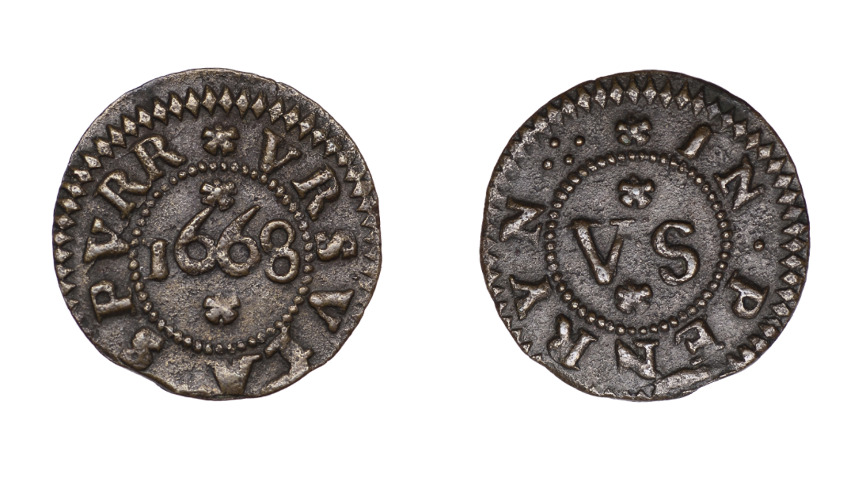
However, a fine example of how studying such tokens can help uncover the personal histories of long forgotten individuals can be found in the 1668 Farthing of Ursula Spurr of Penryn.
“There is evidence in the 1658 Will of Vincent Smaley, father of Ursula Spurr, that she was married to an unsatisfactory husband,” the catalogue explains.
“Smaley left his daughter £8 per year during her husband’s life, but if he died, she was then to have £100 per year – presumably he felt the husband was not competent to handle such a large amount of money.”
Another point of interest is the silver sugar box, left to Ursula by her father, “which was Lady Killigrews”. Jane Fermor (1584-1648) married into the family and, as Lady Killigrew, later escaped to Penryn in 1633. Could its association with the notorious Killigrew family have had any influence on Ursula? Regardless, as Mac McCarthy concludes, Ursula appeared very ready to cheat the authorities.
“In 1653 it was reported from Pendennis Castle that some bags containing 2,709 louis and 718 pieces of eight, taken from a prize ship, had been embezzled by one Captain William Wheatley and conveyed by him to the house of Richard Lobb. Benjamin Sergeant had also embezzled four bags of louis which he conveyed to the house of Christopher Lee in Smithicke, and he exchanged 1,000 of them at 4 shillings a piece with Ursula Spurr.”
The records also show that Ursula’s husband, Henry, described as a Gentleman, was buried at St Gluvias, north of Penryn, on 15 June 1663. The 1664 Hearth Tax returns read “Henry Spurr (Mr) 7 ret 2 too many b.m. & now Mrs Ursula Spurr New tax payer”. Ursula Spurr, described as a widow, was buried at St Gluvias on 16 May, 1678.
Very fine and extremely rare, the Farthing is estimated at £400-500.
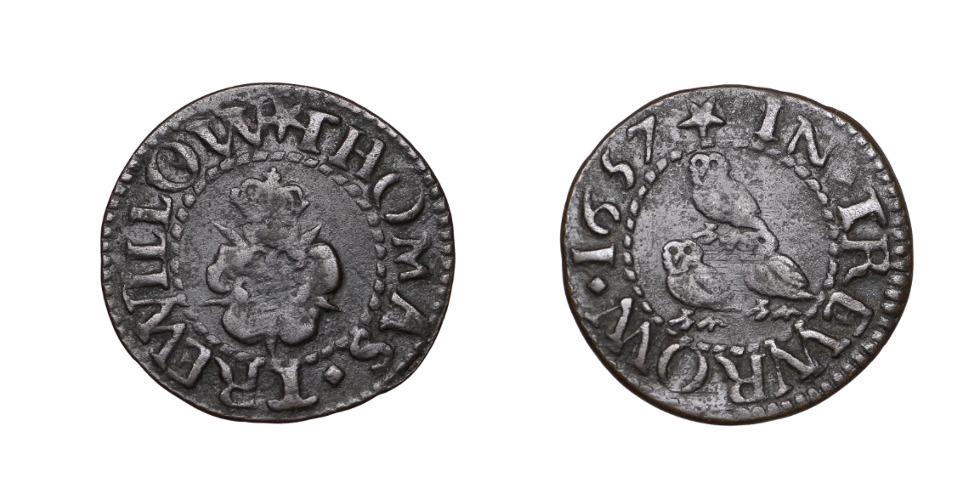
Another highlight – a 1657 Farthing of Thomas Trewillow of Truro – leads to the parish registers from 1640-95, where two people of that name appear – probably father and son.
“The earlier Thomas’ wife was named Ann, and they had a son and four daughters between 1640 and 1646; this Thomas was Mayor of Truro in 1649, and at the time tried to obtain repayment of money he had lent to the government for the siege of Pendennis Castle. He was assessed at 13 hearths in the 1664 Hearth Tax returns,” the catalogue explains.
“The later Thomas married Azias Osgood, née Oates, sometime after 1673 when her first husband died. She was a wealthy widow, having been left goods to the value of £561 4 shillings by her deceased husband. This Thomas was innholder at The Bull in the 1680s and by his Will, dated 15 February 1695 and proved on 8 September 1697, left family properties to the west of Penzance to his kinsman Robert Wells. It is likely that this token was issued by Thomas Trewolla senior, and the next by Thomas Trewolla junior.”
Exceptionally rare, the Farthing is estimated at £400-500.
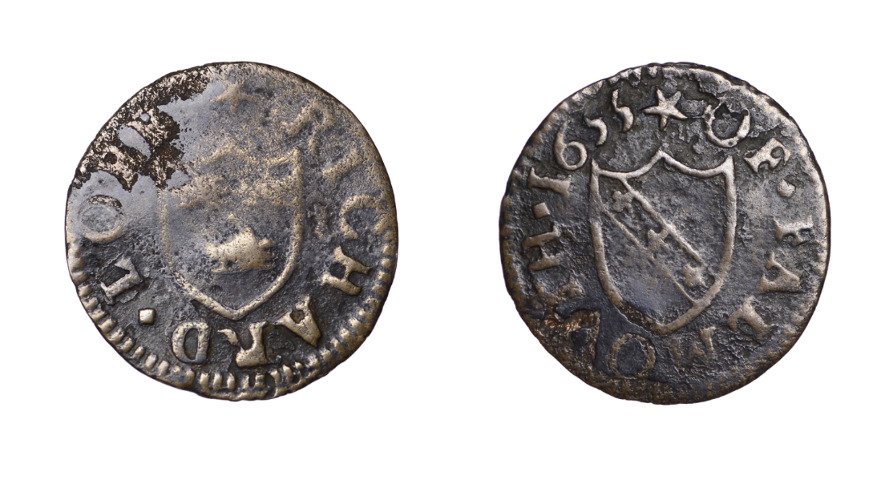
Another Farthing, this one dated 1655, is named for Richard Lobb of Falmouth, who was High Sheriff of Cornwall in 1652, MP for St Michaels in 1659, Captain of the West Cornwall Militia and owner of Falmouth House in Mylor and Treworder House, Kenwyn.
“He dealt extensively in tin and fish, some of which were exported, and was apparently not averse to smuggling. His will, dated 1675 and proven in 1676, describes him as a merchant from Mylor, made his eldest son Richard his executor, and left him what was not left to his other three sons, five daughters and his grandchildren.”
Extremely rare, the estimate is £200-260.
Share This Page