Article
12 March 2026
HOW LONDON’S MOST POPULAR FIRE CHIEF FACED THE HORRORS OF THE BLITZ WITH MARKED PERSONAL GALLANTRY
Eighty-five years on, The Blitz remains the single most devastating and sustained attack on mainland Britain in recorded history.
Estimates vary but some say it claimed the lives of 43,500 civilians – around half the total who died in the entire war – and made one in every six Londoners homeless. The bombing and firestorms that resulted led to the damage or destruction of 1.1 million homes – 2 million when other cities were taken into account. Vital infrastructure, including docks and railways, were also destroyed.
Other cities, including Liverpool, Bristol, Glasgow, Belfast, Swansea and Hull also suffered as the German bombers targeted the shipyards.
The nightly bombing began on September 7, 1940 and continued unbroken for 57 days. The Blitz lasted until May 1941, the final night of devastation raining down on London on May 10. From then on, Hitler turned his attention to his plans to invade the Soviet Union.
Aided by the Auxiliary Fire Service, the London Fire Brigade was at the heart of the firestorms that raged across the capital over those eight months. They had to deal with countless incendiary devices that had not exploded on impact, while also fighting out-of-control fires in soaring temperatures, often with limited or unreliable access to water to douse the flames. The London Fire Brigade estimates that in the first 22 days of The Blitz alone, its men had to tackle 10,000 fires.
Buildings would collapse around them as the bombing continued, and factories and warehouses hit by bombs could add to the peril and conflagration as their inflammable contents caught alight. Meanwhile returning to base gave no let-up as the bombers targeted fire stations too, and communication lines broke down, hampering efforts further. By the end of The Blitz, 327 London firefighters had lost their lives – the national total was 997.
The largest single loss had come in April 1941, when 34 died tackling the devastation at the Old Palace School sub-station in Poplar. It is still the largest loss of life from a single incident for the service in history.
Co-ordinating the battle against the firestorms and devastation in the capital was the Deputy Chief of the London Fire Brigade, Frank Whitford Jackson, who had risen through the ranks to take up the role on the eve of the Second World War in 1939. In reality, Jackson was chief in all but name, his predecessor, Sir Aylmer Firebrace, refusing to give up the title even when moved to other duties as London Regional Fire Officer.
Jackson had begun his brigade career at Euston in 1920 under Firebrace, and their rivalry appears to have lasted until to Jackson’s resignation, after which Firebrace was responsible for shaping the UK fire service; this may be why Jackson’s service with the LFB and wider is not better known.
Key to the effectiveness of the Brigade under Jackson was his constructive working relationship with John Horner, General Secretary of the Fire Brigades Union (FBU). Together they incorporated the auxiliaries of the Auxiliary Fire Service into the London Fire Brigade to create a uniform, streamlined service.
In his 2010 book Firefighters and The Blitz, Francis Beckett recorded the views of Horner: “Jackson believed the Fire Service could not have got through the war without the unions help and incorporation. When (Herbert) Morrison retired (him) from active service he received no honours, no knighthood, but ‘Gentleman Jackson’ deserves honourable mention in this history.”
Once war broke out, Jackson often put himself in the path of danger during raids. “He would often be seen out in the middle of a raid, visiting his men and women as they battled the fiery elements that threatened their city,” his biographer revealed. “He was idolised by his men and respected by his peers.”
The ‘Gentleman Jackson’ soubriquet came from the communist-dominated Fire Brigades Union, and with good reason, as Richard Collier explained in his 1959 book The City That Would Not Die (p.46): “They loved everything about him – his urbanity, the gentle smile even when things were worst, the same unhurried, courteous approach to all comers. ‘To some senior officers,’ one fireman recalls, ‘ordinary fireman were cattle. Major Jackson would walk a hundred yards out of his way to say good morning to a fireman swabbing down the floor. He would remember his name and details of his family.’”
Jackson faced numerous perils. Having been ordered directly by Winston Churchill to protect St Paul’s Cathedral at all costs during the night raid of December 29, on the last night of The Blitz five months later he faced the dilemma of how to protect the rest of the City too. At one point he had planned to create a fire break that would have entailed setting off explosives threatening the foundations of the Cathedral.
The reason Jackson considered taking such drastic action was because the fires were endangering the nearby Faraday Building which at the time was the nerve centre for Britain’s wartime overseas communications. This facility had to be saved at all costs, even if it meant putting St Paul’s at risk.
As Beckett writes, “Each lorry slowly worked its way down through the burning narrow streets to deliver 1,000 gallons each into a 5,000 gallon steel dam. Until the Thames rose again, it would be the only way of saving the world’s biggest telegraph exchange, Faraday House. The north east block of Faraday House, known as the Citadel, was also Winston Churchill’s emergency bunker, and was of vital importance to the future planning of the war. Two cabinet ministers were in residence in the bunker that night – John Anderson, after whom the shelters had been named, and Ernest Bevin, Minister for Labour. It was essential to save the exchange if Britain was to remain in contact with the rest of the world. The FFS was less worried about the two ministers.
“Major Jackson looked on as his men fought the flames. If the relay failed to work, he had received orders to dynamite the street, causing a natural fire break. It was to be an action of last resort, as no one could be sure that the explosion would not damage the foundations of St Paul’s, just 100 yards north, but it would save Faraday House.
“The battle for Faraday House would remain in the balance until 9:30am, when additional firefighters, whose leave had been canceled hours earlier, augmented by firefighters from outside London, began to win control. Faraday House and St Paul’s would not be declared safe until 6pm.”
The deadly nature of that attack finally persuaded the Government to unify Britain’s fire service. On 13 May, the Home Secretary introduced the Fire Services (Emergency Provisions) Bill to see the plan through and on 22 May it received Royal Assent and passed into law, with the National Fire Service coming into formation on 18 August. Jackson became Chief Fire Commander of 33 Fire Force covering London. He was the only individual ever to hold the title, as his successor in 1943 took the title Chief Regional Fire Officer, which was used for all other Fire Forces around the country.
Jackson also helped found the London Fire Service Benevolent Fund – later the Fire Services National Benevolent Fund (FSNBF), today the Firefighters Charity. And he supported the idea of sending firemen artists to tour the USA.
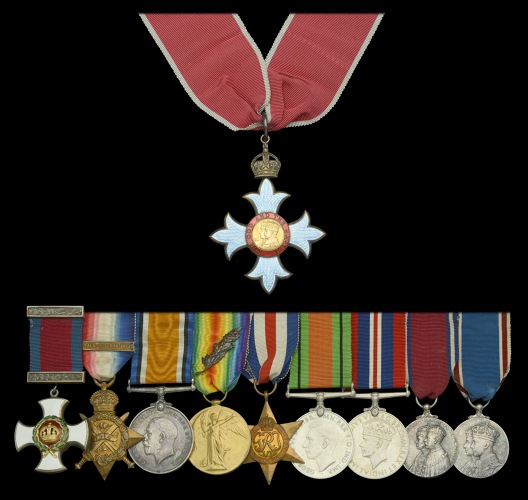
As The Blitz neared its end in April 1941, it was announced that Jackson has been appointed a CBE, with the citation especially noting his “marked personal gallantry on a number of occasions, and in the fullest sense has shared the dangers of his officers and men.”
The measure of Jackson’s popularity among the officers of the London Fire Brigade was not simply found in the verbal and written tributes paid to him (he was later described as “the most popular Chief Officer the London Fire Brigade ever served under”).
He faced his own personal tragedy too: on June 12, 1943 his son, Frank Jnr, died when the Wellington bomber he was piloting crashed at RAF Bircham Newton, Norfolk on its return from a mission over the Ruhr.
Noonans bring Jackson’s medals and presentation gifts from his men and the brigade for sale here. Consigned by his grandchildren, the proceeds will benefit The Fire Fighters Charity.
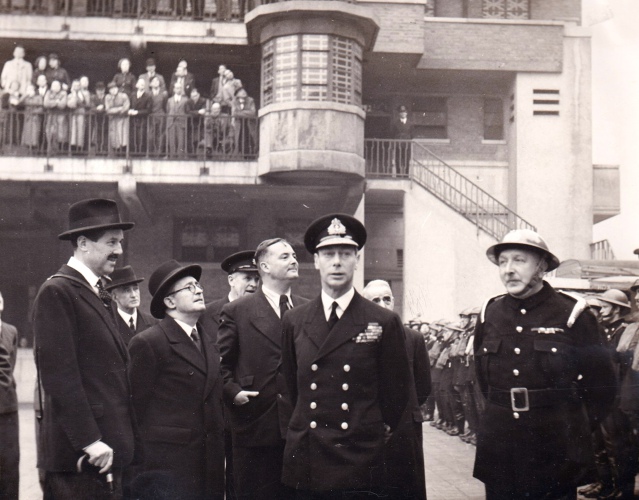
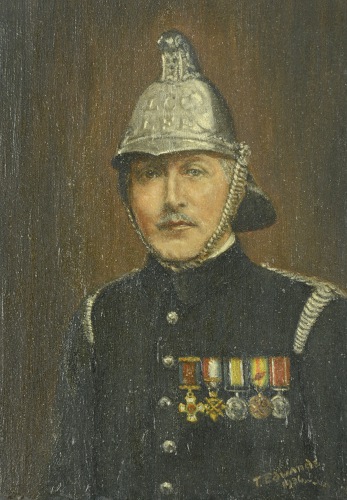
The lot comprises Jackson’s C.B.E. D.S.O group of ten and a 1936 oil on canvas portrait of Jackson in full dress uniform of the London Fire Brigade, wearing what was then his DSO group of five; a silver hip flask with Jackson’s initials; and a selection of photographs, including one of Jackson in uniform with King George VI during a Royal inspection of the London Fire Brigade headquarters.
Included also is his service record from the London Fire Brigade, and original photos taken from the early Blitz bombing of Thames Haven on the 7th September 1940. Other ephemera and paperwork include a copy of a letter from Gowers appointing him as Chief Fire Commander in 1942 in service record, as well as numerous newspaper cuttings about Jackson in his role in charge of the London Fire Brigade, and their work, copies of his birth, marriage and death certificates, and other certificates for members of his family, including copies of his pilot son, Frank’s death certificate.
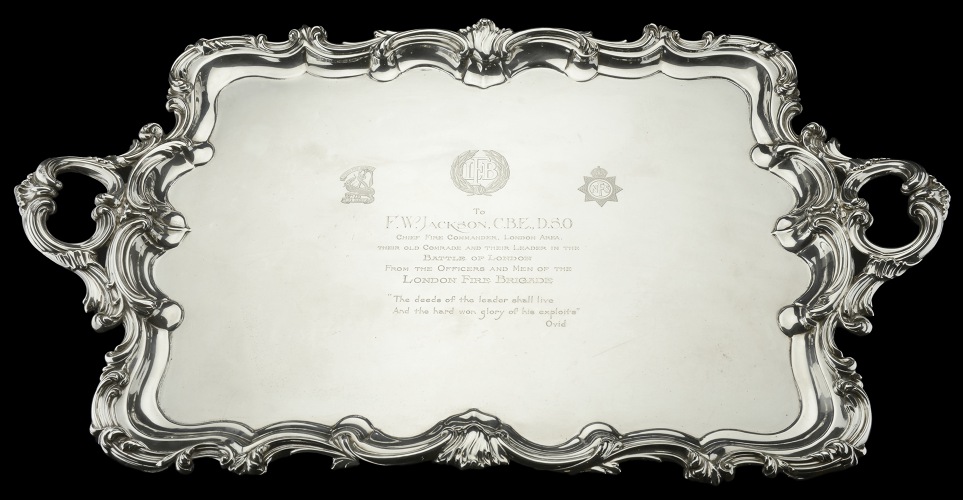
Of particular note are two presentation pieces of silver. The first is a large silver salver inscribed as follows: To F W Jackson CBE DSO Chief Fire Commander London Area. Their old comrade and their leader in the Battle of London. From the Officers and Men of the London Fire Brigade. ‘The deeds of the leader shall live And the hard-worn glory of his exploits’ – Ovid
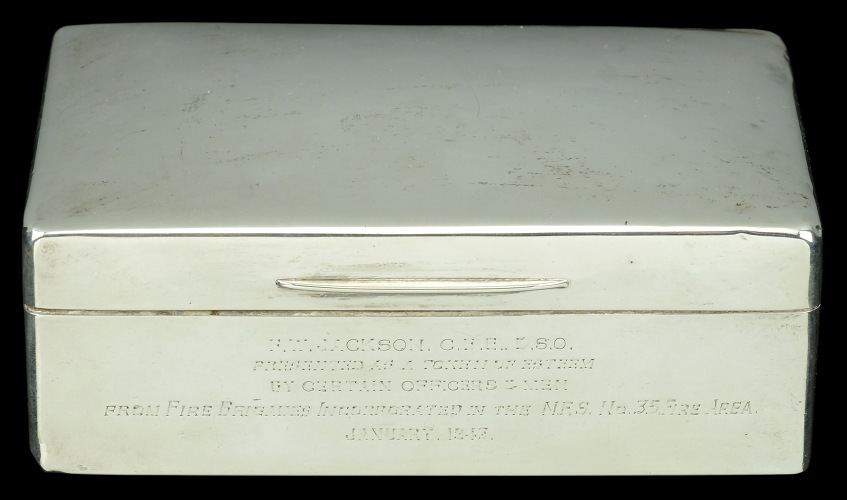
Also included is a silver cigarette box inscribed: Presented as a token of esteem. By certain Officers and Men From Fire Brigades incorporated in the NFS No 35 Area January 1943.
The estimated for the consignment is £20,000-30,000.
Share This Page