Article
24 February 2026
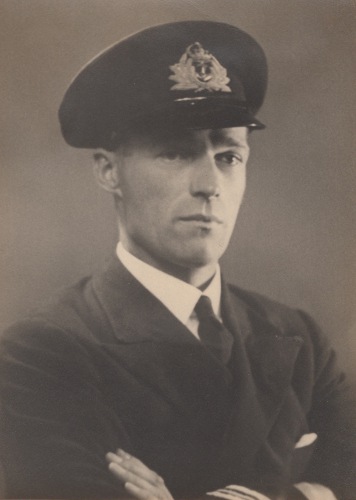
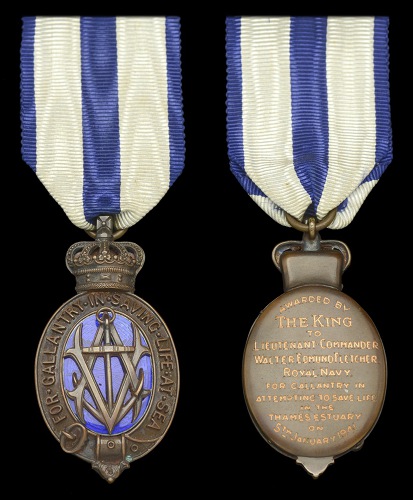
The Albert Medal awarded posthumously to Lieutenant-Commander Walter Edmund Fletcher of the Royal Navy who sacrificed his own life to save the life of the celebrated aviator Amy Johnson after her aircraft crashed into the freezing waters of the Thames Estuary in January 1941 will be offered in an auction of Orders, Decorations, Medals and Militaria at Noonans Mayfair (16 Bolton Street) on Wednesday, March 18, 2026. The medal is estimated at £6,000-8,000 and is being sold by his niece, who wants to give the money to her children.
As Christopher Mellor-Hill, Head of Client Liaison at Noonans commented: “Fletcher served during the Second World War in command of the Barrage Balloon Vessel H.M.S. Haslemere, and on 5 January 1941, he was escorting a convoy off the Thames Estuary when, on an intensely cold and misty day, he saw a parachutist drop from the clouds into the rough sea. Almost immediately afterwards an Oxford aeroplane with dead engines spun down crashing into the icy waters nearby, breaking up. Fletcher immediately altered course and put on full speed. There was a heavy swell and strong currents. A lifeboat was manned and lowered, but at that point the parachutist, described by eyewitnesses as female, was swept past, just 20 yards from the ship. Observing one of his men getting ready to go over the side to rescue the parachutist, Fletcher immediately stopped him, on the grounds that the man was married, and as the only single officer aboard Fletcher decided to attempt the rescue himself. Diving in fully clothed, he searched in vain for the parachutist, before being spotted briefly resting on the door of the Oxford (which had been jettisoned by the pilot before baling out). Another boat was subsequently lowered from the Haslemere to pick up her gallant captain, who had been rendered unconscious from exposure to the freezing sea; taken to the Royal Naval Hospital at Gillingham he tragically died shortly after his arrival.”
He continued: “Although unknown to Fletcher and his crew at the time, the unidentified female parachutist was the celebrated aviatrix Miss Amy Johnson, the pioneering pilot who in 1930 had become the first woman to fly solo from London to Australia, Throughout the 1930s she set many long-distance flying records, including from London to Cape Town and from Britain to Japan. Following the outbreak of the Second World War she joined the newly formed Air Transport Auxiliary, transporting R.A.F. aircraft around the country. Advanced First Officer, on 5 January 1941 she was tasked with flying an Airspeed Oxford from R.A.F. Prestwick near Glasgow, to R.A.F. Kidlington near Oxford. Five hours after taking off, and inexplicably gone significantly off course, her aircraft ran out of fuel and crashed into the Thames Estuary. Her watertight flying bag, including her logbook, were washed up ashore near to the crash site. Quite why such an experienced pilot should have veered so significantly off course, albeit in heavy fog, is unknown, but may have been due to a faulty compass.”
Walter Edmund Fletcher was born at Kibworth Rectory, Leicestershire, in 1906, the son of the Reverend E. S. B. Fletcher, and was educated at Kibworth Grammar School before joining H.M.S. Conway, from where he proceeded to the Royal Naval College, Dartmouth. Passing out as Midshipman in January 1924, he was promoted Sub-Lieutenant on 15 February 1927, and Lieutenant on 1 April 1929, and served in the inter-war years in both the Atlantic and the Mediterranean. He is buried in the Royal Navy section of Gillingham (Woodlands) Cemetery, Kent, and is also commemorated on the War Memorial at Monks Risborough. His Albert Medal was posthumously presented to his mother and brother by H.M. King George VI at Buckingham Palace on 10 June 1941.
Share This Page