Article
29 January 2026
THE REMARKABLE CAREER OF THE MAN WHO SAVED THE KING OF NORWAY AND OVERSAW THE ANZIO LANDINGS
He commanded the operation that rescued the King and Crown Prince of Norway, as well as its government and gold reserves, and had to take the almost impossible decision not to recue over 1,500 stricken sailors in the process.
By the time he was promoted to command all Allied shipping in the Mediterranean and oversee the landings at Anzio, Italy and Southern France, he had completed more than 40 years’ service in the Royal Navy.
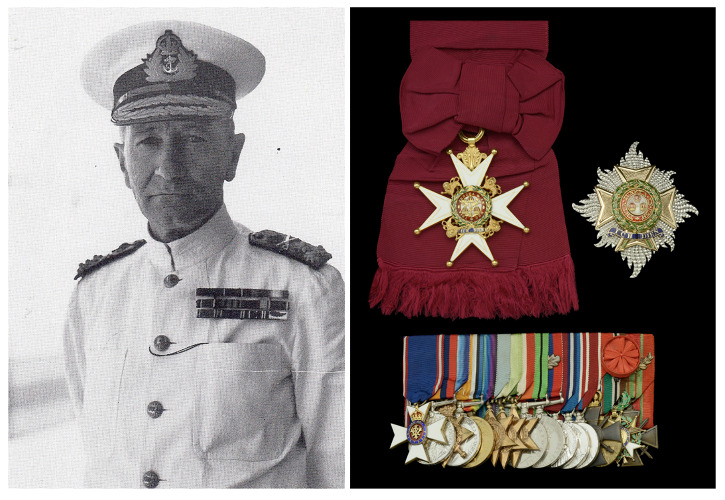
Now Noonans have taken the opportunity to celebrate the career and contribution of Sir John H. D. Cunningham, Admiral of the Fleet and Commander-in-Chief, Mediterranean 1943-46, as his
magnificent G.C.B., M.V.O. group of twenty-two came to auction in this sale. With hopes of £12,000-£16,000, the group sold for £20,000.
Few can claim such extensive experience and influence during one of the most historic periods of our nation’s maritime history, and the sale of this group warrants a closer look at Sir John’s achievements.
Born at Demerara, British Guiana on 13 April 1885, following his education he enlisted in the Royal Navy and in 1900 was posted to cadet training ship Britannia, and in 1901 to the cruiser Gibraltar, taking part in the operations during the Second Boer War. In 1904, he was promoted to the rank of Sub-Lieutenant and then completed the examination to become a Lieutenant in October 1905. After navigation training, he became the assistant navigator for the cruiser Illustrious and senior navigator for the gunboat Hebe, cruiser Indefatigable, and finally the minelayer Iphigenia. On 8 March 1910, he married his cousin Dorothy May; they later had two sons, John and Richard.
During the First World War, he served as a navigator on the cruiser Berwick in the West Indies in 1914, the battleship Russell in the Mediterranean Sea between 1915 and 1916, notably surviving her sinking by a mine, in Maltese waters in April 1916, the battlecruiser Renown in 1916, and the battlecruiser Lion in 1918.
After the war he served aboard the battlecruiser Hood as her navigator, and then later served as the battlecruiser squadron's navigator. In 1922, he served as the commander of the Royal Navy Navigation School and then served with Admiral Sir John de Robeck as his Master of the Fleet aboard the battleship Queen Elizabeth.
In 1924, he was promoted to the rank of Captain and spent time on the staff of the Royal Naval College at Greenwich. At the Review Fleet at Spithead by His Majesty on 26 July 1924, Cunningham was in his position as Master of the Fleet and was rewarded by the King with the M.V.O. 4th Class.
After some time as deputy director of plans at Admiralty House, he commanded the minelayer Adventure between 1928 and 1929. In 1932, he took command of the battleship Resolution, flagship of Admiral Sir William Fisher of the Mediterranean Fleet. In 1935, he served as naval aide-de-camp to King George V. In 1936, he was promoted to the rank of Rear Admiral and was named the Assistant Chief of Naval Staff, which brought him to the administration of the Fleet Air Arm in the following year. In 1938, his office became that of Fifth Sea Lord with a seat on the Board of Admiralty. In the summer of 1939, he was promoted to the rank of Vice Admiral and was deployed back to sea with command over the 1st Cruiser Squadron in the Mediterranean Sea; he broke his flag on the cruiser Devonshire.
On the outbreak of war on 1 September 1939, Cunningham took the 1st Cruiser Squadron back to Britain to join the Home Fleet. Shortly after, he was sent north to support the Norwegian campaign. During the night of 1 May 1940, he led a mixed force of three cruisers, nine destroyers, and three French transports to the port of Namsos, north of Trondheim, to evacuate about 5,700 Allied troops; bad weather postponed the evacuation by a day, but it also somewhat shielded the operation from being attacked by German aircraft.
On 7 June, he took Devonshire to the Arctic port of Tromsø to evacuate King Haakon VII, Crown Prince Olav, other members of the Norwegian royal family, government ministers, and Norway's gold reserve. On the return trip, Devonshire received the distress signal from the carrier Glorious, which was under overwhelming German naval attack; under order to keep strict radio silence on this important transport mission, Cunningham chose to ignore the distress call. He safely delivered the important passengers and cargo to Britain, but Glorious and her two screening destroyers were sunk with the loss of 1,519 men.
In September 1940, Cunningham was appointed joint commander with Major-General N. M. S. Irwin for Operation Menace which planned to land 6,670 British and Free French soldiers at Dakar, Western Africa. The operation turned out to be a failure as local Vichy-French forces put on a fierce resistance.
In 1941, Cunningham was knighted and was named the Fourth Sea Lord in charge of supplies and transport. In August of the same year, his younger son Richard Cunningham, who was a Lieutenant with the Royal Navy Submarine Service, died in action aboard submarine P33 during an attempt to intercept an Italian convoy toward Libya.
Cunningham was deployed to the eastern Mediterranean Sea in June 1943 and promoted to the rank of Admiral in August and given command of all Allied shipping in the Mediterranean Sea. In this role, he oversaw the amphibious operations at Anzio, Italy and Southern France. He remained in the Mediterranean Sea through to the end of the war.
He was appointed as a Chief Commander of the American Legion of Merit on 17 July 1945. He was appointed a Grand Officier of the French Legion of Honneur and also awarded the French Croix de Guerre avec Palmes in 1945. He was also appointed a Knight Grand Cross of the Greek Order of George I on 22 May 1945 and then awarded the Greek War Cross 1st Class on 19 March 1946. Additionally he was appointed Commander of the Norwegian Order of St. Olav on 13 October 1942, and appointed a Knight Grand Cross of that Order on 22 July 1947.
Cunningham was promoted to Knight Grand Cross of the Order of the Bath in the 1946 New Year Honours, and he succeeded Admiral Sir Andrew Cunningham (no relation) as the First Sea Lord in May 1946. As the First Sea Lord his focus was on implementing the Government's policy of scrapping numerous serviceable ships. He was made a Freeman of the City of London in 1946, and he was promoted to Admiral of the Fleet on 21 January 1948, before retiring in September 1948. After leaving the Royal Navy, Cunningham became the chairman of the Iraq Petroleum Company and the Deputy Lieutenant of Bedfordshire.
He attended the coronation of Queen Elizabeth II in June 1953. He retired from the Iraq Petroleum Company in 1958 and as the Deputy Lieutenant of Bedfordshire in 1959. After an exceptionally distinguished career, Admiral of the Fleet Sir John Cunningham died in the Middlesex Hospital on 13 December 1962.
Share This Page