Article
29 January 2026
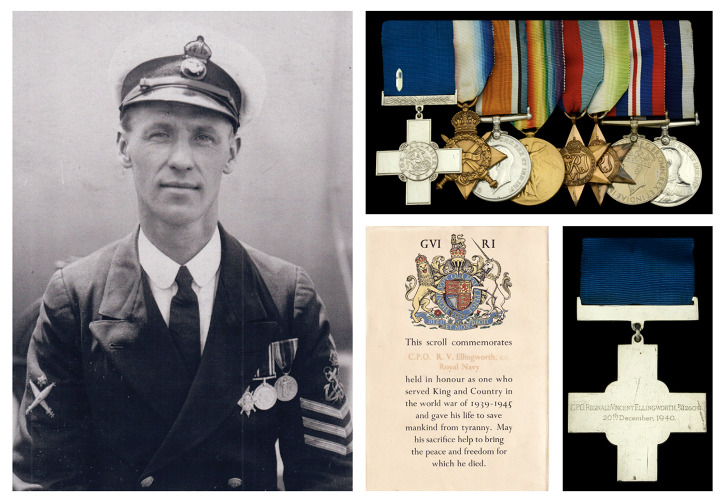
OUTSTANDING POSTHUMOUS ‘LONDON BLITZ’ GEORGE CROSS TO DEDICATED BOMB DISPOSAL EXPERT COMES TO AUCTION
At the height of the Blitz in London, the life expectancy of a bomb disposal expert was said to be just ten weeks. From the testimony of his son, it was a peril of which Chief Petty Officer Reginald Vincent Ellingworth of the Royal Navy was acutely aware.
Those fears were tragically realised on 21 September 1940, and the sale of George Cross group of eight at Noonans on 11 February provides a fitting opportunity to recall his exceptional bravery.
Ellingworth was the first naval rating to receive a direct award of the George Cross and, as a protégé of the pioneering parachute mine disposal specialist Lieutenant-Commander R. J. H. Ryan, G.C., R.N., had already helped render safe just such devices, including the First ‘C’ Type, by the time of the final, fatal assignment which earned him the award.
Born in Wolverhampton in 1898, he had been an apprentice car body-maker at Coventry before joining the Royal Navy as a Boy 2nd Class in July 1913. Having then attended the training ship H.M.S. Impregnable, he joined the battleship H.M.S. Benbow in October 1914, in which he was present at the battle of Jutland and advanced to Able Seaman.
The following year, Ellingworth transferred to the ‘Silent Service’, in which capacity he served in the submarine L.2 from October 1917 to November 1921, followed by further submarine appointments in the Twenties. Awarded his Long Service and Good Conduct Medal in April 1931, he advanced to Chief Petty Officer in November 1936, and was pensioned ashore in January 1938.
When war broke out, Ellingworth joined the torpedo establishment Vernon, where he volunteered for bomb and mine disposal duties and was drafted to the fledgling ‘Rendering Mines Safe’ Party, a perilous pastime shared with the Admiralty’s Land Incident Section.
Enlisted as right hand man to Lieutenant-Commander R. J. H. Ryan, R.N., a noted pioneer in mine disposal, he subsequently shared in many adventures of the hair-raising kind, an early example being the making safe of first magnetic Type ‘C’ mine, which was discovered in the wreckage of a downed Heinkel on the sands at Clacton at the end of April 1940. While their gallant work on occasion took them further afield – they dealt with devices in Cardiff, Liverpool and Sheffield – it was to London they were most regularly called, so much so that they took rooms in the Royal Automobile Club in Pall Mall.
It was his son, Donald’s recalling of their last meeting that provided the insight into Ellingworth’s awareness and acceptance of the extreme risks he was taking: “At the time I was 20 and in the Royal Corps of Signals, so I saw my father only during my infrequent leaves home to Portsmouth. But I distinctly remember our last conversation. It was July 1940 and I had turned up after Dunkirk, where, in the chaotic evacuation, I had been posted ‘Missing, Believed Lost in Action’. My father must have been relieved to see me because he gave me an enormous hug. I was a little taken back. It certainly broke the ice and, for the first time, we spoke man-to-man as we shared a pint and our experiences. I talked of France while he discussed the daily dangers he encountered. “One thing is certain, son,” he warned me. “If anything does go wrong, I won’t know anything about it.” I had never felt closer to my father and when we parted, I left with a heavy heart. With German bombs dropping over England, I realised it was only a matter of time before his selfless courage would cost him his life. Seven weeks later he was killed.”
That moment came when he and Lieutenant-Commander Ryan approached a challenging parachute mine at Dagenham on 21 September 1940. An eyewitness saw the pair of them ‘upright, striding confidently’ towards the entrance of the building from which it was dangling from the roof. “Shortly afterwards, as they commenced work on extracting the fuse, it sprang into action, the resultant explosion causing instantaneous death and destruction.”
Aged 42 and described by his widow as ‘the best of dads’, Ellingworth was buried at Milton Cemetery, Portsmouth, where his Commonwealth War Graves Commission headstone bears the following epitaph: ‘In Everlasting Memory of our Beloved, Killed by Enemy Action. Duty Nobly Done.’
The group is consigned by Ellingworth’s great-grandson and great-granddaughter and is expected to fetch £60,000-80,000.
Share This Page