Article
8 January 2026
HOARDS, RARITIES AND SOME EXCEPTIONAL COLLECTIONS
Hoards, exceptional rarities and remarkable collections contributed to the highlights in Noonans’ Coin auctions throughout the year.
One of the first to make its mark was the Hammersley Collection of British Milled Sovereigns – a white glove sale registering an above-estimate hammer total of £274,000 for just 62 lots on 19 February.
As Head of Coins at Noonans, Bradley Hopper explained: “Introduced as a replacement for the Guinea after three decades of economic turbulence caused by the war with France, the purpose of the Sovereign, as its name suggests, was to re-establish the political and economic power of Britain and its Empire.”
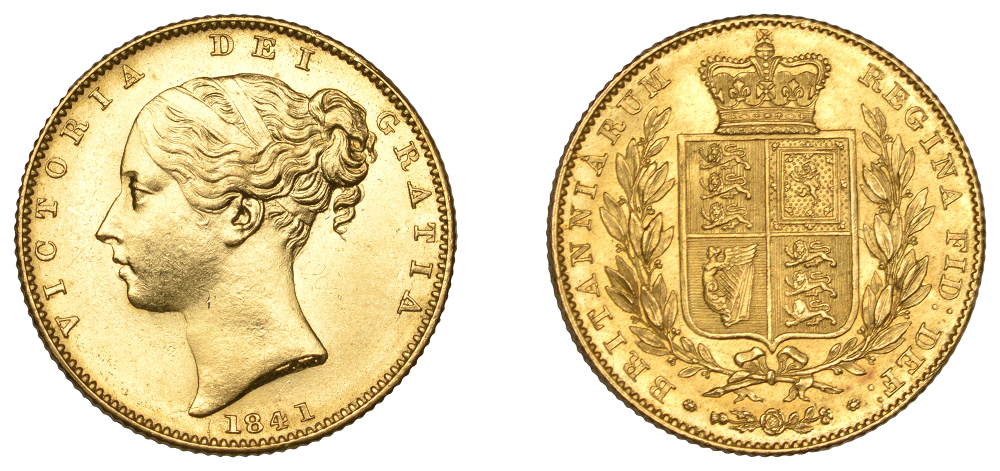
The result reflected the fact that this was the best group of milled sovereigns to be dispersed in London for over a decade. The highest price came for an 1841 Queen Victoria example, described as “The King of Victorian Sovereigns”. In a superb mint state, it sold to an English Collector for £30,000.
An extremely rare 1839 sovereign, in an almost perfect state of preservation and described as “amongst the Finest Known”, had hopes of £6,000-8,000 but went as far as £15,000, achieving a new record.
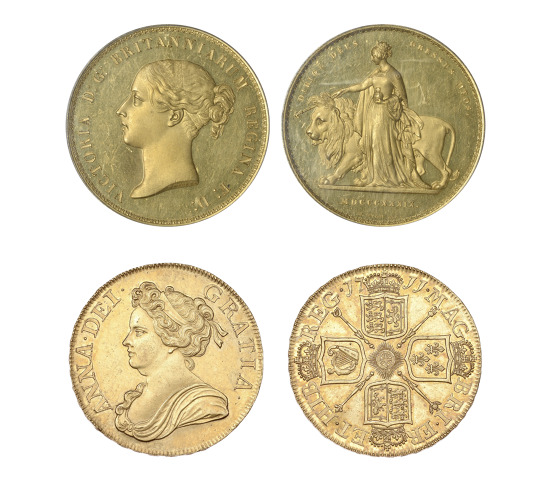
Another outstanding coin was the 1711 Five Guineas of Queen Anne that sold to a Swiss collector after highly competitive bidding from rivals in Japan, Europe and the UK, on 9 September. Described as having the most trifling hairlines, but otherwise better than extremely fine and well struck up, the fields residually lustrous with a hint of reddish toning, this rare coin had been expected to fetch £50,000-60,000, but the hammer fell at £80,000.
Even that was beaten into second place in the auction by an exceptional Victoria (1837-1901), Proof ‘Una and the Lion’ Five Pounds of 1839, which sold for £150,000.
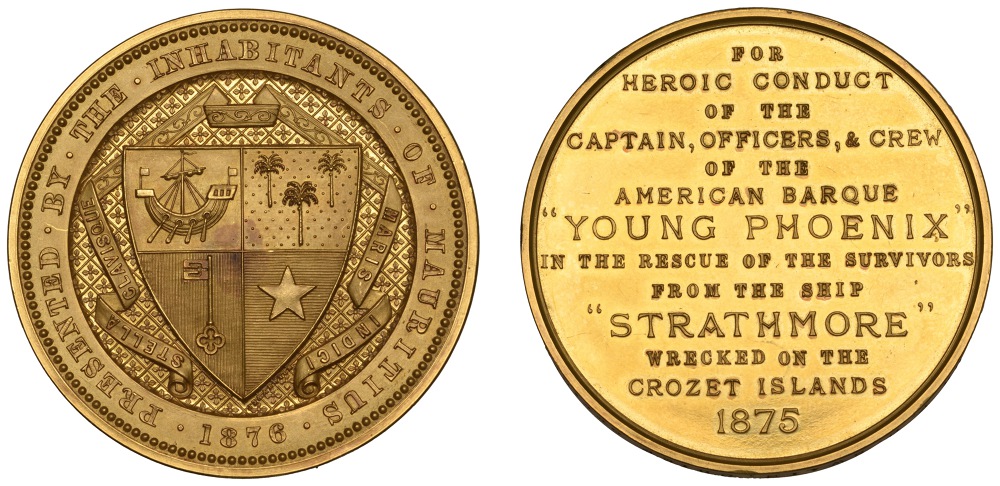
The outstanding collection of the late Jörg Hauchler (1956-2022) proved its worth as the leading highlight left its estimate £4,000-5,000 far behind to sell for £20,000 on 27 May. That was the Rescue of the Strathmore gold medal issued by the people of Mauritius after the sinking of the ship by that name.
The sailing ship Strathmore left Gravesend on 19 April, 1875 for New Zealand carrying 51 passengers, 38 crew and a cargo of railway iron and gunpowder. On 1 July the ship sailed into thick fog in the South Indian Ocean and was wrecked on the Crozet Islands. Captain Macdonald and the first officer were washed overboard, but the second officer and crew managed to launch two lifeboats, with survivors taken ashore onto one of the islands. They remained there for seven months until rescued by Captain D. L. Gifford of the American whaler Young Phoenix on 21 January 1876. Twenty of the survivors were transferred to the Sierra Morena and landed in Ceylon, while Captain Gifford took the rest to Mauritius.
The 43mm diameter medal was presented to Chief Officer F.C. Swain For Heroic Conduct of the Captain, Officers, and Crew of the American Barque Young Phoenix in the Rescue of the Survivors from the Ship Strathmore, Wrecked on the Crozet Islands 1875.
A contemporary of the late Kenneth Clark, The Hon. Robert William Hervey Erskine (1930-2024) was a polymath whose contributions to several fields of scholarship and the arts were outstanding.
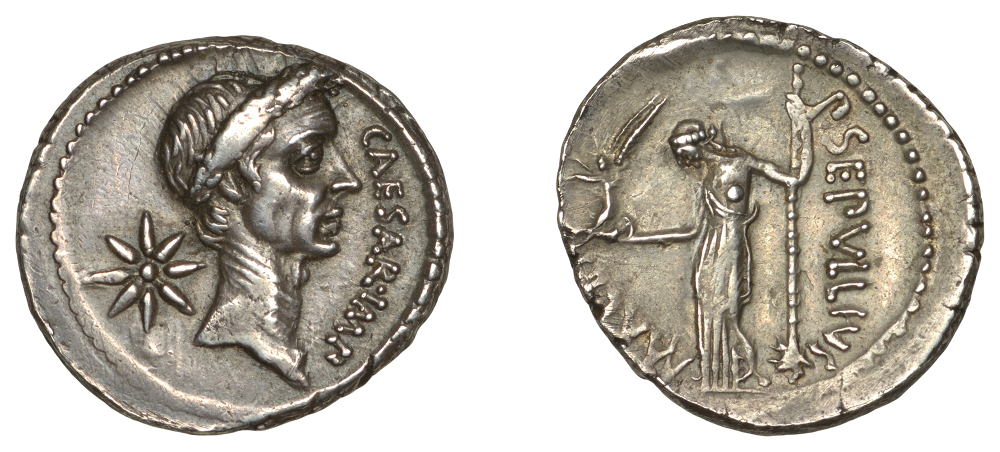
He enjoyed an ad-hoc career as a collector-cum-dealer in antiquities, and when Noonans offered a selection of ancient coins from his collection on 8 April, a notable highlight was the Denarius of Julius Caesar dating to January-February 44 and by the Roman moneyer P. Sepullius Macer.
Depicting the wreathed head of Caesar right, with a star of eight rays behind and caesar imp before, it left a £1,500-2,000 estimate in its wake as it sold for £9,500.
Among the hoards that passed through Noonans’ hands, the Whitwell stater Hoard, which appeared in the same 9 September sale, was notable for having been found in two parts, four years apart, by the same detectorists, David and Judy Haigh. It included five staters of the Corieltauvi, a Celtic tribe occupying the East Midlands before the Roman occupation, and is the largest such hoard discovered to date in Derbyshire. It made a combined £6,050 against a total high estimate of £5,100.
Much earlier in the year, on 18 February, the Sapcote Hoard of Roman coins came up for sale. Found in south-west Leicestershire by 42-year-old bathroom fitter David Dunn, it sold to a buyer in the United States for £4,400, almost three times its high estimate.
Most of the coins in the hoard were minted in London, with a few in Camulodunum (Colchester), with one of uncertain mint and others illegible because of wear. Five fragments are also included.
The remains of a Roman villa were discovered at Sapcote in 1770. A tessellated pavement and building foundations from a Roman building were found to the southeast of the site. In the 20th century more structural remains were unearthed as well as pottery, coins and tiles in the area of the former Calver Hill Quarry.
Noonans Coin Expert Alice Cullen explained the hoard’s significance: “This is a wonderful find of Antoninianus coins by David and we are very pleased to be selling them. The Antoninianus was a coin used during the Roman Empire thought to have been valued at 2 denarii. This hoard dates from the reigns of Carausius who usurped power in 286 after the Carausian Revolt, and declared himself emperor in Britain and northern Gaul; Allectus, who died in 296 and was a Roman-Britannic usurper-emperor from 293 to 296; Diocletian, nicknamed Jovius, who was Roman emperor from 284 until his abdication in 305, and Maximian who reigned from 286 to 305, sharing the title of Augustus with his co-emperor and superior Diocletian.”
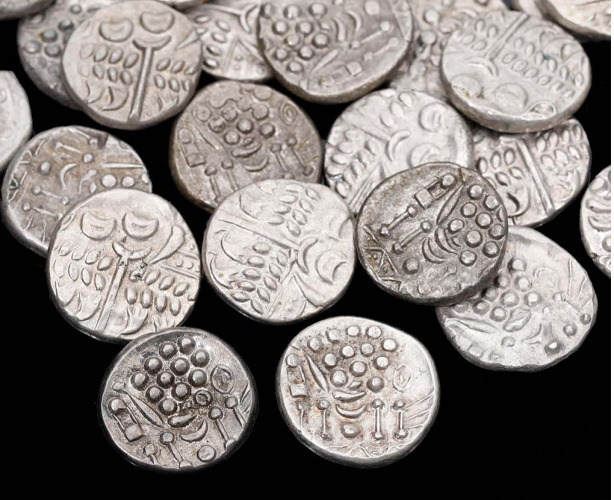
Lateral thinking played an important role in the discovery of the Cranborne Hoard of silver staters from the Durotriges tribe, uncovered between 9 and 14 April 2022 in Dorset.
The thinker in question was detectorist John Hinchcliffe, who began by finding a Victorian penny buried by the gateway of a remote Dorset meadow. Retiring for lunch to a nearby tree, he started thinking about what else might be buried nearby.
He followed his hunch and continued digging, but rather than finding more pennies, something silver popped up. Without a doubt, he knew what he had found, a silver stater of the Durotrigan people, a Celtic tribe who lived in the area before Roman times.
With help from his fellow detectorists, he soon uncovered a total of 67 staters.
Now aged 90 and having been a detectorist for 20 years by the time of the find, John must be one of the oldest detectorist ever to have discovered a hoard. To him the excitement was secondary to the questions the hoard raised: Who buried it? Why did they not return to claim it? Had something dreadful happened here? Unfortunately, these are questions we may never know the answers to.
Presented in 68 lots on 29 May, the hoard sold for a combined £17,540.
One of the more intriguing consignments of the year was the Gietzelt Collection of Scottish Merchant Dollars, sold on 24 September. It included some notable English examples, such as the Mexico, Charles IIII, 8 Reales counterstruck for 5/- in Birmingham by Donald & Co, a hosier and clothing and hat manufacturer, listed in the Birmingham trade directories at various addresses between c.1793 and 1815.
The collection partly traced the early days of the Industrial Revolution, with issues related to landmark locations and companies. For instance, the Cark cotton mill, where one of James Watt’s first steam-engines was installed in 1786, issued its own countermarked coinage and an example from 1787 was on offer in this sale: a Mexico, Charles III, 8 Reales of 1785 countermarked 4/6 to the reverse.
Meanwhile, a Mexico, Charles IIII, 8 Reales, dating to 1802 and counterstamped 4/9, was issued at the Cromford cotton mill where Richard Arkwright, one of the pioneers of the Industrial Revolution, had opened a horse-powered spinning mill in Nottingham in 1775.
• The new year gets off to a promising start with a sale of Irish Coins & British Hoards on 10 February, with other auctions to be announced soon.
Share This Page