Article
5 December 2025
QATAR, SOUTHERN RHODESIA AND NYASALAND UNVEIL THEIR RICHES AS COLLECTIONS SOAR OVER ESTIMATE
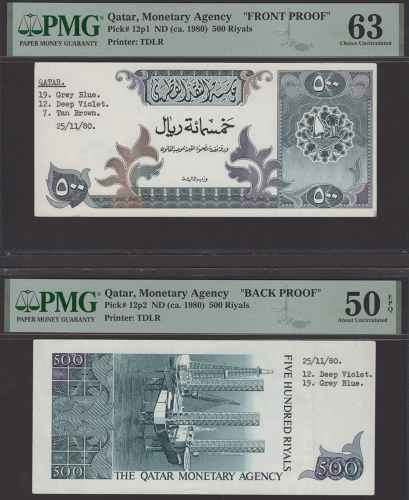
At a combined hammer total of £230,000, the collection of six second issue (1981) die proof notes of the Qatar Monetary Agency went 17 times the high estimate – a magnificent early Christmas present for the vendor and a triumph for Noonans’ Banknotes department.
“It was the first time that anyone had ever seen proof notes from this series, which are rarer than the first issue, and the level of interest was significantly beyond what we were expecting – and that was pretty high anyway!” said a delighted Andrew Pattison, Head of Banknotes.
“Three or four bidders contested the notes up to the halfway mark, at which point it turned into a dogged battle between two bidders for each note. I am happy to say that the eventual buyer secured the whole set, so they will remain together.”
The set provides a unique insight into the De La Rue design process for these choice uncirculated notes, which in every case featured no serial numbers or signatures, had ‘QATAR’ typewritten, and carried colour information, and the date ‘25/11/80.’ in the fields of both proofs.
Individually, they sold as follows:–
– 500 Riyals, with a reverse design of an offshore oil platform, £60,000 hammer against an estimate of £3,200-3,800.
– 100 Riyals, with a reverse design of the Qatar Monetary Agency headquarters building between a tree and a fountain, £48,000 (£2,800-3,600).
– 50 Riyals, with a reverse design of a steel worker stoking a factory furnace, £42,000 (£2,400-3,200).
– 10 Riyals, £32,000 (£1,000-1,500).
– 5 Riyals, £28,000 (£1,000-1,500).
– 1 Riyal, £20,000 (£1,000-1,500).
Two note groups from Rhodesia also carried the day, both consigned by direct descent from one of the two men who signed them.
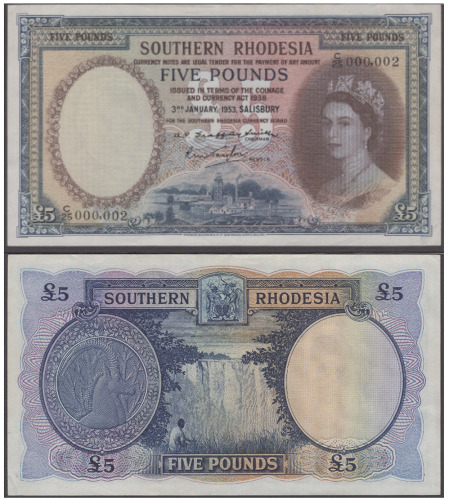
The first group was dominated by a single note – assessed as the finest example graded by PMG. A £5 uncirculated note from the Southern Rhodesia Currency Board, dated 1 December 1952, it was signed by Taylor and Grafftey-Smith, the latter of whom had been presented with the set when it was printed. Carrying the serial number C/25 000002, and arguably the finest Southern Rhodesia £5 note ever to come to market, it soared over its £5,000-7,000 guide to £22,000 hammer.
The second group was from the short-lived Bank of Rhodesia and Nyasaland first series of notes from 1956.
Established that year as the central bank for the Federation of Rhodesia and Nyasaland, its primary role was to manage the new Rhodesia and Nyasaland pound, which had replaced the Southern Rhodesian pound. The federation dissolved just seven years later in 1963, and the bank followed two years after that at the end of 1965, whereupon the central banks of the individual territories, newly established as independent nations, took control of the assets.
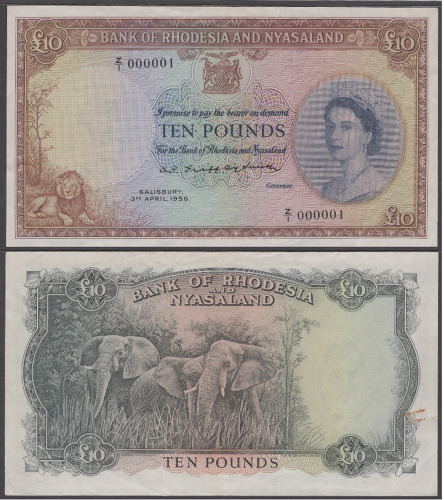
This sale presented denominations ranging from £10 down to ten shillings, the star lot among them being the £10, dated 3 April 1956, with the serial number Z/1 000001, which left its £6,000-8,000 well behind for a hammer price of £18,000.
The £5 note, serial number Y/1 000001, had hopes of £5,000-7,000 and rose to £10,000, while the £1, serial number Y/1 000001, took £9,500 against a guide of £3,000-4,000. The ten shillings, serial number W/1 000001 and also guided at £3,000-4,000, made £8,000.
In all, the series sold for £45,000, with the seven notes going to six separate buyers.
“Africa is incredibly popular at the moment,” says Andrew Pattison. “Collectors have turned their attention to issues that have been somewhat overlooked until recently, and their growing enthusiasm is leading to a very active sector of the market.”
Share This Page