Article
5 December 2025
THE SOLDIER WHO KEPT FLORENCE NIGHTINGALE SAFE DURING THE CRIMEAN WAR
Struck down by frostbite after the battle of Inkermann, Private Samuel Vickery of the Coldstream Guards found himself facing an uncertain future. That was until Florence Nightingale, a close colleague, came to his aid.
The heroine of the Crimea intervened to ask that Vickery be appointed her orderly and effective bodyguard. It was an appointment that was to prove crucial to the success of her role in treating the wounded and introducing new health practices that have echoed down the years.
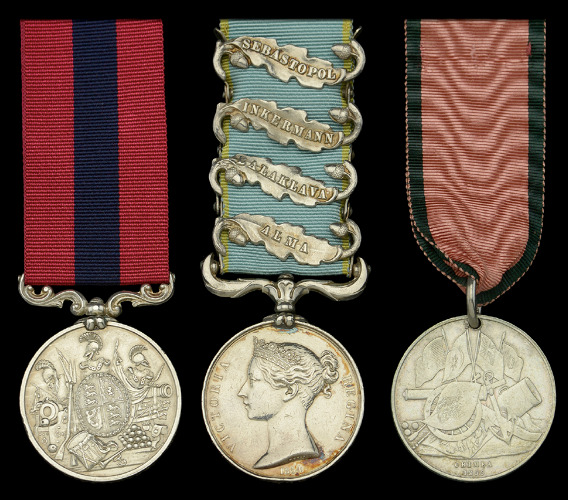
Now Vickery’s Distinguished Conduct Metal and Crimean War Medal with four clasps, (for Alma, Balaklava, Inkermann and Sebastopol) come to auction at Noonan’s on 14 January at a guide of £7,000-9,000.
The auction brings to life once more the fascinating tale of how an army private became Florence Nightingale’s indispensable and trusted bodyguard, about whom she wrote “I cannot speak too highly of Vickery’s honesty and trust-worthiness”.
Vickery had won his DCM during hand-to-hand fighting at Inkermann on 5 November 1854, when he was part of a force that held the Russian enemy at the point of a bayonet and helped recapture a vital battery.
Private William Wilden, a contemporary of Vickery who also received the D.C.M. for his actions at Inkermann, wrote an eyewitness account of the Coldstream’s experience during the battle.
He tells us that such was the ferocity of the fighting that at one point, not only were bayonets used freely on both sides, but the British had to use stones to beat back the enemy from the north western embrasure.
However, the forces pitched against the British were too great, and despite several bayonet charges, they could no longer hold their ground against overwhelming numbers and had to retire, fighting over every inch of ground as they retreated.
As the enemy moved forward, they killed the wounded British who remained on the battlefield.
The Coldstream Guards lost eight of their 16 officers and upwards of 200 rank-and-file of the 400 men that had advanced.
Conditions were no better once they had reached safety.
“Men in the trenches 24 hours at a time,” Colonel Bell wrote in his diary on 13 November, “soaked to the skin. No change when they came up to them miserable tents, hardly a twig to get to boil a bit of salt pork. Short of rations too for one to transport. Everything cheerless.”
The following day disaster struck in the form of an intense hurricane.
In his account, The destruction of Lord Raglan, C. Hibbett describes the violence of the storm and the toll it took.
By 6 o’clock the sound of the downpour and its “heavy beating on the Earth, had to become gradually swallowed up by the noise of the rushing of the wind and by the flapping of the tents”.
Then suddenly “everything went whiz bang in less time than I have taken to tell you”.
Tents leapt into the air and went flying over the plateau, looking like bits of paper; stones were lifted from the ground and crashed into any obstacles in their path, cutting men’s faces, tearing into the sailing canvas, smashing bottles, ringing against cans.
“Great barrels could be seen bounding along like cricket balls.”
Heavy wagons were thrown headlong through the camps, dragging bullocks after them “as if they were mere kittens”.
Hospital marquees collapsed, their poles torn out of the ground, and the sick were tossed in their muddy blankets helplessly across the ground. Men huddled behind walls, in holes in the ground, tied themselves together, clawing at the greasy, slippery earth as they tried to resist the force of the hurricane.
In Balaklava, trees were uprooted and flung across the streets of the town.
All morning the torrent raged, and the rain flew down through the howling wind. At two o’clock the force of the wind dropped. Men got up from their hiding places, covered in mud, their eyes streaming from the cold of the sleet, and looked “at each other in a sort of despair, shivering in wet rags”.
The muddy ground was littered with the damp, collapsed canvas of the tents, broken lengths of rope, smashed boxes, torn blankets, furniture, pots, pans and, against the windward side of the walls and protecting banks, muddled piles of debris. The dead lay around the collapsed and tattered hospital tents and under the waterlogged canvas; horses blown from their picket-ropes walked amidst the chaos.
At five o’clock it became much colder; “the hail and rain changed to a heavy snow”.
“As night began to fall, the men scraped the mud and snow from their tents and tried to pitch them again; their movements were slow, their fingers numb with cold.”
Such were the conditions in which Private Samuel Vickery found himself, and he contracted severe frostbite, probably while serving in the waterlogged and exposed trenches in front of Sebastopol. It should be noted that he would have been wearing the summer uniform in which he had landed at Calamita Bay in September. The ship carrying winter uniforms and great coats to keep the army had sunk in Balaklava on 14 November.
As his Discharge Examination reported no marks or scars on his face or the visible parts of his body, Vickery’s frostbite was almost certainly mostly in his feet, and he probably lost several toes, which may have permanently affected his balance. He was certainly too serious a case to stay in the regimental hospital camp and was evacuated, first to the British Army Hospital at Balaklava and then to the Base Hospital at Scutari, on the Asian side of the Bosphorus, opposite Constantinople.
At Scutari, he found himself in the care of the 34-year-old Florence Nightingale, who had arrived from England only a few weeks before. She oversaw what was still at that time a filthy Barrack Hospital where infection was rife and such care as existed was provided by male army orderlies who lacked any nursing skills and were usually drunk and frequently ill disciplined.
This was the moment that Nightingale secured her place in the history books. Submitting a written damning indictment about the conditions and lack of cleanliness, she also railed at the vermin and disgusting condition of the food supplies.
The authorities did not react well, and obstructed all her attempts to improve the situation, harassing her in the hope that she would return to England.
It was at this point that at the request of Florence Nightingale, Vickery took on the role which was to prove vital to the transformation of healthcare both at the battlefront and eventually at home.
He soon became indispensable. Tall, an accomplished soldier, with over ten years’ experience as a Guardsman, he principally served as her sounding board, personal protection expert and bodyguard, both in the dirty and dangerous environment
of Scutari and then during her visits to the two main hospitals across the Black Sea in the Crimea itself.
The General Hospital and the Castle Hospital were both located at close to the front at Balaklava, and throughout the war were constantly menaced by a likely sudden coup-de-main thrust from the Russian Field Army, who were attempting to drive the Allies from their siege lines.
Vickery is mentioned several times by O’Malley in his work Florence Nightingale 1820-56.
‘When Miss Nightingale left the hospital to go home at night, an orderly (Robert Robinson) led the way, carrying a lantern, while Vickery protected the rear, assisted by a 12-year-old Russian boy called Peter. “He was a prisoner, and was in the General Hospital at Balaclava. He is a fine-looking, hearty little fellow, speaks English. He goes with my bodyguard Vickery and Robert, when I go home at night and sleeps in a little bed in their room.”’
Vickery turned his hand to other tasks when security conditions were normal. For example, during the day he worked in the hospital stores and kitchens and cooked ‘Extras’ (special Additional Diet food and comforts purchased with cash and outside of the Army Commissary system).
He always waited for Miss Nightingale to finish her rounds at night and accompanied her on her daily journeys between the hospital and her house, where he had a room on the lower floor, close to the entrance.
It was Vickery who ensured Nightingale’s safety and protection from unwanted advances from drunken and licentious convalescents. As the only woman allowed to enter the awards after eight at night, she soon acquired the admiring title, the Lady of the Lamp.
A most important impact of her innovations was a dramatic drop in the death rate at Scutari Hospital from 42% in February 1855 to 2% in June that year.
The significance of Vickery to the success of the Nightingale regime is reflected in an important letter she wrote to Colonel Gordon Drummond of the Coldstream Guards, General Hospital, Balaclava, on April 15, 1856. It sold at Christie’s in November 2011.
In it, Nightingale asks permission to retain Vickery as an orderly in the case of the regiment being ordered home: Vickery “was frostbitten soon after Inkermann, & sent down to Hospital in Scutari. He recovered sufficiently to become one of my Orderlies and has since become indispensable” – “I cannot speak too highly of Vickery’s honesty & trust-worthiness. On one occasion, he was the principal means of discovering a robbery, of a large amount, of Stores.”
When the war ended, the hospitals closed in July 1856 and the British Army returned home. Vickery applied to be discharged, and his request was granted on December 3, with his character described as Very Good. He was still only 30 years old.
Little is known about him after that time, except that he married Sarah, a woman four years older than himself (possibly a widow).
He would have had a significant sum of money at his discharge because of the very few chances to spend his pay while in the Crimea, and he also benefited from his DCM gratuity (worth £475 in 2025, according to the Bank of England).
By the census of 1871 he was listed as an ‘unemployed servant’, living with his wife in
Broadclyst, south Devon, near to his sister. No children are recorded as living in the house.
Tragedy struck later that year when Vickery was killed in an accident while working as an agricultural labourer at Thorverton Mills on December 9. His leg became trapped in a water-powered chaff-cutting machine, pulling him into its mechanism. He died in the Devon and Exeter Hospital of a fractured leg and concussion of the brain, aged 45.
“It is astonishing to think that this ordinary private soldier, who led a largely simple, unnoted and unremarkable life, can claim to have had such a significant impact on not just the health and survival rate of the wounded in the Crimea, but also on the entire future of healthcare for the British nation,” said Noonans’ Medal specialist Oliver Pepys.
“It is clear from what Florence Nightingale had to say about Samuel Vickery that he was essential to her wellbeing and ability to succeed in her vital work on a day-to-day basis.”
Share This Page