Article
15 November 2025
EXCEPTIONAL DARING – AND SUCCESS – OF CANADIAN GREAT WAR ACE
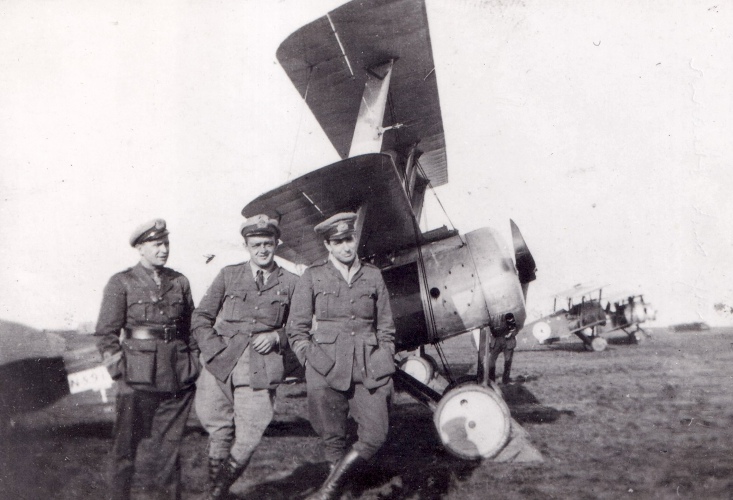
It was a tragic irony that having survived so many near-death experiences in the cockpit and served in the legendary Naval Eight of the Great War, the Canadian ace Captain D. M. B. Galbraith should die in a car crash less than three years after the Armistice, aged just 25.
By then, however, the Ontario-born pilot had not only downed numerous enemy aircraft, he had also served in the Royal Air Force, Royal Naval Air Service, and become a founder member of the Royal Canadian Air Force.
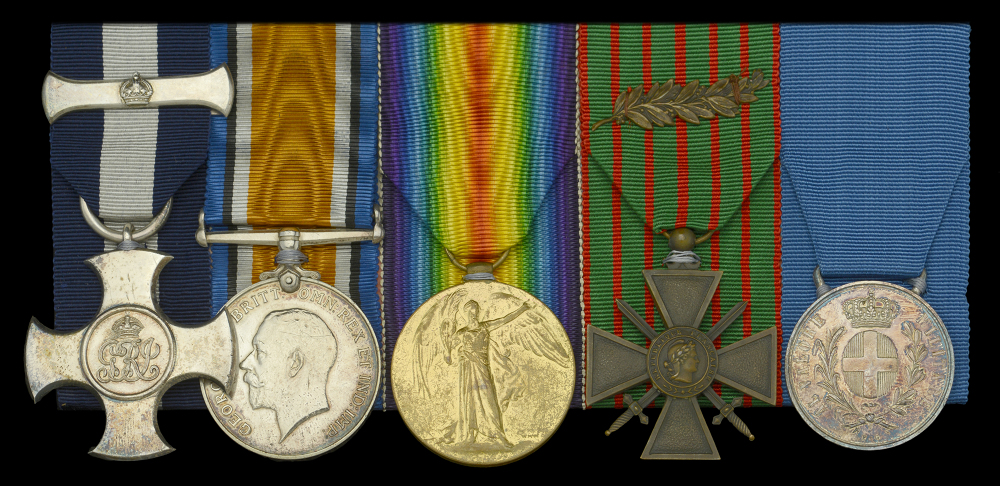
Now his exceptional Great War Canadian ace’s D.S.C. and Bar group of five come to auction in this sale with an estimate of £10,000-14,000.
Described as ‘an extremely plucky pilot’, Galbraith won his D.S.C. in September 1916 for destroying a large enemy two-seater seaplane which blew up mid-air, but not before his windscreen and gun sight were shot away by accurate return fire. The record shows that the plane probably blew up after its bombs were hit by Galbraith’s fire, and that the seaplane was probably on the way to attacking the south-east of England.
Two months later, in a typical act of bravado for which he was again decorated, he made a solo attack on a formation of six enemy aircraft, destroying one of them, driving another down and seeing off the rest who ‘gave up the fight’.
Earlier, on 21 July, Flight Sub-Lieutenant Galbraith had encountered a hostile seaplane off Ostend. Looping his machine over the German to get behind him, Galbraith attacked. “The German pilot was seen to be hit, and the machine fell in a vertical dive and broke into flames. This officer is an extremely plucky pilot and has rendered consistently good service since June 12th, 1916.”
Galbraith’s self-taught looping tactic apparently caused a stir in R.N.A.S. circles, Vice-Admiral Bacon referring to the action in a letter to the Admiralty.
Transferred to the famous ‘Naval Eight’ in October, he was immediately at the centre of action:
“On 22 October 1916, in a Sopwith Scout off Blankenberghe, dived from 15,000 to 7,000 feet and attacked an enemy seaplane (probably the one which dropped a bomb on the Nore). Having emptied two trays into the enemy, the machine was seen to nose dive straight into the sea. Pilot followed down to 3,000 feet and saw traces of the broken machine floating about.”
Galbraith fought another telling combat on 9 November 1916, when he attacked two hostile 2-seaters and killed or wounded the observers in both. But for his ‘Pup’ developing engine trouble, he may have taken matters further. It mattered not, for by way of compensation, he took out an LVG recce. aircraft at 15 yards range on the 16th.
Then, in a typical act of bravado, while on patrol east of Cambrai on 23 November 1916, Galbraith mounted a solo attack on six hostile 2-seaters at 6,000 feet, bringing down two of them and seeing off the remainder. He was awarded just two months after winning his D.S.C. On 16 February 1917, the London Gazette explained why:
“For conspicuous gallantry. On 23 November 1916, he attacked single-handed a formation of six hostile aircraft, no other Allied machines being in the vicinity. One hostile machine was shot down, a second was driven down under control, and the remaining four machines then gave up the fight and landed. In several other combats in the air, Flight Lieutenant Galbraith has displayed exceptional gallantry, particularly on 10 and 16 November 1916, on each of which days he successfully engaged and shot down an enemy machine.”
Galbraith also won the French Croix de Guerre in recognition of the same acts for which he was awarded D.S.C., while confirmation for his Al Valore Militare remains outstanding but it is believed to have been awarded for anti-submarine patrols off Italy in 1918.
The strain of combat eventually brought on Neurasthenia and Galbraith was invalided to England. Having then served as an instructor, he was posted to 66 Wing in Italy in May 1918, in which he was engaged in attacking shipping in the Adriatic.
His final wartime posting was in No. 11 (Irish) Group, during which he met his wife, and the couple returned to Canada and settled at Carleton Place, and thence in Almonte, Ontario. He was placed on the semi-permanent staff of the fledgling Canadian Air Force as a flying instructor at the School of Special Flying at Camp Borden, Ontario. Tragically, however, he was killed in a car accident on 29 March 1921.
The medal group includes his Distinguished Service Cross, G.V.R., hallmarked London 1917, with Second Award Bar; British War and Victory Medals (Capt. D. M. B. Galbraith. R.A.F.); France, Third Republic, Croix de Guerre with palm; Italy, Kingdom, Al Valore Militare, silver, mint mark crowned Z over F.G, unnamed as issued, together with a named St Andrews College sports medal and his numbered Canadian war service badge.
Included with the lot is his original Canadian soldiers’ pocket diary with extensive entries for the period January to November 1916, including descriptions of some of his combats; a card-mounted portrait photograph and copies of the Almonte Gazette from 1 and 8 April 1921, with reports relating to his death and funeral.
Share This Page