Article
26 October 2025
HEROES OF THE PENINSULA AND OMDURMAN TO THE FORE ONCE MORE
Among the bravest of the brave in battle are those who volunteer in the face of almost certain defeat and death. Singled out among them are those of the ‘forlorn hope’, men whose task is particularly dangerous and against the odds.
Such was the challenge for the volunteer group of around 100 men during the Siege of Badajoz (1812) as they led a perilous assault on the breached walls of the city.
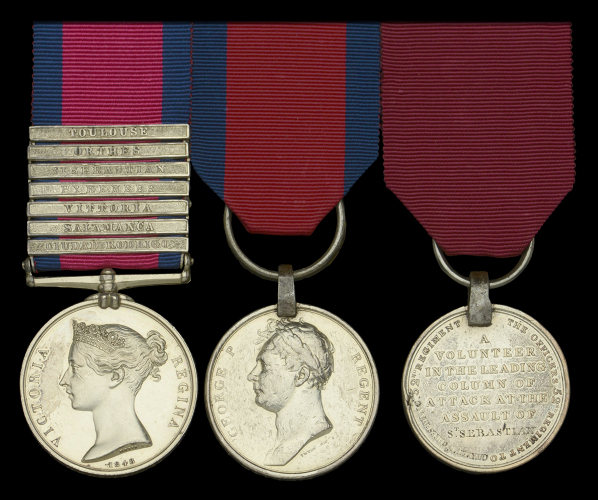
Those under the command of Lieutenant James Webster at the siege included Corporal Carpenter Cheeseman, 52nd Foot, of Canterbury, Kent, who had enlisted at Winchelsea, Sussex, in 1809, aged 20, going on to serve throughout the Peninsula campaign, and at Waterloo, before being discharged aged 33 in 1822.
The 52nd Foot ‘Forlorn Hope’ medal was instituted by a Regimental Order dated Lichfield 19 January 1820, and was awarded for Ciudad Rodrigo 1812, Badajoz 1812, and St Sebastian 1813.
From an earlier date, those who survived the forlorn hope of Rodrigo and Badajoz were distinguished with a laurel badge on the right arm, with ‘VS’ (for Valiant Stormer) placed beneath the wreath. The medals are of the highest rarity with fewer than 10 known to have survived, three of these being in the Royal Green Jackets Museum.
Thus Corporal Cheeseman’s Military General Service 1793-1814, Waterloo and ‘St Sebastian’ Forlorn Hope Medal group of three is extremely rare. His M.G.S. comes with seven clasps: for Ciudad Rodrigo, Salamanca, Vittoria, Pyrenees, St. Sebastian, Orthes, Toulouse (Corpl. C. Cheesman, 52nd Foot.). His Waterloo 1815 medal is fitted with a steel clip and ring suspension, while his 52nd Foot Forlorn Hope Medal, in silver, has the Light Infantry bugle and ‘LII’ surrounded by a laurel wreath on the obverse, with ‘31st Aug. 1813’ above. The reverse is embossed ‘A Volunteer in the Leading Column of Attack at the Assault of Ciudad Rodrigo. The Officers 52nd Regiment to Carpentr. Cheeseman Cpl. 52nd Regiment’.
The estimate is £20,000-24,000.
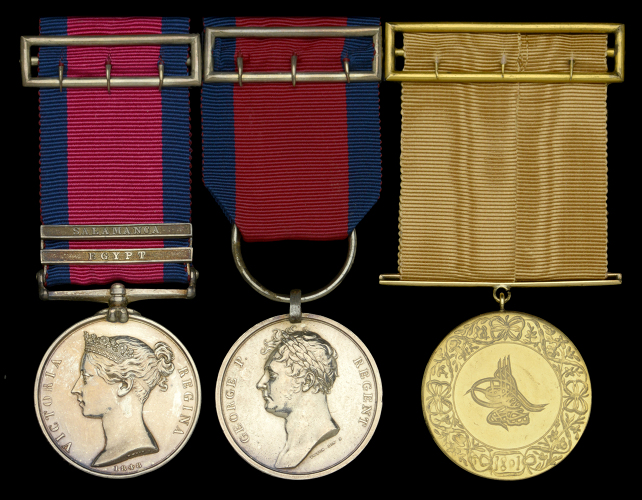
Also offered here is a fine Egypt, Peninsula and Waterloo campaign group of three awarded to Lieutenant-General J. C. Bourchier, 11th Light Dragoons, afterwards Colonel of the 3rd Dragoon Guards.
James Claud Bourchier (1780-1859) served in the Waterloo campaign of 1815, including Quatre Bras, covering the retreat on 17 June, and the capture of Paris, serving with the Army of Occupation. His group of there has a guide of £6,000-8,000.
He was the father of Lieutenant Claude Thomas Bourchier, Rifle Brigade, who was decorated with the Victoria Cross for his gallantry at the capture of the Rifle Pits, Sebastopol, 20 November 1854.
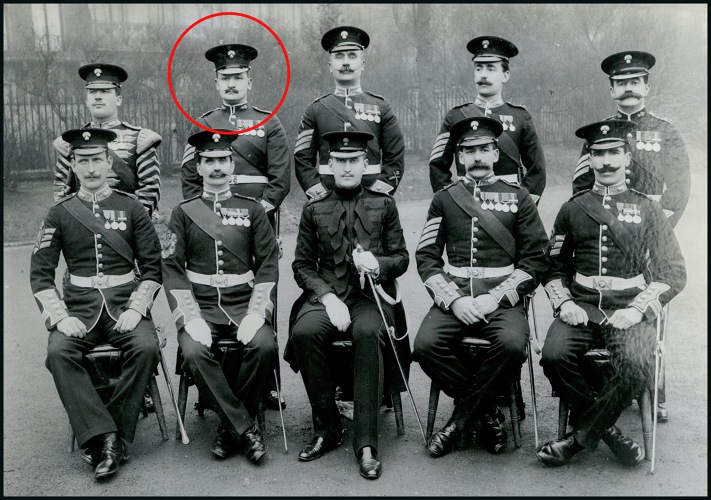
Sergeant Master Cook John. M. Brooke, Grenadier Guards, commanded one of the Maxim guns that saved the day at the Battle of Omdurman (1898) by fighting off Dervish masses rushing Kitchener’s brigades as they maneuvered in the open desert. He was also specially selected to be a pallbearer at the State Funerals of both Queen Victoria and King Edward VII.
As one of the bearer party at the funeral of Queen-Empress Victoria on 2 February 1901, Brooke (1874-1952) escorted the coffin on its gun-carriage and carried it during the funeral service at Windsor Castle, under the watchful eyes of high-ranking British and foreign military officers.
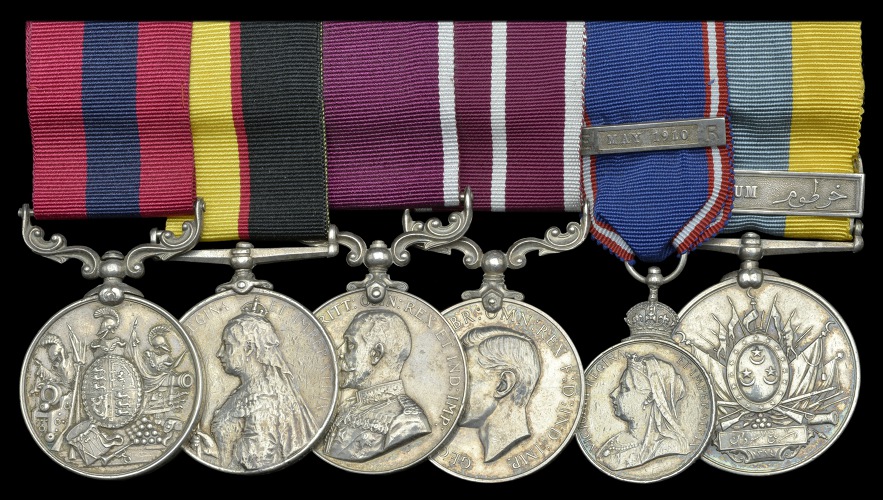
In recognition of this service, Brooke was presented with the Royal Victorian Medal in Silver by the new King-Emperor on 18 March 1901.
Brooke was again selected to be one of the bearer party of the Grenadier Guards at the funeral of King-Emperor Edward VII on 29 May 1910. He was granted the excessively rare (one of only four), specially produced Second Award Bar (dated May 1910) to his Royal Victorian Medal in Silver.
Now his unique ‘Guards Machine Gun’ Omdurman Distinguished Conduct Medal, and State Funeral pallbearer’s Royal Victorian Medal with excessively rare dated Bar group of six comes to auction with an estimate of £6,000-8,000.
Share This Page