Article
26 October 2025
HOW LIVINGSTONE INSPIRED EXCEPTIONAL DEDICATION AND SACRIFICE AMONG HIS SERVANTS
Few tales of Victorian exploration are as celebrated or romantic as that of David Livingstone and his quest for the source of the Nile. Perhaps less known, though no less remarkable, was the dedication of his native servants in returning his body to the authorities, allowing it later to be interred in Westminster Abbey.
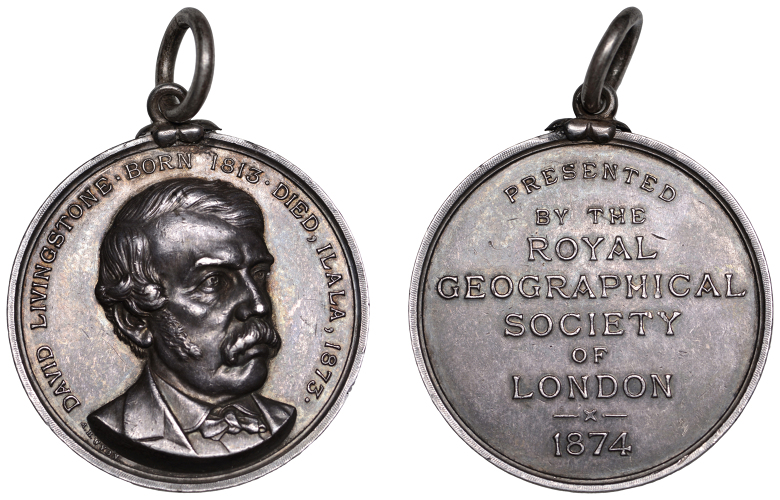
Ensuring that their dedication was not forgotten was the Royal Geographical Society’s decision to create a special medal: David Livingstone Bearer’s Medal, 1874. In all, 60 were struck.
The silver award by A.B. Wyon depicts the bust of David Livingstone three-quarters right, the reverse legend in eight lines (Presented by The Royal Geographical Society of London 1874).
The example offered in this sale was awarded to Maganga, listed as recipient no. 35 on the medal roll prepared in the British Consulate in Zanzibar. Named as Maganga – Faithful To The End, he was one of the party sent up to Livingstone by Henry Stanley in 1872. He is shown as “away with Arab traders” in August 1875, but is known to have met Stanley in the interior in May 1876.
Described by Stanley as a tall Mynamwezi, and initially as “a native of Mkwenkwe, a strong faithful servant, an excellent pagazi, with an irreproachable temper”, Stanley later tempered his opinion by saying that “he…and his weakly-bodied tribe…were ever falling sick.”
Maganga was singled out for note, however, because, as Stanley recorded, “on approaching a village the temper of whose people might be hostile to us, Maganga would commence his song, with the entire party joining in the chorus, by which mode we knew whether the natives were disposed to be friendly or hostile.”
The missionary and explorer David Livingstone set out in 1841, with his career of African exploration divided into three phases, the high point of the final chapter, to locate the source of the Nile, being his historic meeting with Henry Morton Stanley at Ujiji on 10 November 1871.
After spending four months together, Stanley left Livingstone on 14 March 1872 at Unyanyembe (Tabora) where he remained until the 56 native porters and fresh supplies which Stanley had sent up from the coast arrived to reinforce the expedition. Reaching Lake Tanganyika in October, Livingstone then made for Lake Bangweulu but by the time he arrived there in February 1873 he was seriously ill.
Pressing on despite rapidly deteriorating health, towards the end of April he could go no further; his servants built a hut to shelter him at Ilala where he died in the early morning of 1 May. After three days of mourning, his bearers decided unanimously to embalm their master’s body and take it back down to the coast from whence it could be returned to England for burial.
Going first to Unyanyembe, where they rested for a month, relays of porters carried the body through swamp, desert and forest, eventually reaching the port of Bagamoyo in February 1874.
On 18 April 1874 David Livingstone was laid to rest in Westminster Abbey
“In all, the journey had covered 1,000 miles in nine months, with the bearers facing significant danger and hardship along the way,” said Noonans’ Coins specialist Oliver Hepburn. “It is no wonder that the inscription on Livingstone’s tomb reads: ‘Brought by faithful hands over land and sea, here rests David Livingstone’.”
On 22 June of the same year the Council of the Royal Geographical Society resolved to award a special medal to all those native servants who had carried Livingstone’s body halfway across Africa the previous year.
Commissioned from J.S. & A.B. Wyon, 60 silver medals were struck and sent to Zanzibar for distribution. By the time they arrived at the end of June 1875 most of Livingstone’s bearers had long since dispersed, including 33 who had joined Stanley’s Anglo-American Expedition of 1874-7. In due course, however, many of the recipients received their medals and the details are contained in the
archives of the Royal Geographical Society in London.
Today, fewer than 10 specimens are believed extant, four of which are in institutions [British Museum, Livingstone Museum, Zambia, Blantyre Museum, Malawi, and the Royal Geographical Society]. Maganga’s medal with clip and ring for suspension, has minor surface marks, but is otherwise very fine and toned. The estimate is £4,000-5,000.
Share This Page