Article
2 October 2025
TWO MEDALS DEMONSTRATING HOW ARTISTIC EXPRESSION CAN DO JUSTICE TO SCIENCE AND TECHNOLOGY
Further highlights from this remarkable collection focus on technology and science, with two examples showing how accomplished medal design can be when tackling any subject.
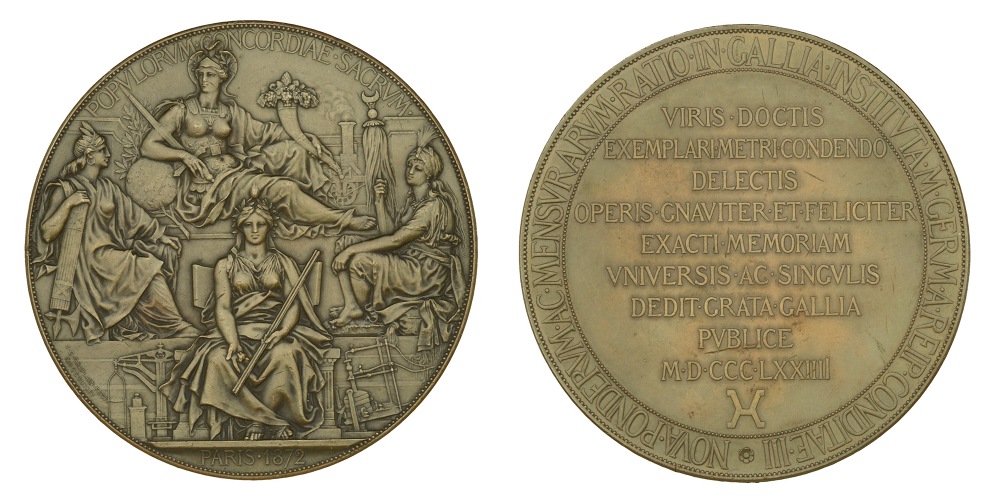
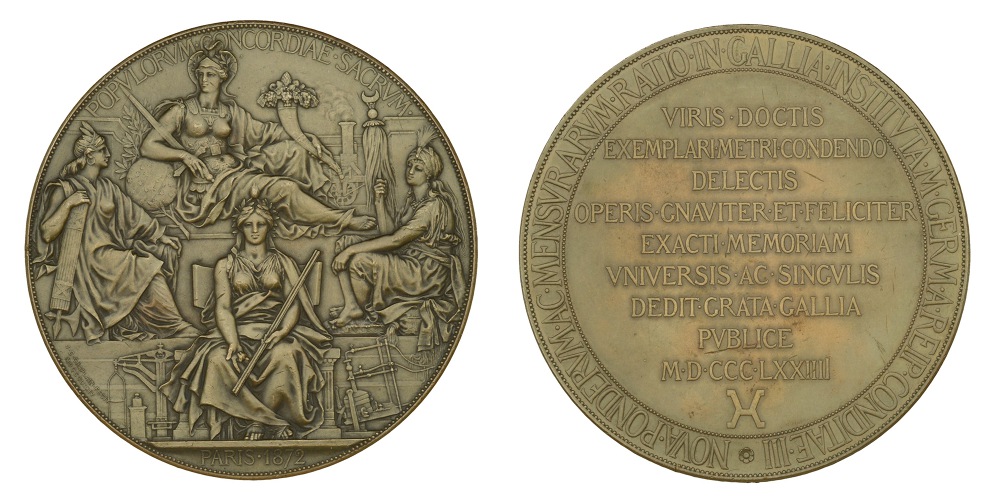
The first was designed in 1874 and struck a years later to mark the International Commission on the Metric System and its Diffusion.
The International Metre Commission, as it was known, convened under Napoleon III in 1870 and 1872 to establish international standards for weights and measures, culminating in the Metre Convention of 1875. The treaty also established the International Bureau of Weights and Measures (BIPM) in Paris to preserve the international prototypes of the metre and the kilogram. Thus a universal and standardized system of measurement was established for scientific work, trade, and everyday life.
Such an achievement called for a medal of note, and the French medallist Jules-Clément Chaplain (1839-1909) did not disappoint. Struck in bronze, it shows a seated female representing Science, surrounded by other robed females representing Europe, Asia and America, with measuring instruments at the sides. The reverse bears the legends marking the achievements, while the edge is impressed with cuivre and a bee. This is an extremely fine very rare, and most handsome medal, which comes in its original fitted green gilt-blocked case of issue. The estimate is £240-300.
Wireless Telegraphy was a later technological advance of note and also earned its own medal. Designed in Art Deco style by another French medallist, Paul-Marcel Dammann (1885-1939), it dates to 1927 and is also in bronze. Obverse shows the robed figure of Iris advancing to right, with signs of the Zodiac behind, while the reverse depicts the globe encircled by an antenna emitting radio waves, with TSF around the tablet below. The edge is impressed moneta 45 and cornucopia.
Iris, the messenger goddess of the rainbow, which was her bridge between heaven and earth, appears vas a symbol by the artist to indicate the speed with which wireless radio waves move through space.
At an impressive 98mm in diameter, it is extremely fine and very rare in this size. The estimate is £240-300.
Share This Page