Article
2 October 2025
MILITARY MEDAL AWARDED TO A 19-YEAR-OLD HERO OF GOOSE GREEN COMES TO AUCTION WITH HOPES OF £70,000
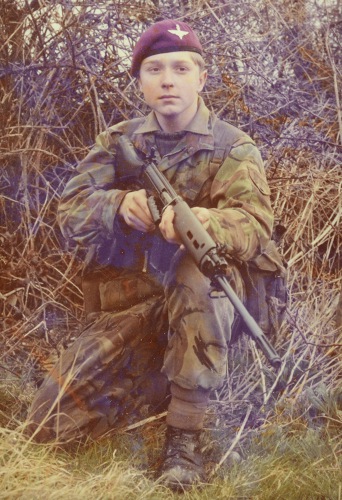
‘Baz’ Grayling was just 19 years old when he made a frontal charge on an Argentine machine-gun post. Hit at close range in his water bottle, it exploded shattering his hip.
The battle was Goose Green in the Falklands War of 1982 and Corporal B. J. ‘Baz’ Grayling, 11 Platoon, ‘D’ Company, 2nd Battalion, The Parachute Regiment, was awarded the Military Medal for his heroism.
Tragically, Grayling’s fellow Corporal and best friend ‘Gaz’ Bingley, who had joined him in the assault, was cut down by the enemy fire, the pair having launched their attack without knowing quite where the machine-guns were. They found themselves virtually overlooking the position and the two of them took the five-strong position between them. While his friend died, Grayling was slightly injured.
Of the epic frontal assault on Coronation Point in the dark hours of May 28, the London Gazette of October 8 recorded: “Private Grayling and Lance Corporal Bingley moved to a position where they thought they could put down suppressive fire. Instead, they found themselves within ten metres of the enemy. With a total disregard for their own safety they immediately attacked and destroyed the enemy machine gun position. Lance Corporal Bingley was killed, and Private Grayling continued and successfully pressed home the assault.”
Their Company commander Major Phil Neame stated, “The assault led to four casualties. One of those killed was Corporal Bingley who was very brave… Bingley was killed in the process and Grayling slightly injured. It was that sort of immediate get up and go and flair that really got us out of a very sticky situation.”
Lance-Corporal ‘Bill’ Bentley M.M., 2 Para medic, later retrieved Bingley’s body from the battlefield. “It was a moving moment for everyone,” he said. “Gaz was the first of our dead to be recovered. The story of his last few minutes of life had already reached us through Baz Grayling. They had been making a frontal charge on an Argie machine-gun post. Grayling was hit at close range in his water bottle; it exploded shattering his hip. As Grayling collapsed, still firing, they silenced the Argie MG. But as fate would have it the last few rounds squeezed off by the Argie gunner ripped through Gaz Bingley’s head, killing him instantly.”
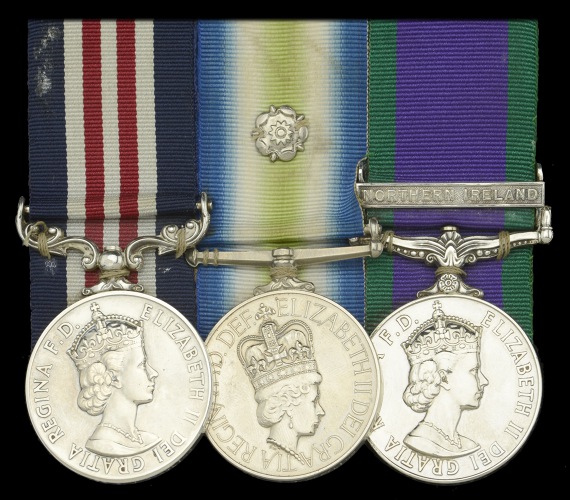
Now Grayling’s M.M group of three – to include the South Atlantic 1982, with rosette with official corrections; General Service 1962-2007, 1 clasp, Northern Ireland – is being offered for auction at Noonans with an estimate of £50,000-70,000.
Corporal G. D. ‘Gaz’ Bingley was awarded a posthumous M.M. for his gallantry at Goose Green, and his medal group appeared at public auction in 2018.
The Battle of Goose Green took place after several delays, with new orders to capture the garrison rather than simply launch a raid. Famously led by Colonel ‘H’ Jones, the most senior British officer killed in the war, who lost his life in the battle and was posthumously awarded the Victoria Cross, 2 Para Battalion (approximately 450 men) set out on their mission just after dusk on 26 May.
They had already lost the equivalent of a platoon of men to the ravages of frostbite and exposure.
Led by ‘D’ Company, they moved off the mountain and navigated, in pitch darkness, the 8-mile trek through the marshy and rock strewn terrain towards the unoccupied Camilla Creek House, in the environs of which the entire battalion, bar those on patrols, spent the following day resting and preparing their equipment. The men, now in light fighting order, were carrying their weapons, including ammunition, two water bottles and food for 48 hours. The 2-inch mortars were left behind since H.M.S. Arrow would be on hand to provide starshell illumination, but at the last moment ‘H’ agreed to bring two 81mm mortars. Radio equipment, three Milan missile firing posts and 17 missiles were also taken.
Then, in a rather shameful turn of events, the Signals Platoon, tuning into the 10am BBC World Service, realised their mission had been compromised; the news reader announcing to the world: “A parachute battalion is poised and ready to assault Darwin and Goose Green.”
Their incredulous Colonel raged incandescently, fulminating that he would sue the Corporation and the government in due course. The culprit was never found but political expediency from within Margaret Thatcher’s war cabinet was always suspected. Nonetheless, working with very little fire support and limited information about his target, ‘H’ gave the orders for the attack to his company commanders and battalion specialists late on May 27, shortly after which the various companies moved into their start line positions at the top of the isthmus, highly motivated for a fight.
It was known that the Argentine defences comprised at least three rifle companies, in addition to some Air Force personnel. Mixed intelligence gathered from previous patrols in the area did little to clarify the situation. It was, however, known that there was a system of at least 16 trenches near Darwin Hill, with more in and around Boca House and Darwin itself.
What resulted was a six-phase, night/day action, with the ground and numbers both in favour of the defenders. This did not deter the ‘Red Machine’. 2 Para were tasked with covering 14km, capturing Goose Green and its garrison (with close to 1,100 well-armed troops who were in prepared positions, protected by minefields), all within 14 hours. Grayling’s 11 Platoon was commanded by the 19-year-old Second Lieutenant Chris Waddington, known by the nickname ‘Boy Wonder’. The latter was the same age as Grayling. The 24-year-old ‘Gaz’ Bingley being the Platoon Leader.
Grayling’s ‘D’ Company started as the reserve for the attack, moving through the night with the firefights growing in noise as the day broke. It would be at Coronation Point after daybreak that ‘D’ Company would come to the fore. As often occurs in the heat of battle, the original plan for Major Neame’s men had to be adapted. They had followed ‘C’ Company as directed to their start line. However, in the darkness and with ‘.... this enormous gaggle of bodies’ it soon became clear they had overshot the mark, finding themselves not only in front of the RV, but ahead of Colonel ‘H’ Jones.
Major Neame’s account offers further detail of his Company’s action:
“The last thing I wanted was to end up ahead of ‘A’ and ‘B’ Companies and get caught up in their crossfire. So we trod a very careful path back to a known start point, found the track and sat down to wait for our battle to start.
“Fortunately ‘A’ and ‘B’ Companies were still ahead of us, but what I hadn’t taken into account was that we had got ahead of H’s Tactical H.Q. He came stomping down the track, found us and took this as a most immense personal affront that his reserve company was actually closer to the battle than he was. Suitably chastened we just sat where we were and watched him go stomping further down the track only to find himself caught in crossfire further down. By this time both ‘A’ and ‘B’ Companies had put in an attack of sorts. H. came stomping back and having been shot at, identified one position where he thought the fire came from and directed me to go and destroy it. My only difficulty was that I couldn’t really see where this position was, and he didn’t really know where it was on the map. So we called up a fire mission from the ship that was offshore, hoping it was one of the pre-targeted objectives. They gave us about two rounds and then the gun jammed on the ship, so that was a great start! We were already underway so it just became an advance to contact and hope for the best.”
Grayling and Bingley’s heroic assault came soon after.
Colonel Jones was killed while charging an enemy position, firing on it with a sub-machine gun. A desperate measure, he had taken it to overcome the enemy position and rekindle the attack, and to prevent heavier Battalion casualties.
Grayling (b.1963) later served in Belize and Northern Ireland, with further postings in the U.S.A., Cyprus and Canada. He was discharged, 8 January 1990, having served 10 years and 230 days with the Colours.
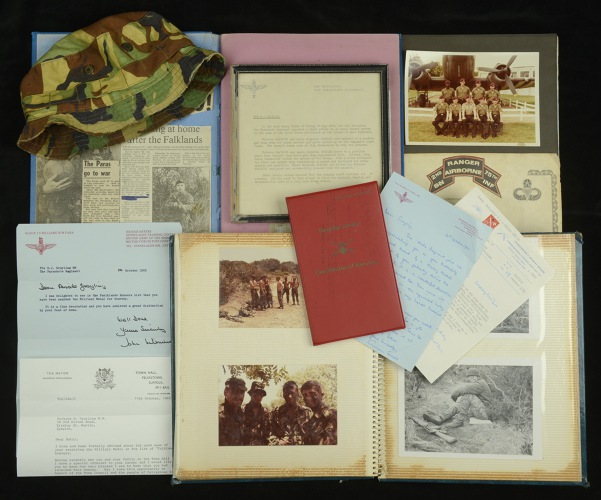
He was invested with his M.M. at Buckingham Palace, on November 25, 1982, and a reception was held in his honour by the Mayor of Felixstowe.
Share This Page