Article
13 September 2025
COUNTERSTAMPS FROM SOME OF THE MOST NOTABLE PIONEERS OF THE INDUSTRIAL REVOLUTION
Although largely focusing on Scottish Merchant Dollars, the Gietzelt Collection includes a selection of notable English examples in this sale.
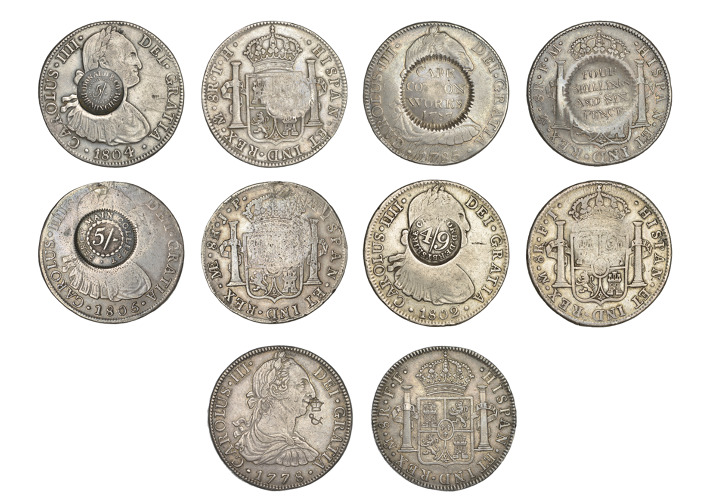
The first is a Mexico, Charles IIII, 8 Reales counterstruck for 5/- in Birmingham by Donald & Co, a hosier and clothing and hat manufacturer, listed in the Birmingham trade directories at various addresses between c.1793 and 1815. In fine condition – the countermark better – it is of the highest rarity being one of only five known specimens. The estimate is £3,000-4,000.
Thackery, Stockdale & Co was a partnership between James Stockdale (1724-1806), an entrepreneur who lived at Cark House, Joseph Thackery and Joseph Ryder, Manchester cotton merchants, Thomas Satterthwaite, a West Indian merchant from Lancaster, and Edward Hardy (†1796), an engineer from Mossley, who operated the Cark cotton mill.
One of James Watt’s first steam-engines was installed at Cark in 1786, which was in full production by 1787.
The cotton works issued its own countermarked coinage and an example from 1787 is on offer here: a Mexico, Charles III, 8 Reales of 1785 countermarked 4/6 to the reverse. About very fine and toned, the countermarks better, it carries hopes of £1,500-2,000.
Richard Arkwright was one of the pioneers of the Industrial Revolution, making huge improvements in methods of spinning cotton. He opened a horse-powered spinning mill in Nottingham in 1775 and a few years later a larger water-powered mill at Cromford, utilising the waters of the river Derwent. His son, also Richard, took over the running of Cromford and other mills in 1792 and his concern for the health and welfare of his workers resulted in numerous innovations, including the provision of circulating coinage.
One of the merchant Issues in this sale comes from Cromford, a Mexico, Charles IIII, 8 Reales, dating to 1802 and counterstamped 4/9. In fine condition, the countermark nearly very fine but with some weakness, this scarce coin has a guide of £1,200-1,500.
A counterstamped coin issued from the Revolution Mill, built on the north side of Spital Hill, Retford and opened in 1788, is a Mexico, Charles III, 8 Reales, dated 1778 and counterstamped with a crown and ampersand. The mill’s proprietor was John Cartwright (1740-1824), and the mill fell into disuse by the turn of the 19th century, after which the building was sold in 1805, and Cartwright moved to London.
The coin and countermark are about very fine and scarce, and the estimate is £800-1,000.
Percy Main Colliery, on the lands of the Duke of Northumberland between Wallsend and North Shields, was opened in 1796 and operated until 1851. There a PERU, Charles IIII, 8 Reales, dated 1805, and counterstamped for around 5/- also comes for sale here. Pierced and plugged at 12 o’clock at some time, the coin is in nearly fine condition, with the countermark a little better. Extremely rare, it is expected to fetch £1,500-2,000.
Share This Page