Article
13 September 2025
A £15,000 GEM FROM THE 1950s EXPANSION OF HSBC
The creation of the People’s Republic of China in 1949 had a dramatic impact on the international banking sector. What was to become the global finance house, the Hongkong and Shanghai Banking Corporation (HSBC), closed its China network – apart from its Shanghai branch – and turned its eyes further afield.
The 1950s saw it expand in the Middle East and acquire the Mercantile Bank, which had been active in India and China, as well as London, in 1959.
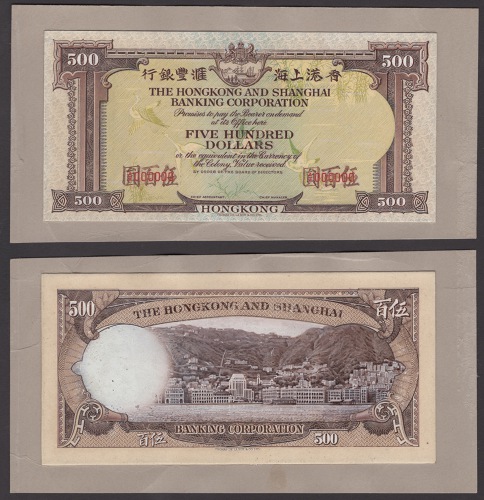
A reminder of the bank’s eminence led this auction: a beautiful hand-executed essay for a proposed $500, ND (c.1950s), serial number A/A 000000. The obverse was brown on a light blue and green under print with the bamboo and geese in flight design. Mostly hand painted with a few printed elements, the reverse carried a stunning hand painted view of Central Hong Kong Island and the HSBC headquarters in brown. Backed on card, it was a stunning essay of the highest quality, with Thomas de La Rue artwork. Unlisted it was estimated at £5,000-7,000 but more than doubled upper hopes at £15,000.
Other highlights included a State Bank of Pakistan, Haj Pilgrim Issue. An incredibly rare specimen 100 Rupees, ND (1950), serial number A//1 000000, it was produced in red print, with the denomination at left, and the star and crescent emblem at right. The navy blue overprint read FOR PILGRIMS FROM PAKISTAN FOR USE IN SAUDI AND IRAQ, while the black De La Rue ovals read Specimen Cancelled. It was also annotated Specimen No. 2.
The reverse was also printed in red, with guilloche patterns. This choice uncirculated note is the highest graded on the PMG population report, an excessively rare specimen of the highly elusive note. It sold for a mid-estimate £11,000.
Selling for the same price was a De Nederlandsche Bank, 200 Gulden, 2 July 1921, serial number AG036041. The paper showed very minor toning and had light to moderate folds across the body of note, all of which contributed to an astonishing good very fine to extremely fine condition for a note that is virtually never seen. A great European rarity, the estimate had been £5,000-7,000.
Share This Page