Article
13 September 2025
HISTORICAL DOCUMENTS THAT RECALL THE LONG-LOST NAMES OF SUFFOLK MERCHANTS
Ivor Brecker was a man of 35 when he first settled in Yoxford, the Suffolk village that was to provide a home for him and his family for more than 50 years. It was also the starting point for his life as an avid collector of tokens.
He passed away aged 90 in 2024, and this auction allows Noonans to pay tribute to his dedication and tenacity in rooting out the rare trade tokens that he first encountered in the antique and bric-a-brac shops around the county.
Many of these tokens dated to the 17th century and shed light on local figures and tradespeople of the time. Brecker found more of the rare types by engaging with specialist dealers and auctions and continued to collect right up to the end.
“He was meticulous in keeping track of sales and dealers’ offerings and improving and expanding his collection as better examples became available,” his son and daughter reveal.
“Comprising 277 pieces, the Brecker cabinet of Suffolk tokens, started in September 1969, stands alongside the county series put together by John Harris and Eileen Judson auctioned in recent decades, and those formed by Ranulphus Carthew, Keith Jarmin, David Pryke and the Norwebs dispersed by retail outlets,” says Noonans’ Special Projects Director Peter Preston-Morley. “Many pieces from those renowned collections are to be found in the following pages.”
Tokens of the type found in this catalogue were vital to the local economy at times of social and political unrest, when supplies of government-issue small change coinage were short.
The English Civil War was just such a time, as was the early period of the Industrial Revolution in the late 18th century, when the turmoil of the French Revolution and the emergence of Napoleon cast a shadow over British shores.
Most Suffolk tokens were issued by individual traders. Ipswich, Lowestoft, Southwold, Bungay, Beccles, and Bury St Edmunds were the larger market towns from which dozens were issued, while the smaller centres of Framlingham, Saxmundham, Halesworth, Dunwich, Sibton and Yoxford accounted for a handful.
Designs vary. Some show a landmark of the town, such as the house and sheep-pen which form the arms of Beccles, Bigod’s Castle for Bungay, the rose and crown arms of Lowestoft, and three ships and a lion for Ipswich. The Southwold and Woodbridge civic issues also bear the legend For the Poores Advantage.
The source of tokens in Yoxford is William Smith, who issued a farthing in 1666, and a halfpenny in 1667, for use in the village. As Ivor Brecker explained, these simple tokens helped unlock a detailed history of the issuer, demonstrating just how significant coins and tokens can be as documents of the period.
“Investigating William Smith provided me with several fascinating hours in the Suffolk Record Office in Ipswich, where helpful staff soon located his original Will, dated 25 August 1682, and a probate inventory of his goods and chattels, dated 14 August 1685,” Brecker recalled. “These amounted to £522 18s, a very large sum at the time, and indicate that William was a man of considerable substance in Yoxford at that time.”
William left everything to his wife Margaret for life, on condition she pay for the education of their daughter, also Margaret, until the age of 21. He also left an annuity of £3 per annum to his mother-in-law, Olive Smith. Robert Smith, his brother, received £20 “for the paines of being an executor”.
Further investigations among the microfiches of the parish register of baptisms, marriages and burials of that period revealed that William had married, firstly, Mary on 28 April 1631 and their daughter, also Mary, was baptised on 18 May 1636. They also had a son, James, baptised on 26 July 1642, but his wife was buried on 15 March 1658 and his daughter on 14 May 1659.
After these tragedies William married a second time, to Margaret Smith, possibly a cousin. Their daughter Margaret was baptised in 1671. William was buried on 26 July 1685 when his daughter was 14, hence the provision for her education. His son, James, was not mentioned in the Will so probably pre-deceased him.
“Unfortunately, no information was available on the location of William’s home and business, but he obviously had considerable trade interests to warrant issuing his own tokens. He was also in the position of being the person authorised to certify the completed Register books,” Brecker noted.
Brecker also investigated the family of Israel Barrel, a grocer who issued a token in Stowmarket, where in 1641 he contributed three shillings to fund a lecture at the church.
The records showed that he was also a receiver of “the rate for the discovery of witches” around the time (1644) Matthew Hopkins was the Witch Finder of the Eastern counties.
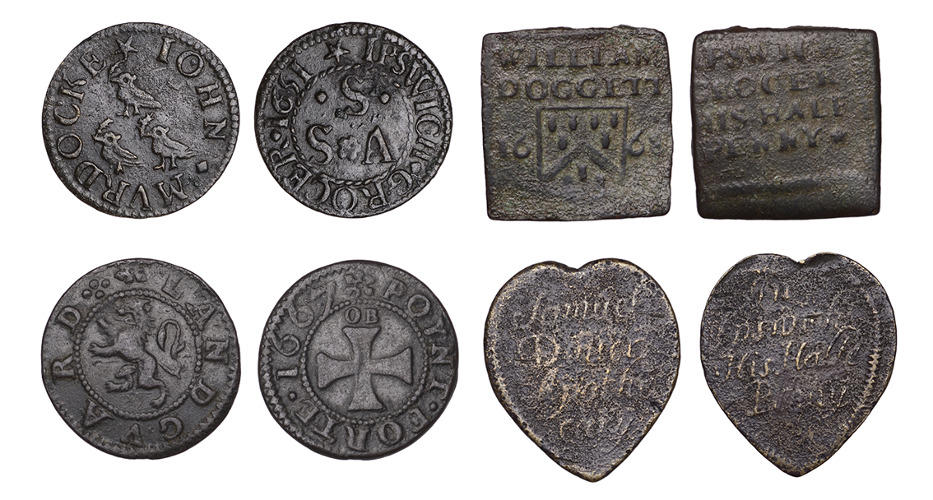
17th century token highlights from the Brecker collection here include a mule farthing (using mismatched dies) issued by John Murdocke, a grocer of Ipswich. The obverse has three doves with olive branches in their beaks, a motif from the arms of the Tallowchandlers. The reverse – in fact, a different obverse – has the initials S.A.S. [for Samuel Stannard, another Ipswich grocer]. One theory is that Murdocke married Stannard’s widow and used the latter’s dies as a base for his own token. Very fine and extremely rare, very few specimens are known, and the estimate is £200-260.
A square halfpenny, issued by William Doggett of Ipswich in 1668, has the Worshipful Company of Grocers’ Arms to the obverse and an off-centre reverse. It is weakly struck, but remains fine and very rare and comes with a guide of £150-200.
Samuel Dover, the Ipswich apothecary who issued a heart-shaped halfpenny offered here at £100-150, was probably the great grandfather of Samuel Kilderbee, the Ipswich lawyer known for being a lifelong friend of the artist Thomas Gainsborough.
A Governor’s halfpenny for Landguard Point, the fort protecting the port of Harwich, was issued in 1667, the same year as it held off a raid by in the second Anglo-Dutch (1665-67) war. The estimate is £120-150.
Share This Page