Article
20 August 2025
UNA AND THE LION PROOF COMES WITH UPPER HOPES OF £180,000 WHILE CELTIC TRIBES RISE TO THE SURFACE ONCE MORE WITH TWO HOARDS
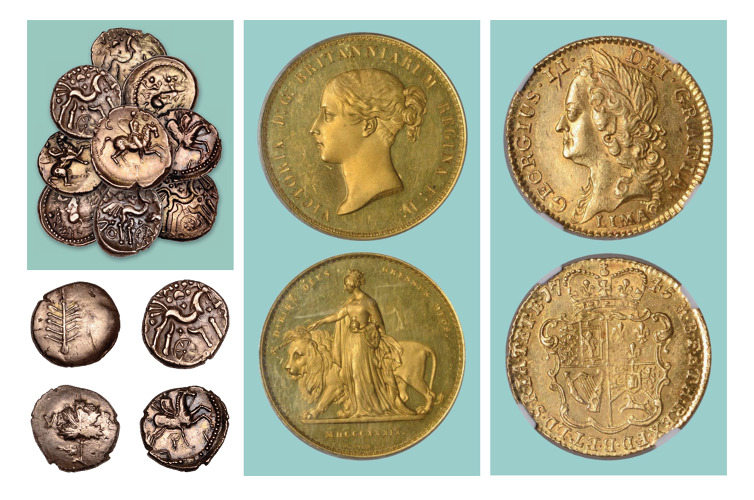
Leading the highlights in this auction is an exceptional Queen Victoria Proof ‘Una and the Lion’ Five Pounds of 1839. With William Wyon’s celebrated portrait of the young Queen on the obverse, and his drawing theme based on Spenser’s Fairie Queene to the reverse, this is considered one of the finest coins in existence.
Originally struck for inclusion in specimen sets, further examples of the 1839 date proof came from the Royal Mint, although the total number was limited to just a few hundred.
While the Royal Mint holds a total of 13 covering a range of varieties, only two are gold. The example in this sale is in good extremely fine condition and estimated at £150,000-180,000.
Two hoards make their mark in this auction, one of them, The Whitwell Stater Hoard, being the largest hoard of Corieltauvian staters found in Derbyshire. Only one other hoard has been found in the area, and it comprises two staters, one of which is broken into fragments.
Detectorists David and Judy Haigh found the hoard in two parts, four years apart. Their first find was on 12th September, 2019 and the second between 30th September and 1st October, 2023.
The couple had been searching together for seven years before they made the first major discovery, having decided to focus on parts of north Nottinghamshire and the Trent Valley owing to its Roman history – never expecting to find an Iron Age hoard instead.
In 2019, they found five staters of the Corieltauvi, a Celtic tribe occupying the East Midlands before the Roman occupation. It was “the find of a lifetime” said David who at first thought they were brass buttons. Declared Treasure, the coins found a new home in the Western Park Museum in Sheffield.
It was another four years before David returned to the find spot, a field where he had only a limited time to search, as it was due to be seeded the following day.
After experimenting with his detector’s settings, David found various items including a buckle, a token and a Cartwheel Penny. As he was returning to his Jeep, his detector started picking up a faint signal. He was very tired from a long day of digging so he almost left it but decided to persevere.
With the help of a probe, suddenly a strong signal sounded out and David describes “hands shaking, I gently wiped the earth off the round disc in my hand and revealed a bright shining 2000 year old superb gold stater”.
Despite being too tired to do the ‘Gold Dance’, he “just couldn’t believe it, I’d struck lucky again”. Judy was amazed, but understandably disappointed that she was not there at the time.
Again, it was declared Treasure and offered to the Western Park Museum, but budget constraints meant that it could not acquire the coins, and the finders have now consigned them to this sale.
After splitting the money raised with the landowner, David and Judy plan to put the money towards visiting their favourite place in the world, the Roman mosaics overlooking the harbour in Paphos, Cyprus.
R.D. Van Arsdell’s research tells us that “about the middle of the Gallic War, economic pressures caused a debasement in the value of the Celtic Stater throughout Britain”. He states that tribes either reduced the weight of the coins, debased the gold content, or produced a combination of the two. The Corieltauvi reduced the weight of their coins, to approximately 5.6-6.1 grams, as is fairly consistent with this hoard.
Highlights include a gold stater with a devolved head of Apollo right, in the form of a wreath, cloak and crescents, the reverse with a disarticulated horse left, charioteer’s arms and pellets above, and solar pellet below, with coffee bean motif behind, two pellets before, and zigzag and pellet pattern between two exergual lines below. Centrally struck on a slightly oval flan, and well-centred, toned and good very fine, it has an estimate of £900-1,200.
The Crane Valley Hoard also features in this auction, having been unearthed near Dorset in May 2022. This hoard is unusual because it comprises coins from two different non-local coin producing regions: the Western coinage is ascribed to the Dobunni – a tribe centred on the Bristol/Gloucestershire area, and the southern coinage to Verica, King of the Atrebates, who dwelt in the region to the north of Hampshire. In addition, all the coins found are inscribed issues, which are rarely found in the Dorset area.
Highlights include an Atrebates gold stater of Verica (c.AD 10-40) of the Warrior Rex type, the reverse depicting a warrior riding horse right, holding a spear. With a slight weakness below the horse, but otherwise struck on an attractive coppery gold flan, well-centred and better than very fine, it carries hopes of £800-1,000.
Pick of the Dobunni gold staters is a Catti (c.AD 1-20) example of the Tree type, with Dobunnic leaf emblem, and pellet at the base, on a plain field. The reverse shows a triple-tailed horse right, with pellets and saltires around, and a six-spoked wheel below. The obverse is slightly off-centre, but otherwise struck on a flan of coppery gold and good very fine, and rare. It has a guide of £1,200-1,500.
Among the other highlights in the sale is an extremely rare George II (1727-1760) Half-Guinea struck from the silver captured from French ships off the coast of Peru in 1745. The victors, Privateers John Morecock and James Talbot, were Captains of the Prince Frederick and the Duke.
According to Harry Apling (Seaby’s Coin and Medal Bulletin, March 1970), the booty filled 45 wagon loads after landing at Bristol before heading for the Royal Mint. Largely consisting of Pieces of Eight with the Lima mint mark, it was decided to add the name Lima below the bust of the King right, to celebrate the triumph. The condition of the Half-Guinea offered here is about as struck and the guide £7,000-9,000.
Share This Page