Article
28 July 2025
A WEALTH OF HISTORY PACKED INTO A RARE COIN FROM OXFORD
For a coin to be produced over a period of just three years and in only two places is rare enough; for it to have the equivalent modern value of around £612 is unusual, but then it is the highest denomination English coin ever produced.
Politics and circumstance created the conditions for Charles I’s triple unite, minted in Oxford from 1642/3-44, and in Shrewsbury shortly before that. Production came to an end after the great fire of Oxford.
Worth 60 shillings, or three pounds, this gold coin was more than twice the value of any other previously issued. It provided the king, who was based in Oxford after fleeing London in the Civil War, with the means to finance his military effort, buy favour and reward loyalty. Its design promoted the sovereign’s rights against the background of civil war, while its name – introduced by Charles’s father, King James I (and VI of Scotland) – was supposed to unite the two kingdoms of England Scotland symbolically and in practice.
Importantly, such high value contained in so relatively small an object was vital at a time of conflict when the king needed to move his wealth quickly.
According to R.D. Beresford-Jones in his essay for the British Numismatic Society, The Oxford Mint 1842-6 Unites and Half-Unites, a key distinction between the triple unites from the two mints is the plume: the Oxford plume has bands, while the Shrewsbury plume does not.
Even though it was produced over such a short period, it is thought that as many as 25 variations of the triple unite were hammered, some of the differences explained by the need to use several punches to impress the head and body of the King and his sword and olive branch.
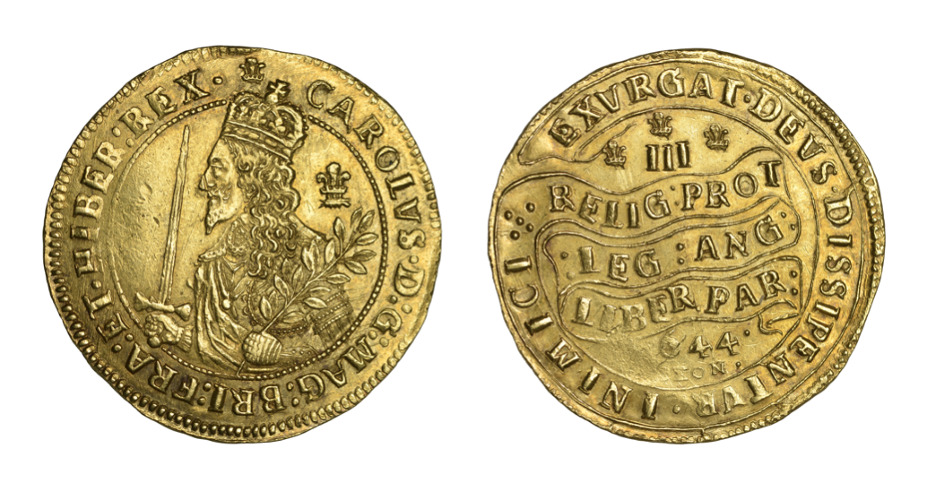
In all, around 250 are thought to survive. One appears as a highlight in this sale. Minted in Oxford in 1644, it shows the plumelet on the obverse only, with the half-length figure of the king left, holding sword and olive branch, surrounded by pellet stops. The reverse presents the Declaration (‘The Protestant religion, the laws of England, the liberty of Parliament’) in three lines on a continuous scroll, with three Oxford plumes and value (III) above, and 1644 oxon below. Surrounding it all is the legend, translated from Latin as Let God arise and His enemies be scattered.
Earlier designs, including the Shrewsbury triple unite, have the Declaration set across two lines, but the three-line scroll of the later Oxford design fits the field better.
With scattered marks and scuffs (concentrated in the obverse field), this is otherwise a good very fine coin with an excellent portrait, and peripheral orange toning. The estimate is £24,000-30,000.
Share This Page