Article
8 July 2025
EXETER MINT RARITIES FOR CHARLES I AND EARLY ANGLO-SAXON COINS DO WELL
During the English Civil War, Royalist forces established a mint at Exeter and struck Halfcrowns and Crowns there in 1642, 1644 and 1645. The mint mark was the Truro rose.
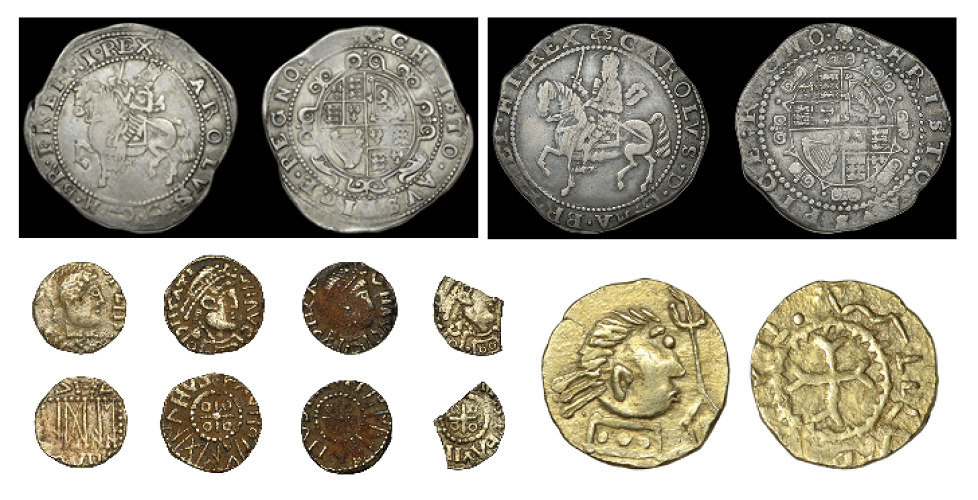
Two Charles I (1625-1649) Halfcrowns struck at Exeter but of slightly differing types did well. The first, dated 1644, depicts the King leaning backwards on a walking horse, with an oval scroll-garnished shield to the reverse. In good fine condition and extremely rare it sold for double low estimate at £6,000.
The second Halfcrown lacked the date, had a more worn figure of the king to the obverse and showed the king’s sash tied in a bow. In good fine condition and also extremely rare, it was pitched at £800-1,000 and took £1,800.
Other highlights in the 3 July auction included the Chelmsford Hoard of ‘Dark Age’ Gold Coins, dating to the Early Anglo-Saxon Period.
Discovered near Chelmsford, Essex, between 30 August and 4 September 2021, it contained four gold shillings of the Late Transitional/Pre-Primary period, struck in Kent, c. 665-675. Each was of the ‘Pada’ type, one with the PaIA variant, the others with PaIII variant.
They fit perfectly into the “pale gold types, visibly debased and sometimes appearing silver, containing 10-35% gold” described by Abramson (2022).
Generally in good fine to very fine condition, of pale yellow gold with dusty hoard patinas, the second and third coins also had surface deposits. The estimate was £2,400-3,000 and the hammer price £4,800.
An Early Anglo-Saxon Period, Substantive Gold Phase, Shilling (Thrymsa) – another detectorist find registered with the Portable Antiquities Scheme – sold as part of the Dark Age Coins from the Collection of Bruce Hearn, showed the bust right with braided hair and three diadem ties, and a band collar below ornamented with three pellets, with a trident in field before the face. The reverse had a cross fourchée in a serrated circle, with pseudo-legend around. Apart from a minute scuff on the reverse, this was a good very fine coin, the obverse of charmingly naive style and remarkably well centred and thus rare. It sold o top estimate at £4,000.
Share This Page