Article
8 July 2025
COMMANDER OF THE 18TH HUSSARS' VIVID ACCOUNT OF THE BATTLE OF WATERLOO RECALLED AS HIS MEDAL GROUP COME UP FOR SALE
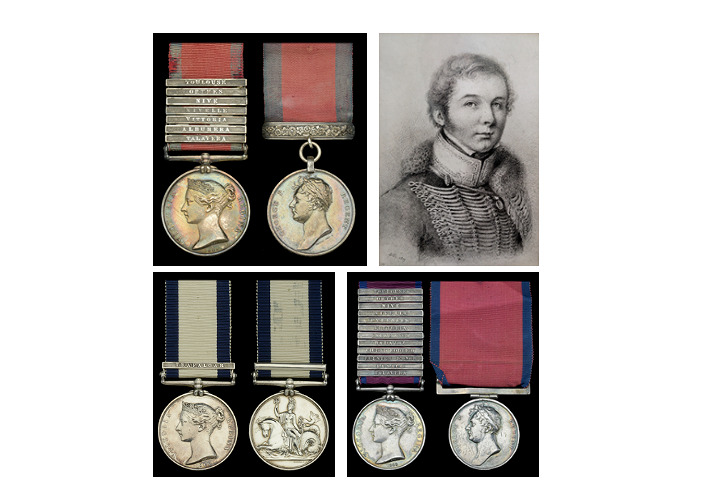
The history of George Luard is all but the story of the Peninsula War itself, as his career at the front began soon after it started and continued well after its climax at Waterloo.
Now his fine Peninsula and Waterloo pair are being offered for auction at Noonans in this auction. The Military General Service 1793-1814, has seven clasps, for Talavera, Albuhera, Vittoria, Nivelle, Nive, Orthes, and Toulouse.
Luard was born in 1788, the third son of Peter John Luard, of Blyborough Hall, Lincolnshire, Captain in the 4th Dragoons, by Louisa, daughter of Charles Dalbiac, of Hungerford Park.
Appointed a Cornet in the 4th Dragoons on 24 June 1802, he was promoted Lieutenant on 5 February 1807, serving at this rank for much of the Peninsula War before exchanging as Captain to the 18th Hussars on 21 July 1813. He became Major on 27 September 1821.
Luard served in the Peninsula, France, and Flanders, from April 1809 to the end of the war. He was at the battle of Talavera, in the retreat to the lines of Lisbon, and their occupation, and saw action at Pombal, Redinha, Condeixa, Campo Mayor, and Los Santos, as well as at the battle of Albuhera, and at Usagre, Fuente Guinaldo, and Aldea de Ponte.
He also took part in the sieges of Ciudad Rodrigo, Badajoz, and Burgos, and the battle of Vittoria; after which he served as Captain in the 18th Hussars, at the battle of Pyrenees in front of Pampeluna, the battles of the Nivelle, the Nive, Orthes, Toulouse, and Waterloo, and he served with the Army of Occupation in France until August 1819.
Two accounts of the action at Croix d’Orade, on 8 April 1814, convey the daring, courage and peril of Luard and his men as they set about capturing the bridge so that Wellington's army could proceed.
"It was reckoned the best cavalry affair that has occurred, and all the praises which we have acquired have met my most sanguine expectations, and Lord Wellington has been most kind to me," concluded Luard's commander, Major Hughes.
It is Luard's own vivid account of his part as commander of the 18th Hussars in the battle of Waterloo that provides the most fascinating memoir. Writing to his mother in the aftermath, he says: "Thanks be to God I am untouched, as well as dear John [Lieutenant in the 16th Light Dragoons]. His brigade, as well as ours, has shared in the glories of the day. They repulsed a charge of cavalry in our centre in a most gallant manner."
It was towards the close of the evening that the 18th Hussars closed with the enemy, "and I do not hesitate in saying that our gallant and desperate charge decided the fate of the day".
"We were brought from the left of the line to support our infantry on the right who at that moment were excessively pressed and rather losing ground. Our appearance rallied them and we immediately charged in to the centre of infantry, cannons, and cavalry, which were quite completely put to the rout and made dreadful havoc. This took place about dusk, and we pursued the routed enemy till dark. It will be gratifying to you to hear that I commanded the advance of the 18th and brought them to the charge on the flank of the cuirassiers."
As to his own survival, Luard writes: "How I escaped the different pokes the fellows made at me and the destructive fire of a solid block of infantry, God only knows. Out of 60 men who composed my own troop I can only muster 35. My poor horse is shot through the hind leg and I fear I shall be obliged to shoot him."
They also captured a number of cannon and "a great quantity of baggage".
"Tom Fenton is unhurt, but his regiment nearly cut to pieces. I have just heard that the eighth captain will be first. Nothing could equal their gallant charge. The French are in full retreat, Blucher moving on their flank and Bulow pressing their rear. Our army suffered very much from having resisted the attack from Bonaparte’s whole force (130,000) till 4 o’clock when General Bulow arrived with 40,000 men. Bonaparte was in the field and most of the attacks were led by Jerome. The French prisoners say their army have lost one third."
Tragedy had struck too: "I do not think we shall advance till the end of this day. So sad an account must I give you of the suffering friends that I fear it will strike you with horror. Poor young Gunning was shot but suffered little, only crying ‘Great God’ and dropped from his horse quite dead in a moment."
Placed on half-pay as Major, 8 April 1826, he died in Ireland on 19 December 1847, leaving three daughters.
The Peninsula and Waterloo pair, offered as part of The Luard and Casson Family Medals, have an estimate of £10,000-14,000.
Also at the battle of Waterloo, Talavera and Nivelle, where he was wounded in the head, was Corporal John Slater, of the 52nd Foot, later a Chelsea Pensioner.
His Military General Service 1793-1814, has 12 clasps, for Talavera, Busaco, Fuentes D’Onor, Ciudad Rodrigo, Badajoz, Salamanca, Vittoria, Pyrenees, Nivelle, Nive, Orthes, Toulouse and Waterloo 1815. The estimate is £7,000-9,000.
Only two officers and 24 men of the 52nd received the clasp for Talavera, where they served in the 1st Battalion Detachments. Only 87 medals were issued with 12 clasps including 18 to the 52nd Foot, one other with this combination of clasps.
The Naval General Service 1793-1840, of John Tart, who served as an Ordinary Seaman on H.M.S. Victory at Trafalgar and is confirmed on the medal roll as one of 118 recipients aboard, carries an estimate of £10,000-14,000.
Share This Page