Article
16 June 2025
CUMBRIAN HOARD MAY BE LINKED TO SCOTS BORDER DISPUTE IN REIGN OF WILLIAM II
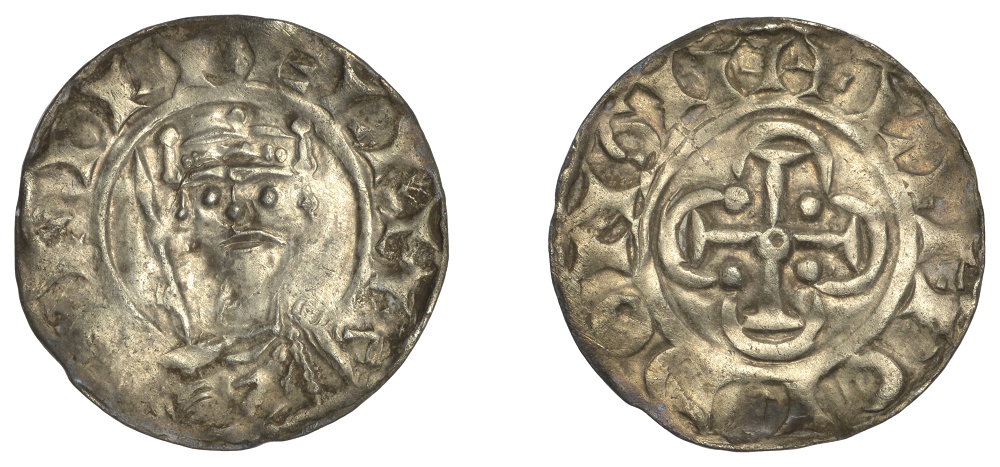
Struck by a series of mints from Ipswich and Maldon to London and Malmesbury, a small hoard of silver pennies dating to early in the reign of William II (1087-1100) appears in this sale after being found in Cumbria in 2017.
Declared Treasure under the Portable Antiquities Scheme, they have now been disclaimed and returned to the finder.
The coins are a tight chronological group of coinage in circulation at the time of burial and are, without exception, of William Rufus’s Cross-in-Quatrefoil type, conventionally dated to the period c.1089-1092.
Although carelessly struck, they are relatively unworn, and it would be reasonable to assume that they were buried in the early- to mid-1090s.
The standard of lettering and striking deteriorates quite sharply during William II’s reign, the letters A, I, M, N, U, V, all descending into a series of upright strokes. This makes attribution more difficult and many of the following identifications are therefore somewhat tentative.
William II's coins are rarer than either his father, William I (1066-87), or his younger brother, Henry I (1100-1135), who succeeded him
The find spot at Stainmore is in a remote rural parish in the Westmorland and Furness area of Cumbria near the border with County Durham and North Yorkshire, an area which in the late 11th century was disputed between the kings of England and Scotland. Having been in Scots’ hands at the time of Domesday, Carlisle (around 40 miles north west of Stainmore) was taken by the English king in 1092 and it is possible that the hoard may be associated with military movements in the area at the time.
The original report states that on discovery there were 12 Pennies, 7 cut halfpence, 2 cut farthings and 13 fragments and some coins have broken subsequently. It is unlikely that the silver content is substandard; environmental and soil conditions are the likely cause of their fragility. The lots here are all in a fragile state, and this is reflected in the pre-sale estimates.
The combined high estimate for the 13 lots is almost £5,000.
Separately, a William II Penny struck at Chichester by Edwine is expected to sell for £1,500-2,000.
Share This Page