Article
21 May 2025
HONOURS EVEN AS CIVILIAN AND MILITARY AWARDS SHARE THE GLORY AT £12,000 EACH
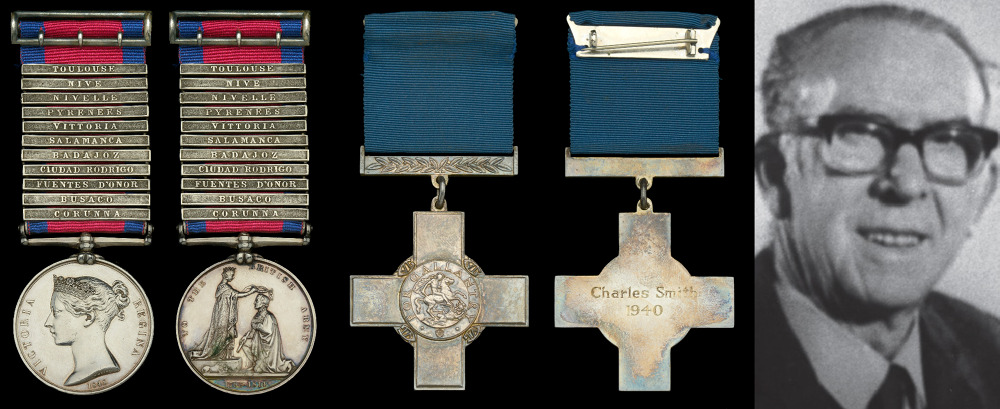
Military and civilian honours shared the limelight among the highlights of this sale, with a Peninsula War Medal and a George Cross each selling above estimate at £12,000.
The George Cross (exchange Edward Medal) was awarded to mineworker Charles Smith (1908-87), for his gallantry in rescuing a trapper miner at Askern Main Colliery, Yorkshire, on 3 January 1940; he later distinguished himself whilst employed above ground at the Stargate Colliery, County Durham, where, thanks to his keen eyes in spotting a frayed cable on a mine shaft lift on 3 February 1953, he ‘averted a disastrous occurrence’.
In a joint citation, regarding the rescue, with Gwyn Morgan [awarded the Edward Medal in Silver] and Matthew Thompson [awarded the Edward Medal]), the London Gazette of 28 June 1940 explained what had happened:
“At 10 a.m. on the 3rd January, 1940, a fall of roof occurred at a coal face in Warren House Seam at Askern Main Colliery, Yorkshire, and a miner named Charles Liversidge was buried by the fall. He was extricated some three hours later, without having suffered serious injury, through the gallantry displayed, in conditions of the greatest risk, by a rescue party.
“Morgan, the Agent of the Colliery, arrived a few minutes after the accident and took charge of the operations. With great difficulty a way was cleared under the fall, and it was found that Liversidge was completely buried, except for his head and shoulders, and that his arms were pinned by fallen rocks and by a steel bar. Morgan succeeded in removing a stone which was pinning one of his arms. Later, when one of the other men had failed, he succeeded in getting through to Liversidge and after thirty minutes’ work in the most cramped position was able to free him and to pass him through to the other rescuers. Throughout he displayed outstanding courage, resource, and leadership.
“Smith and Thompson were both close at hand when the fall occurred and at once commenced rescue operations. They took a prominent part in the dangerous work of clearing a way under the fall, and both were able to remove some of the debris which had pinned Liversidge down. Thompson attempted to get through to effect the final release of Liversidge, but was driven back by a further fall.
“The whole work of rescue was carried on in the most difficult and dangerous conditions, and slight falls occurred frequently. A further heavy fall occurred later in the day which completely closed the passage through which the rescue had been made.”
For this act of gallantry Smith also received a Carnegie Hero Trust Fund Certificate on 25 April 1940. He was invested with his Edward Medal, alongside Gwyn Morgan and Matthew Thompson, by H.M. King George VI at Buckingham Palace on 2 July 1940.
Following his Edward Medal exploits, Smith attested for the Royal Artillery, and served with 60 Regiment during the Second World War in Burma, being advanced to the rank of Sergeant. For his wartime services he was awarded the 1939-45 Star; the Burma Star; the Defence Medal; and the War Medal 1939-45. Following demobilisation in 1945, he returned to his coal industry, and was employed on the surface as a banksman at Stargate Colliery, Ryton-on-Tyne, County Durham, from 1945 to 1961.
On 3 February 1953, whilst at work at the Stargate Colliery, Smith spotted a fracture in one of the main cables on the mine shaft lift, just as the lift, full of miners, was about to be lowered down the shaft; pointing this out to the foreman, the lift was emptied and the cable replaced. In a letter to the recipient from the Colliery’s Consultative Committee, dated 19 February 1953, the Secretary of the Committee thanked him “for the manner in which you averted a disastrous occurrence ... we all realise just how close a call it was and all sections unite in appreciating your presence of mind and quick reaction to signs of danger”.
Awarded a gratuity of £10 by the Durham Division of the National Coal Board, as a token of appreciation, Smith subsequently worked in the coking industry at Derwenthaugh, County Durham, from 1961 until his retirement in 1973. Having elected to exchange his Edward Medal for the George Cross, he was invested with his G.C. by H.M. Queen Elizabeth II at Buckingham Palace on 18 July 1972, and subsequently received the Silver Jubilee Medal in 1977. He died at Blaydon, County Durham, on 25 October 1987.
The George Cross was sold with a copy of the original citation for the Edward Medal, housed in a glazed frame; two original letters to the recipient, one for the Stargate Colliery Consultative Committee, the other from the National Coal Board (Durham Division), regarding the recipient’s act in spotting the fractured lift cage cable, both dated February 1953; and two newspaper cuttings regarding the recipient’s G.C. investiture.
The Peninsula War medal awarded to Private Thomas Harding, 95th Foot, Rifles, who was wounded in the left thigh in the attack on Buenos Ayres in 1807, and in the left leg at the forcing of the pass at Vera in 1813; he also took part in the Walcheren Expedition in 1809 and was present at the battle of Waterloo in 1815.
Harding’s Military General Service lasted from 1793-1814, and his medal carries 11 clasps, for Corunna, Busaco, Fuentes D’Onor, Ciudad Rodrigo, Badajoz, Salamanca, Vittoria, Pyrenees, Nivelle, Nive, Toulouse.
In all, Harding served 25 years 95 days, which included 5 years 150 days of service in the Fencibles, and his 2 year allowance for Waterloo, at which battle he was present in Beckwith’s No. 10 Company.
Share This Page