Article
21 May 2025
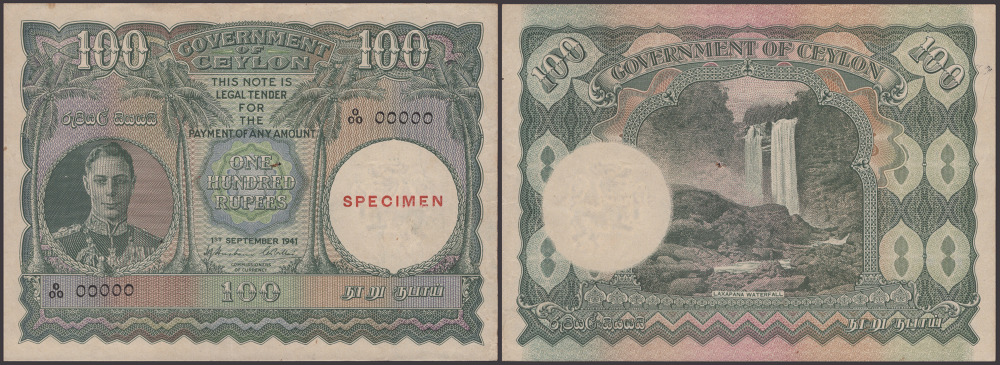
WWII EMERGENCY MEASURES IN INDIA CREATED THE OPPORTUNITY FOR SOMETHING SPECIAL, AS SPECIMEN CEYLON SERIES SHOWS
Wartime specimens from the Nasik Security Press in India are always incredibly sought after, and Noonans are offering a truly remarkable set from Ceylon in this auction.
The Ceylon Board of Commissioners of Currency relied on the Currency Note Press (CNP) of Government of India to avoid having to import currency from the UK during the Second World War – a risky endeavour.
The Board ordered a series of pictorial notes showing generic scenes of Ceylon as well as landmarks to the reverse – the 100 Rupees note, for instance, carries an impressive engraving of the Laxapana Waterfall to the South West of the island.
As with all the specimen notes on offer here from this series, the obverse depicts King George VI, left, and is dated 1st February 1941 with the serial number serial number O/00 000000 and THIS NOTE IS LEGAL TENDER FOR PAYMENT OF ANY AMOUNT.
The group includes specimens for the 1 rupee, 2 rupees, 5 rupees and 10 rupees, followed by the stunning large-format 50 rupee and 100 rupees. Examples of these notes have not come to auction in well over a decade, which amply demonstrates their incredible rarity.
The 100 Rupees carries the highest estimate at £15,000-18,000, and the group of six has a combined high estimate of £51,600.
This auction also presents the seventh and penultimate part of the Laurence Pope Collection of Portuguese Colonial Banknotes, dispersed at Noonans for over three years so far. Despite the sheer scale of the collection, interest has risen as time has gone on and 28 May will be almost the last chance to acquire these wonderful specimens, proofs and trials.
Pope began collecting paper money in January 1992, focusing on Portuguese notes after spending a holiday in Portugal in early 1993. “Later I discovered that she had issued paper money for eight of her colonies and began collecting everything I could from her overseas bank, the Banco Nacional Ultramarino,” he revealed.
Most of this bank’s notes were printed by Bradbury Wilkinson, which had a unique system of recording serial number and signature runs in their archive.
Fascinated by the printing process, Pope pursued these specimens, proofs and archival photographs and began detailed research, which ultimately led to collaboration with others to author the catalogue, The Portuguese African Paper Money of the Banco Nacional Ultramarino.
Pope lots to look out for among the dozens on offer in this latest outing include Banco Nacional Ultramarino notes for Macau and Mozambique, each guided at £1,000-1,500.
Share This Page