Article
1 May 2025
THE MAN WHO BRIEFLY STRUCK GOLD, AND A LONDON CLUB'S PROOF AGAINST GAMBLING DEBTS
The debasement of coinage has long been an issue, from the Roman era, through the Dark Ages to the Tudors and beyond.
One man who determined to do something about the state of precious metal coinage in circulation was John Berkeley Monck (1768-1834), a wealthy philanthropist and reformer who found himself in possession of the necessary fortune to follow his ambitions when he inherited £100,000 from his father in 1809.
Monck had 70oz. of standard gold coined into 200 40 shilling pieces by Edward Thomason’s Birmingham manufactory sometime in early 1812. He planned a second issue, advertising for gold to buy in the Reading Mercury on 13 April 1812. However, he was forced to abandon his scheme after the Prime Minister, Spencer Percival, intervened.
Perceval was assassinated on 12 May 1812 while leaving the chamber of the House of Commons, the attack prompted by an unconnected issue.
Monck unsuccessfully contested one of the borough seats for Reading in the general election of November 1812; he was later elected MP for Reading in 1820 and again in 1826.
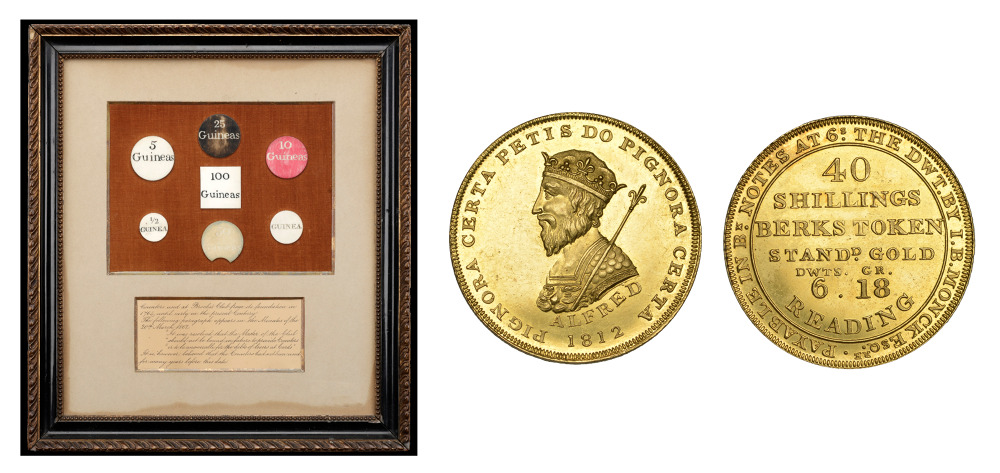
Very few of the gold 40 shillings tokens that Monck had struck in 1812 survive. This auction includes an extremely fine and rare example, with a bust of King Alfred left, and the reverse carrying the value. The estimate is £6,000-£8,000
Monck’s issue may be the star lot of this sale, but even more important is that it comes from the so-called ‘Royal Berkshire’ collection of tokens, the most important and wide-ranging cabinet for the county of Berkshire that has ever been put together by a private individual.
It was mostly put together between 1965 and 1995, with some later additions. If the Reading gold 40 shillings issued by Monck – and acquired for this collection 55 years ago – stands out, even rarer is the companion silver 40 shillings, estimated here at £1,500-2,000.
The portion of the collection offered in this sale consist of 374 17th century issues, plus a further 189 from the 18th to the 20th centuries. The owner, well-known to the principal dealers, diligently pursued opportunities to buy pieces from a range of sources. Even so, some 17th century issues continued to elude him so there are gaps in this section of the collection; he was, however, able to secure most of the pieces he needed from the fabled Norweb collection of 291 pieces that were not required for the National Collection.
“He also acquired some of the 181 tokens put together by Barzillai Lowsley, the first numismatist to study the county’s tokens in any depth,” says Peter Preston-Morley, Associate Director at Noonans. “Regretfully, the county still lacks a modern illustrated reference, and one hopes that the appearance of this collection will help to lead to such a volume one day.
The sale also includes a collection of counters for Brooks’s Club in St James’s, London. The descriptive label reads: ‘Counters used at Brooks’s Club from its foundation in 1764, until early in the present Century [i.e. 20th century]. The following paragraph appears in the Minutes of the 20th March 1862: "It was resolved that the Master of the Club should not be bound in future to provide Counters or to be answerable for the debts of losers at Cards”. It is, however, believed that the Counters had not been used for many years before this date’.
Included are the following: a white bone square 100 Guineas, 38mm; green bone 50 Guineas, 39mm; black bone 25 Guineas, 39mm; red bone 10 Guineas, 39mm; white bone 5 Guineas, 39mm; white bone Guinea, 30mm; and a white bone Half-Guinea, 26mm.
In fine to very fine condition, this very rare group is mounted in a glazed display frame with descriptive label and has an estimate of £800-1,000.
Share This Page