Article
1 May 2025
A SPY, GUNRUNNER, ADVENTURER, GREAT WAR PILOT AND BRIGADIER GENERAL – ALL BEFORE DYING AT THE AGE OF 32
He went from being a gunrunner for the early 20th century Irish Republican cause to a much decorated and beloved commander in the Royal Flying Corps, as well as a Brigadier General by the time he was killed at the age of just 32.
Such was his acclaim that, as the most senior officer of the RFC killed in action in the Great War, some twenty Generals and a thousand officers attended the funeral, which was preceded by Canadian pipers and a firing party.
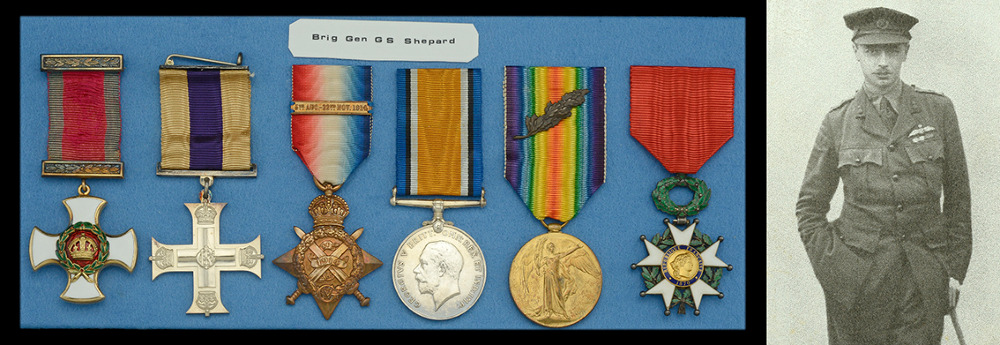
Now Brigadier General G. S. Shephard’s Great War pilot’s D.S.O., M.C., ‘August 1914’ Legion of Honour group of six is for sale in this auction with an estimate of £8,000-12,000.
‘Short as was his life, it practically covered the history of the Flying Corps. Few of those who flew to France in 1914 withheld their perishing till the last year of the War. The old army seemed destined to do what they had to do quickly and to pass away, leaving the field to the new armies and their victory. Few were able to offer a service so unique and so prolonged as Gordon. He deserved to survive...’ (Memoirs of Gordon Shephard by S. Leslie refers)
Shephard’s tale is the perfect inspiration for a novel. Perhaps this was no mere coincidence, given that he knew Erskine Childers, author of the celebrated spy thriller The Riddle of the Sands.
An adventurer, ‘gunrunner’ and gallant airman, he courted controversy by ‘spying’ on strategic places around the German seaboard immediately prior to the Great War - only to then use his yachting prowess to help Childers provide 900 rifles with 25,000 rounds of ammunition to the South Irish Volunteers on 26 July 1914.
Childers went on to become an associate of Michael Collins (and was executed by firing squad in 1922), but he also fathered a future President of Ireland. Shephard, meanwhile, a serving British Army officer, was perhaps spared further inquiry by the outbreak of the Great War. He was also one of the few pilots to survive almost the whole length of the war.
Shephard’s covert operations in Germany had come to an abrupt halt when he and a companion were briefly detained by the authorities at Emden, after injudiciously taking photographs in a sensitive area. Fortunately for him, Shephard was released without charge and returned to the UK to begin learning how to fly. He gained his Royal Aero Club Certificate (No. 215) on a Bristol aircraft at Brooklands on 14 May 1912. Shephard was attached to the Royal Flying Corps from July 1912, and initially focussed on the use of airships for military purposes.
He served as a Flight Commander with 4 Squadron, and a flew a B.E. 2 over to France as part of the original R.F.C. contingent, on 13 August 1914. He flew in the early reconnaissance missions of the Great War, including during the retreat from Mons, 24 August 1914, when his report saved the British forces from being outmanoeuvred and over run by von Kluck’s Second Corps.
His skill as a pilot and fearless courage were recalled by Captain P. H. L. Playfair:
“He was flying B.E. all through the retreat and subsequent advance. I remember one day he came back with his machine very much shot about, as owing to clouds he had been flying about for a considerable time quite low over the Huns. He had one bullet-hole through the slack of his breeches which left him quite unperturbed, except that it appeared to rather amuse him. On another occasion, when he was forced to land some distance away from his aerodrome at the end of the reconnaissance, he was held up by the French country-people for quite a long time as he was suspected of being a spy, and it was only when an Englishman in the crowd went bail for him that he got away.”
Shephard commanded 6 Squadron from March 1915, before commanding 12th (Corps) Wing throughout the Battle of the Somme, July - November 1916.
In an account of the work of the 2nd Wing during the period April and May 1915, Lieutenant Colonel C. J. Burke, the Wing Commander, says of the then Major G. S. Shephard:
“Prior to his being promoted to command a squadron, this officer performed a number of daring deeds. For these he received the Military Cross and the Legion of Honour. From the time he took over No. 6 Squadron the dash of this unit combined with a capacity for hard work have been remarkable. During the attack which commenced on April 22 he rose to a very difficult occasion. He combined considerable dash with coolness in his handling of his squadron throughout a critical time.”
Shephard commanded I Brigade, R.F.C. during the Arras offensive of 1917, and became the highest ranking officer in the flying services to be killed whilst on active service during the Great War, 8 January 1918 - when he crashed his Nieuport Scout carrying out a squadron visit.
Following the accident, General Lord Horne wrote to Lady Horne:
“He was looked upon as one of the cleverest pilots, perfectly at home in the air. It is difficult to explain the cause of the accident, but the general idea is that he must have turned faint and lost consciousness in the air.... He was in the habit of going his rounds by flying from one aerodrome to another, and he was doing so that morning. His machine was observed to behave in an unusual manner, and then to fall straight down, and he was killed practically on the spot. I am very sorry to lose him. His was a very charming personality; he was a very fine fellow.”
Loved by the men that he commanded, he was accorded a military funeral with full honours at Lapugnoy, not far from Bruay.
The medal group is offered with a rare copy of Memoirs of Brigadier General Gordon Shephard, D.S.O., M.C. edited by S. Leslie at the behest of the recipient’s mother, and privately printed in 1924. The inside cover annotated ‘Philip Shephard from Granny. June 1924’; the latter with extracts from various letters from the recipient written to family members and friends during the Great War; with copied research.
Share This Page