Article
4 April 2025
MEDIEVAL RINGS AND FINE SAPPHIRE ATTRACT TOP BIDS
Noonan’s Spring Jewellery auction showed a strong demand for both fine gemstones and exceptional historical pieces.
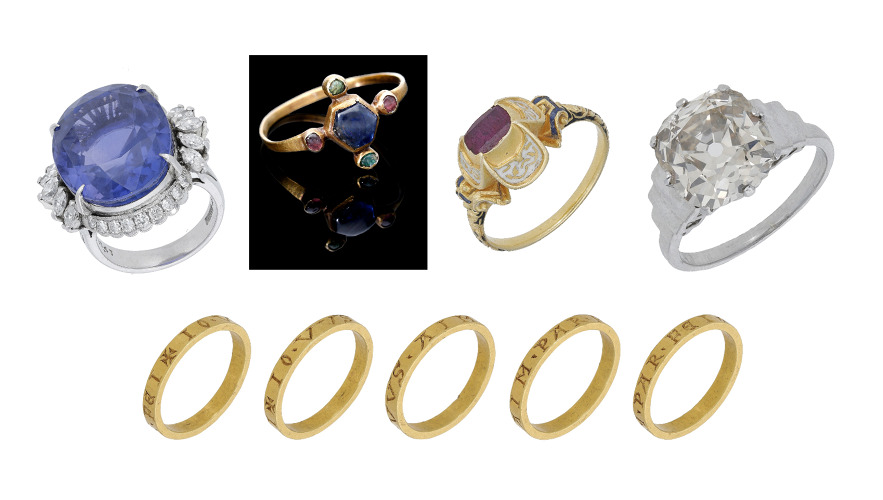
A Sri Lankan sapphire and diamond ring, set with an oval-cut blue-purple colour-change untreated sapphire weighing 31.41 carats, within a diamond set surround, led the sale. With hopes of £15,000-18,000, the beautiful sapphire ring sold for a hammer price of £28,000.
The auction included an excellent selection of early rings.
The first, with a fascinating history behind it, was The King Row Ring, an extremely rare 12th/13th century Bishop's gem-set ring, mounted with sapphire, garnets, and emeralds, discovered by a metal detectorist in October 2019 near Shipdham in Norfolk. The ring had probable links to the Bishops of Ely, who had owned a manor house and a Royal deer park in the 13th century in the locality around Shipdham. Found in amazing condition, the gemstones all still intact, this ring was disclaimed as Treasure under the Portable Antiquities Scheme.
This style of medieval ring, with a principal cabochon stone, usually a sapphire, surrounded by smaller collet set satellite stones (garnets or rubies, and emeralds), can be securely dated to the late 12th or early 13th century, and is closely associated with the bishopric. With a pre-sale estimate of £15,000-18,000, the ring exceeded the top estimate, selling to a private collector for £19,000.
Another historic piece was an exceptionally fine Medieval gold ring, The Merton Posy Ring, dating to the 13th/14th century, inscribed to the exterior in serifed capitals in a mix of Roman and Lombardic forms, reading: +IO.VVS.AIM.PAR.FEI. This translates from Medieval French as ‘I love you by faith’ or ‘I love you faithfully’.
This ring was also discovered by a metal detectorist in Norfolk, in the village of Merton, in March 2024, recorded under the Portable Antiquities Scheme and subsequently disclaimed as Treasure. Merton Hall was built in 1613 on the site of a house which had been in possession of the de Grey/de Gray family since the mid 14th century, and prior to that of their ancestors in the female line, the Baynards, to whom the property was granted at the time of William the Conqueror. In extraordinarily fine condition, and described by the British Museum in the PAS report as ‘unworn,…’, it had an estimate of £6,000-8,000 and sold to the successful bidder at £11,000.
The auction included a further rare and beautiful early ring, an Elizabethan ruby set example, circa 1560-1580, with scalloped, bezel and volute shoulders, and decorated in white, blue, and black enamel. An exquisite example, from a Private Collection, the ring sold over top estimate for £8,500.
Further sale highlights included a diamond single stone ring, the old cushion-cut diamond of light brown tint, weighing 4.67 carats, between stepped shoulders, which doubled mid estimate, selling for at £13,000.
Share This Page