Article
31 March 2025
Ancient coins from the collection of the Late Robert Erskine will be offered in a single-owner sale at Noonans Mayfair on Tuesday, April 9, 2025, at 4pm. Comprising 139 lots, the collection is expected to fetch in the region of £60,000.
The Hon. Robert William Hervey Erskine (1930-2024) was a person of wide knowledge and learning whose contributions to several fields of scholarship and the arts were outstanding. He was described in his obituary in the Times as “supreme among the post-Kenneth Clark generation of aesthetic talking heads”. The son of Lord John Francis Ashley Erskine and Lady Marjorie Erskine (née Hervey), he spent his early years between London, Madras – where his father served as governor between 1934 and 1940 – and Ickworth House, his mother’s family seat.
As Bradley Hopper, Head of the Coin Department at Noonans explains: “Robert was educated at Eton, which gave him a passion for the arts. His subsequent scholarship at Cambridge – to read archaeology at King’s – was won through a demonstration of his prodigious knowledge of Anglo-Saxon coinage as to Robert, coins were both works of art in miniature and windows into a lost world. They are artefacts that provide a tactile link to the past.”
He continued: “Following a time as a print dealer in the 1950s and 60s, Erskine pursued an ad-hoc career as a collector-cum-dealer in antiquities. This pursuit culminated in the discovery and reconstruction of the famed Sophilos vase, a signed masterpiece of sixth century Attic black-figure wear. Robert’s eventual sale of the vase to the British Museum (at a price far below market value) reflected his fundamental belief that the beautiful and interesting should be made available to all. It was this same principle that led him to print making, which he saw as a ‘democratic media of art’ and, of course, to his career as a television presenter.”
He finishes: “To many of a certain generation Robert Erskine will be most familiar as one of Kenneth Clark’s contemporaries; a worldly ‘talking-head’ whose programmes on BBC and ITV sought not only to educate and entertain – aims which were easily achieved through his relaxed, jovial screen presence.”
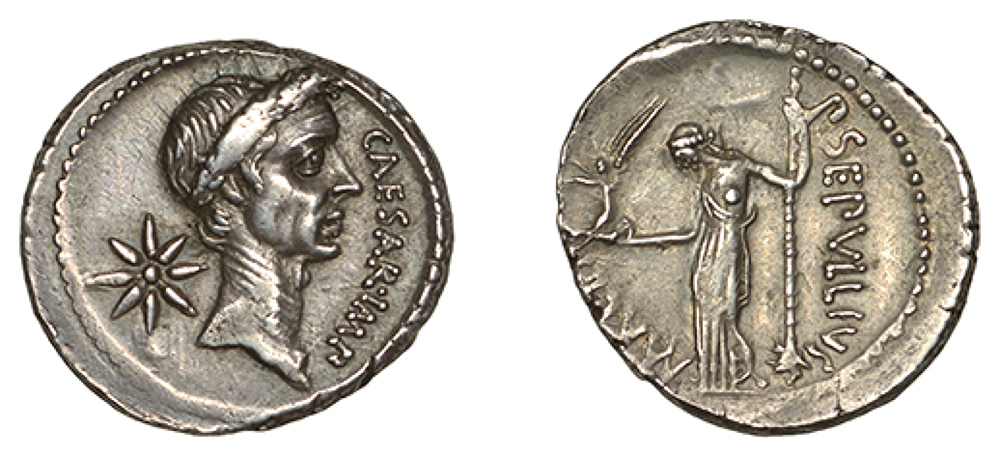
Highlights of the collection, which has estimates ranging from £60 up to £2,600 include a Denarius of Julius Caesar dating to January-February 44 and by the Roman moneyer P. Sepullius Macer. It depicts the wreathed head of Caesar with a star of eight rays behind on one side, while of the other, Venus stands left, holding Victory in her right hand and a sceptre in her left and is estimated to fetch £1,500-2,000 [lot 1584].
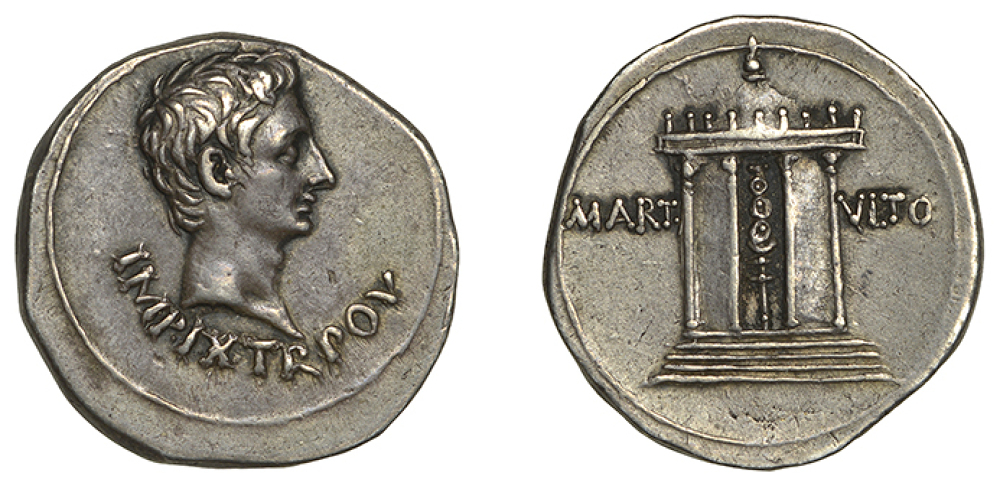
A Cistophoric Tetradrachm of Octavian, Augustus who reigned from 27 BC to AD 14, from the Greek city of Pergamon, dates to 19-18 BC and shows the emperor with bare head, while the reverse depicts a tetrastyle temple of Mars Ultor. It is estimated at £600-800 [lot 1596].
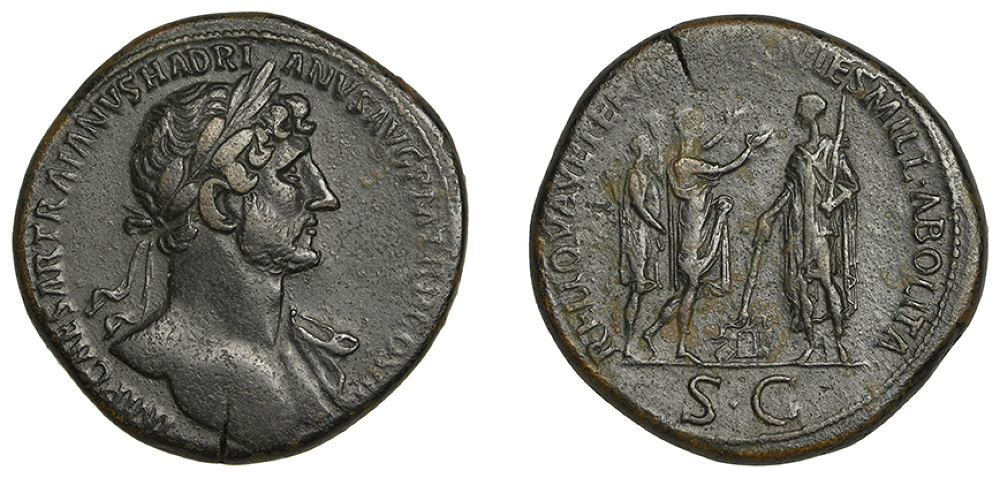
Meanwhile, a very rare and early (119-20 AD) Sestertius Hadrian of Hadrian (117-138) is also estimated at £600-800. This rare specimen of a small issue commemorates Hadrian’s writing off 9 million Sestertii in tax arrears in 119, owed to the state by private citizens. Records were publicly burned and an inscription celebrating Hadrian’s generosity was erected in the Forum of Trajan [lot 1609].
Noonans will be holding further parts of the Erskine collection, including his collection of Indian coins later this year.
Share This Page