Article
21 February 2025
HOW THE ‘PIRATE OF BASRA’ WON HIS VICTORIA CROSS
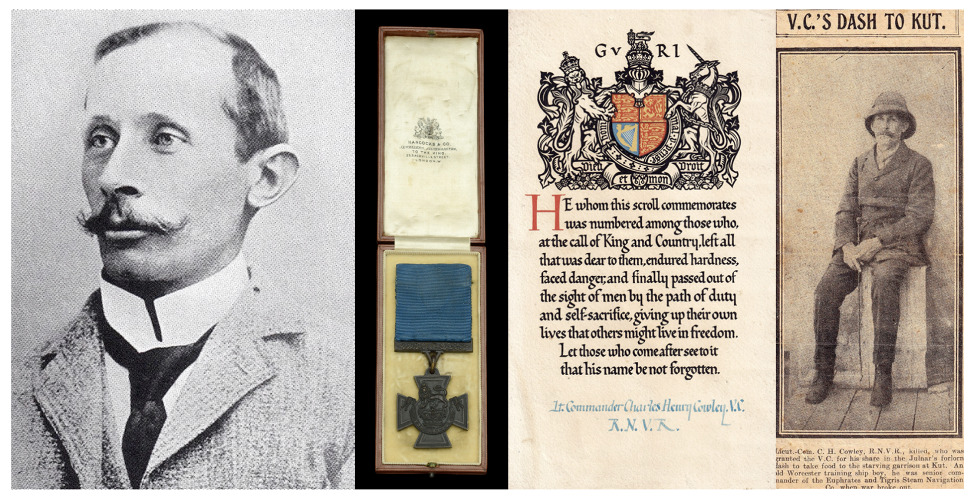
An exceptional posthumous Victoria Cross from the Great War presented to 44-year-old Lieutenant-Commander Charles Henry Cowley of the Royal Naval Volunteer Reserve – “Pirate of Basra” – comes to auction at Noonans Mayfair on 11 March with an estimate of £180,000-220,000.
The V.C. is another outstanding award from the Naval Medals Collection of the late Jason Pilalas, the first part of which sold for just over £1.8 million hammer last July.
The child of an Irishman who was Senior Captain of the Euphrates and Tigris Steamship Company, and a half Armenian mother, Charles Henry Cowley was born a British citizen in Baghdad in February 1872.
As a commercial steamer captain and then a Royal Navy ship’s captain, the fluent Arabic speaker was to become such a thorn in the side of the Ottoman Turks as he traversed the major rivers of Persia during the First World War that they sentenced him to death in absentia and dubbed him the Pirate of Basra – resulting in him flying the skull and crossbones whenever he returned to Basra. The Turks even sent an assassin to kill him in his bed. The assassin failed, but the Turks would succeed in killing Cowley in the end.
In August 1914, as commander of the steamer Mejidieh, Cowley was sent by his employers from Basra to Baghdad to evacuate all British nationals who wished to leave. His command having then been formally requisitioned by the Royal Navy, he went on to play a critical role in carrying troops back and forth on the Euphrates and Tigris.
Among the more notable operations carried out by the Mejidieh in this period was her part in shelling enemy troops during the capture of Kurnah, when she had embarked two 18-pounder guns and some gunners from the R.G.A. Cowley’s ‘meritorious conduct’ was duly noted by their Lordships and he received a special letter of thanks from the Admiralty. While during the rapid advances made in the spring and summer of 1915, Cowley’s command was a leading participant of “Towshend’s Regatta”, often acting as a floating H.Q. for the General and his staff. Later still, after the tide turned at Ctesiphon, the Mejidieh was the means by which hundreds of wounded men escaped Basra.
In August 1915, in an effort to protect Cowley in the event of capture, he was appointed to the temporary rank of Lieutenant-Commander in the “Wavy Navy”, and duly borne on the books of H.M.S. Espiegle for service with river steamers in Mesopotamia. It was at this point that the Turks dispatched their assassin to kill him on the Mejidieh. By chance, however, the knife attack one night in November 1915 seriously wounded Captain Wingate, who was occupying the bed normally used by Cowley.
When Cowley set out on the mission that culminated in his Victoria Cross, he must have been well aware of just how the odds were stacked against him.
Charged with taking 270 tons of supplies on the Julnar to the Kut garrison, Cowley and a hand-picked crew of volunteers – all unmarried men in recognition of the dangers they faced – set off from Falahiyah at 8 p.m. on 24 April 1916, covered by artillery and machine-gun fire so as to distract the enemy.
Despite this she was shelled on her passage up the river and by 1 a.m. the next day, General Townshend reported she had not arrived, and that at midnight a burst of heavy firing had been heard at Magasis, some eight and a half miles from Kut by river, which had suddenly ceased.
There could be but little doubt that the enterprise had failed, and the next day the Air Service reported the Julnar in the hands of the Turks at Magasis. Cowley, and his expedition commander Lieutenant H. O. B. Firman, R.N., were reported killed. The surviving crew were made prisoners of war.
An eyewitness account of what happened was later recorded in Stephen Smelling’s history of Great War Naval V.Cs.
Once they reached the enemy position at Sannaiyat “very heavy rifle fire was opened on the Julnar from both banks … and before we had gone much further the ship was riddled with bullets. They kept penetrating the engine-room and falling down among the engines.” Leading Stoker Cooke and Seaman Blanchard were both slightly wounded and the crew were only spared heavier losses by what Murphy described as ‘wretched’ shooting.
Surviving the encounter, the Julnar continued upriver until it arrived opposite the Turkish position along the Sinn Bank. There heavy artillery and rifle fire put the oil burners out, but no other notable damage and the steamer carried on under hostile fire.
The Turks brought guns down to the river-bank near Magasis Fort and three shells “passed clean through the ship” before another struck the bridge, killing Lieutenant Firman instantly. Cowley, standing near him at the time, was hit in the back, though not seriously.
Under heavy fire, Julnar had no room to manoeuvre or take evasive action. A shell smashed into the stern and fires flared along the top deck where piles of protective atta bags were set alight by the hail of splinters and bullets.
The injured Cowley took command in these bleak circumstances control, ploughing on through a storm of fire. For five more minutes she defied the odds, until the old mud fort at Magasis loomed up on the right bank.
Here the river broadened briefly, the strong current flowing north for almost two miles before twisting south-west for the final run-in to Kut. Julnar was nearly opposite the fort, where the river curved sharply, when disaster overtook the brave crew. Unbeknown to Cowley, an underwater chain straddled the Tigris at this point. It is not clear whether it was placed there as an obstruction or was used to operate a ferry, but the effect was the same. Julnar struck the cable head-on, the current swinging her stern round towards the right bank, where it grounded below the Magasis Fort, within sight of Kut.
Trapped within easy reach of gun batteries at the water’s edge, Cowley made desperate attempts to pull clear as shells burst around him, but to no avail. They were sitting ducks.
By the time the fire eventually slackened, Julnar resembled a sieve. Her upper decks were ‘absolutely riddled’, her crankshafts were wrecked and the bridge was scorched and scarred by fire. But her Colours were never struck. Instead, remembered Able Seaman Bond, “we watched them burn down”. Their fate no longer in any doubt, Cowley ordered a white lamp hoisted as a sign of surrender, only to see it shot away. A red lamp was raised in its place, and, soon after, the firing ceased.
Having surrendered, Cowley and his crew were taken ashore and ferried by raft to the opposite bank, where they were placed in a camp, under armed guard
Just before leaving Julnar for the last time, Lieutenant-Commander Cowley was heard by Seaman Williams to remark, “I am finished now, I shall be killed.” Initially, however, they were well treated. The injured, including Cowley, had their wounds daubed with iodine.
Cowley was later interrogated by a Turkish Staff Officer but kept back when the rest of the officers and crew were dispatched to Baghdad. His men never saw him again.
Various stories emerged as to what had happened – he had been murdered in cold blood, he had been shot attempting to escape, killed by a Turkish officer after an argument, executed as a traitor, and even murdered by Khahlil Pasha, commander of the Turkish forces besieging Kut, in a drunken rage.
Once Baghdad was captured, however, an investigation started by Cowley’s colleagues among the naval flotilla and taken up by his friends and relatives began yielding more reliable evidence. It formed the basis for the ensuing war crimes inquiry.
In trying to reconstruct his final movements, the most compelling evidence appeared to come from a captured officer, a Jewish interpreter who was attached to the Turkish 13th Army Corps when Cowley was brought ashore. Cowley “seemed quite well and was talking Arabic with the Turkish officers”.
The following morning, together with other members of Julnar’s crew, he was taken across the river to the Turkish H.Q. at Fallahiyah. There, following a heated exchange with a Turkish staff officer about his nationality, the officer left the tent and ordered a guard to shoot Cowley through the canvas.
The investigation into the exact nature of his demise was quietly wound up in 1920 and no one was ever prosecuted for the murder of the Pirate of Basra. Nor was his grave, said to be at Fallahiyah, ever located.
The London Gazette announced Cowley’s V.C. on 2 February 1917 in a joint citation with Lieutenant H. O. B. Firman, R.N.
Share This Page