Article
21 February 2025
HOW CHARLES I'S DAUGHTER PROVED A KEY FIGURE IN THE SUCCESSION
When it comes to the English Civil War, Charles I, his son – later Charles II – and Oliver Cromwell are understandably the focus of attention. But a medal struck in 1642 honours a largely overlooked but nevertheless key figure in how history and the fate of England would unfold.
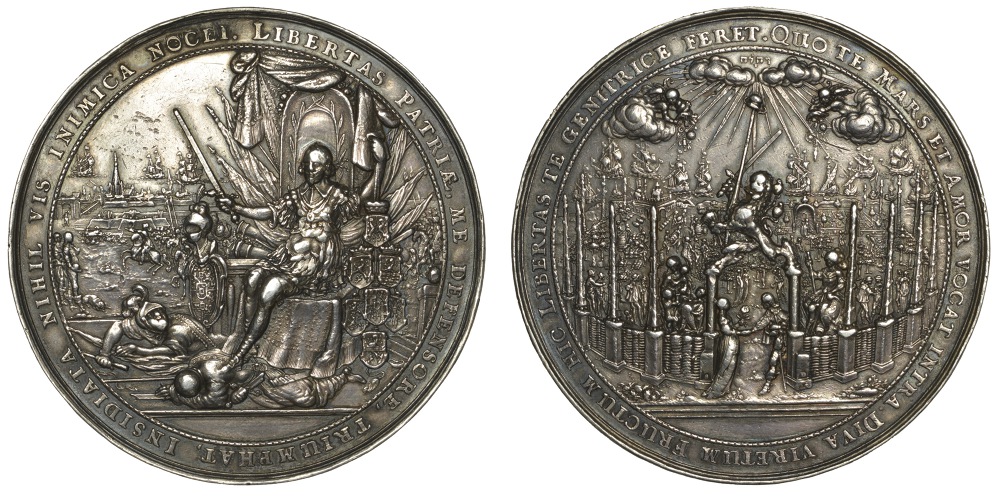
Designed by the German medallist Sebastian Dadler (1586-1657), the 73mm diameter silver medal celebrates the arrival in Holland of Princess Mary, eldest daughter of Charles I and sister to Charles II.
The medal depicts Frederick, Prince of Orange, seated left, trampling his enemies while holding a sword in his right hand and a band with shields of the seven United Provinces in his left. Prince William and Princess Mary are shown at left, with the cityscape in the background.
The reverse depicts a pleasure garden within wattled fence, the Belgic lion above the entrance at which Prince William receives his bride.
The union between the two royal households was to prove crucial. Princess Mary (1631-60), the 9-year-old eldest daughter of Charles I, was married to Prince William II of Orange, then aged 14, in May 1641 but, by the terms of the marriage contract, she was expected to remain in England until the age of 12.
As the political situation in England deteriorated, the royal family moved to Hampton Court and, in February 1642, Mary and her mother, Henrietta Maria, left for The Hague.
Mary would only end up spending a few years in the Netherlands with her husband before he died of smallpox in November 1650, and only eight days after losing him did she give birth to the future king of England, William III of Orange.
Mary supported her older brother, the future Charles II, while he was in exile and was an avid supporter of the restoration of the monarchy; however, this made her increasingly unpopular in the Netherlands, as did her strained relationship with her mother-in-law, Amalia of Solms-Braunfels (1602-75), who thought the princess young and inexperienced.
At the restoration of the English monarchy in 1660 Mary returned to London for celebrations, but contracted smallpox and died on Christmas Eve. Nonetheless, her legacy was to prove historic when the Catholic James II succeeded his brother to the throne in 1685.
Three years later, his son James was born. With the heir's succession in question on religious grounds, Mary's son William became the focus for the dissenting political class. Invited to assume the throne, within months he had landed at Brixham in Devon, and by February 1689 William had assumed the throne as joint monarch with his wife Mary, daughter of James II.
This rare medal has minor surface marks in the fields, but is otherwise very fine and toned. The estimate is £2,000-2,600.
Share This Page