Article
29 January 2025
HOW INTERNEES TURNED TO ART, HUMOUR AND SUBTERFUGE TO MAKE LIFE EASIER
Established during the Second World War, the Hay internment camps in New South Wales, Australia were used to house arrivals from Nazi Germany and Austria, mostly Jews. Hay is in Western Riverina of the state, at the centre of a huge agricultural district, Hay Plains – an isolated spot and so ideal for such a camp.
Many of those interned had already experienced internment in the UK before shipping out under threat of Nazi invasion. They suffered such poor conditions during the voyage on the ship Dunera that it led to a public outcry.
The Dunera Boys, as they became known, remained in camps 7 and 8 at Hay for nine months from September 1940 to May 1941 when they were sent off to join the Pioneers Corp of the Australian Army. Their place was taken by Italian prisoners of war.
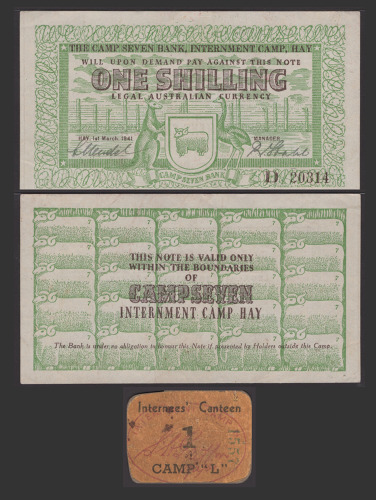
Forbidden access to Australian currency, the internees designed their own, and the Hay Internment Camp one shilling note dated 1 March 1941, that appears in this sale, would have been issued to them by their own camp mates.
The notes were elaborately designed by Georg Telscher (1904-83), a Vienna-born graphic designer from the Bauhaus who later returned to the UK to work on British propaganda,
He depicted a border of barbed wire surrounding a central shield of a sheep supported by a kangaroo and emu. The note carries the serial number D20314, and signatures of the bank’s ‘managers’, R. Stahl and A.A. Mendl.
Hidden in the design of the border of barbed wire are the monotonous song lyrics ‘We are here because we are here because we are here…’. The barbed wire at the foot of the fencing also conceals a message: ‘HMT Dunera, Liverpool to Hay’.
The reverse depicts ranks of sheep, whose woolly fleeces contain the names of some of the internees.
The notes are rare because the internees only managed to hold onto them for three months before the authorities found out about them and had them seized as illegal under Australian currency regulations.
An exceptional original example in about uncirculated condition, it carries an estimate of £2,400-3,000.
Also in the sale is a chit to the value of 1 (cent?) for Canada, Internment Camp L. Located at Cove Fields on the Plains of Abraham in Quebec, this was a temporary camp that lasted for just over three months from July to November 1940. Its purpose was to take in German refugees who were already interned in the UK following the fall of France and the perceived threat of imminent Nazi invasion.
Apart from 90 Nazi sympathisers, all proved to be refugees from Nazi Germany, with more than half of them Jewish. By September they were reclassified as refugees.
The camp returned to military use quickly after its location in the middle of a city rendered it unsuitable for internment purposes.
Surviving chits would be rare anyway, but as they were produced over such a short period, this would make them all the scarcer.
The example here carries the serial number 1557 and was issued for use in the Internees’ Canteen. Stamped and hand signed, it is expected to fetch £100-£150.
Share This Page