Article
7 January 2025
HOW SCOTLAND DID THINGS DIFFERENTLY
A number of factors set Scottish coins apart from their English counterparts. One was that old coins had to be handed in when lower standard replacements were issued in exchange, making the old coins all the rarer as survivors.
Another was weight. As Ian Stewart's 1952 paper, The Heavy Silver Coinage of James II and James IV, attests, the Scottish Acts of Parliament make it clear that in 1484 a new coinage was issued of groats current at fourteenpence each, and struck in the proportion of ten to the Scottish ounce, and thus weighing 47-15 grains Troy.
These provisions appear to have lasted until 1490, as few examples of what appear to be the latest heavy groats appear after that. They were replaced by a new light coinage of groats struck at twelve to the ounce, introduced soon after the beginning of the reign of James IV.
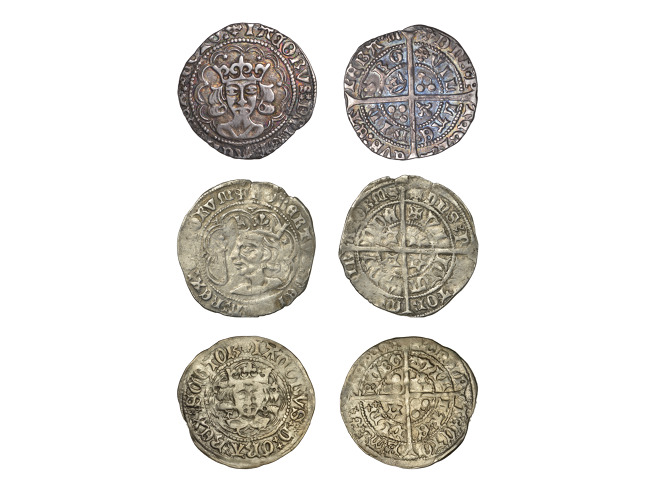
This sale includes some notable rarities, starting with a Heavy coinage groat of James IV (1488-1513). Issued from Edinburgh, the type IIb, mm. with cross fleury and stars on the four uppermost cusps, the obverse has a few hairline scratches on the bust, but is otherwise about very fine. The reverse is better and toned. A very rare coin, it has a guide of £1,200-1,500.
A groat of Robert II (1371-1390), the first Stuart king and grandson of Robert the Bruce, is a Phase 3 coin struck at Dundee – Edinburgh and Perth being the alternative mints of the period. With cross pattée, normal ‘Robert II’ head, a tressure of six arcs, trefoils in spandrels, and nothing on the sceptre-handle, it is also distinguished by the absence of a line below the bust, double saltire stops, and nothing after sctorvm. With double saltire after dns, and a plain a to both sides, it is about very fine, and extremely rare. The estimate is £1,000-1,200.
A James III (1460-1488) Light issue, groat of 1467, is of type Ic and struck at Edinburgh. On a full flan, about very fine and very rare, it is expected to fetch £800-1,000.
Share This Page