Article
7 January 2025
NO BETTER STATEMENT OF INTENT REGARDING BRITAIN’S IMPERIAL AMBITIONS
One of the most compelling aspects about currency from an historian’s point of view is its close ties to the politics of the period when it was introduced. This is notably true of the Sovereign, as Noonans’ Coin Expert, Jim Brown, explains:
“Introduced as a replacement for the Guinea after three decades of economic turbulence caused by the war with France, the purpose of the Sovereign, as its name suggests, was to re-establish the political and economic power of Britain and its Empire.”
That meant commissioning the finest numismatic artists of the day to create imposing designs to reinforce the majesty and power of the empire.
“Driven by the impetus provided by the burgeoning Industrial Revolution, the Sovereign had become one of the pre-eminent world currencies by the 1870s. Struck on the new machinery designed by these advances and employing some of the finest engravers of their age – Benedetto Pistrucci, Jean Baptiste Merlon, William Wyon, these are the industrial works of art produced for the new age.”
The Hammersley Collection of Exceptional British Milled Coins illustrates the point well and is the finest group of milled Sovereigns to be dispersed in London for over a decade. Securing the best preserved examples in outstanding condition and bringing them together to establish an unrivalled collection takes time.
As Head of Coins, Brad Hopper, notes, the collection reflects “not only the vendor’s superb eye, but also his predisposition towards patience; the latter trait being all too rarely found in the collectors of today”.
It also demonstrates the exceptional aesthetic quality of the engravers’ art: “Pistrucci’s reverse design, which adorns the cover of this catalogue, can be fairly described as iconic, while the obverse effigies, delicately engraved by Pistrucci and later Wyon, offer a charming gallery of Britain’s nineteenth century monarchs,” says Bradley Hopper.
“Further still, the series is one of layered complexity; many of the coins are easy to acquire, even in respectable grades; others are incredibly difficult, owing to their great rarity. The proliferation of overdates, error legends and die varieties offers a fascinating insight into the inner workings of the Royal Mint during the nineteenth century.”
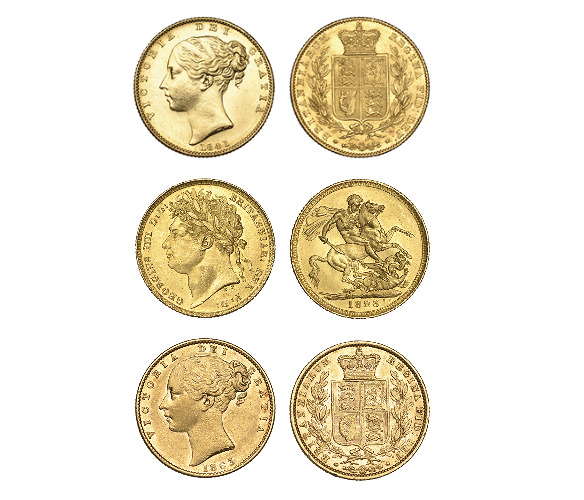
Leading the highlights is an 1841 Sovereign of Victoria (1837-1901). Engraved VICTORIA DEI GRΛTIΛ [with As unbarred], it depicts the queen left, bare headed with her hair bound up by two fillets. About as struck with bright lustrous fields, it is extremely rare, carrying the key date in the Victoria Sovereign series. The estimate is £30,000-36,000.
A George IV (1820-1830) Sovereign from 1823, featuring the king’s laureate head left, has a reverse with St George on horseback, slaying the dragon below, with the date in exergue. It has trifling bag marks across otherwise lustrous surfaces, is in good extremely fine condition and extremely rare. It has a guide of £10,000-15,000.
The third highlight is an example of the enigmatic ‘827’ sovereigns, which come in two varieties: those with the die number 22 on the reverse and those without. Both are extremely rare, the latter being perhaps the more difficult to acquire in higher grades. Die numbers for 1863 run from 1 to 26, and on this basis the ‘827’ issues can be placed towards the end of the calendar year. Noting this, in the 1970s the Royal Mint Curator G.P. Dyer proposed a link between the coins in question and a series of experiments run in November of that year, looking at the brittleness of gold. For these tests the Rothschild refinery provided several 200-ounce ingots.
Two of these bars are recorded as having been numbered: 816 and 830. The figure 827 fits neatly between the two, and it is possible that the Victoria Sovereign offered here was produced as part of the same experiment, with the gold originating from another one of the Rothschild’s ingots.
With scattered marks, it is otherwise good very fine with traces of diffused lustre. As described above, this is an extremely rare coin and is expected to fetch £10,000-15,000.
Share This Page