Article
7 January 2025
C.G.M. AWARDED AFTER SUICIDAL CHANNEL RAID EXPECTED TO SELL FOR UP TO £100,000
The attack was all but suicidal, with just five out 18 airmen – and no aircraft – returning to tell the tale. But the raid to prevent enemy shipping breaking out of Brest Harbour in what became known as the ‘Channel Dash’ made the sacrifice essential to the war effort.
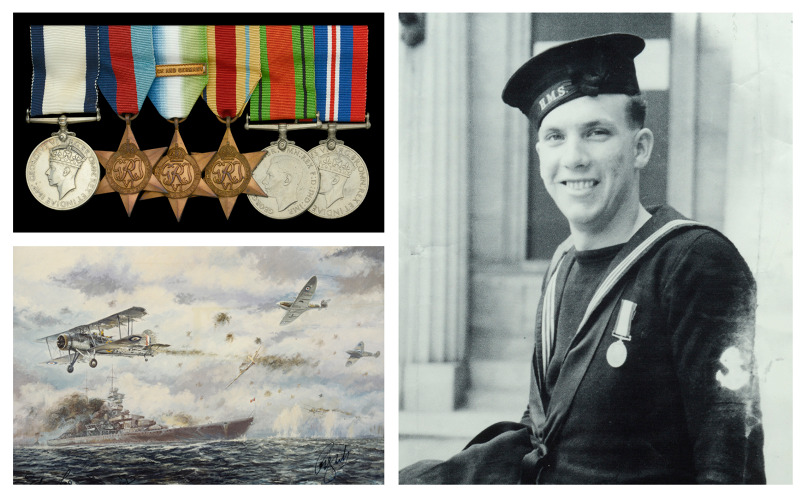
Now Noonans present the unique ‘Channel Dash’ C.G.M. group of six awarded to Chief Petty Officer (Air) D. A. ‘Don’ Bunce, a Telegraphist Air Gunner in 825 Naval Air Squadron, Fleet Air Arm, who was one of the five who made it back. The estimate is £80,000-100,000.
The extreme peril the crews faced on 12 February 1942 is no better conveyed than in the January 2003 Daily Telegraph obituary for pilot Pat Kingsmill, who also survived the raid:
“Kingsmill, who was following Esmonde, flew so low that he was hit by ricochets from the surface of the sea as he pressed through the smoke and bursting shells. He watched Esmonde’s aircraft erupt in a ball of fire and then his friend Brian Rose crash into the sea, before he turned towards the Prinz Eugen at a range of 2,000 yards. Kingsmill had received the first of several wounds, a hit in the back. His observer, ‘Mac’ Samples, had blood running from his boots, and his leading telegraphist air gunner, Don Bunce, had his seat shot away, so that he had to brace his legs to avoid falling into the sea.
“Swordfish W5907 had one wing on fire, it had engine damage, and the controls were becoming increasingly sluggish as Kingsmill turned full circle to avoid enemy fighters, then steadied up for his torpedo drop. Prinz Eugen manoeuvred violently to comb the torpedo track which just missed astern. As Kingsmill turned away, his Swordfish was hit again, detonating its distress flares. Trailing ragged fabric streamers and with gaping holes in virtually every part of its wings, fuselage and tail, he tried to prevent it stalling before ditching.”
By the time he joined the raid, Bunce, who was only 20 years old at the time, was already a veteran of a celebrated Swordfish attack against the Bismarck in May 1941, when his pilot dropped to 100 feet in the face of a ‘very vigorous and accurate barrage of heavy and light A.A. fire’ – and indeed of the loss of the Ark Royal.
As he and the rest of the sortie approached in their aged Swordfish bi-planes, they faced curtains of flak and relentless cannon shell fire from the newly introduced single-engine fighter Fw 190s – aircraft with a top speed of almost three times that of the Swordfish.
The Swordfish targets were the battle cruisers Scharnhorst and Gneisenau, and the heavy cruiser Prinz Eugen, which were covered by the Fw 190s, six destroyers and 34 E-boats, and a mass of Me 109s.
Bunce’s armament amounted to a ‘feeble’ .303 Vickers machine-gun and ‘every Naval swear word I could muster’.
Of the six Swordfish that went in, none returned, just five airmen out of 18 surviving to tell the tale – all plucked from the icy coastal waters after their planes crashed or ditched. The force’s leader, Lieutenant-Commander Eugene Esmonde, D.S.O., R.N., was awarded a posthumous V.C., a distinction which recognised the valour of all of 825’s participating aircrew:
“Their aircraft shattered, undeterred by an inferno of fire, they carried out their orders, which were to attack the target. Not one came back. Theirs was the courage which is beyond praise.”
Bunce’s C.G.M. was announced in the London Gazette on 3 March 1942:
“Naval Airman First Class Donald Arthur Bunce, FAA/SFX. 631, who was Air Gunner in the Swordfish aircraft piloted by Sub-Lieutenant Kingsmill. With his machine on fire, and the engine failing, he stayed steadfast at his gun, engaging the enemy fighters which beset his aircraft. He is believed to have shot one of them down. Throughout the action his coolness was unshaken.”
Of all the actions taken to counter the enemy fleet’s progress in breaking out of Brest, the strike mounted by the six aircraft of 828 N.A.S. under by Lieutenant-Commander Eugene Esmonde, D.S.O., R.N. stood out.
“In my opinion,” wrote Admiral Sir Bertram Ramsay, Flag Officer Dover, “the gallant sortie of these six Swordfish constitutes one of the finest exhibitions of self-sacrifice and devotion to duty that the war had yet witnessed.” Admiral Otto Ciliax of the Kriegsmarine was equally impressed, writing in his diary: “The mothball attack of a handful of ancient planes was piloted by men whose bravery surpasses any other action by either side that day.”
What made the sacrifice all the more poignant and courageous was that the crews were well aware of what they faced before they set out.
At R.A.F. Manston, when the call to arms arrived in the late morning of 12 February 1942, Esmonde didn’t mince his words. He told his aircrew, “Fly at fifty feet, loose line astern, individual attacks, and find your way home.” But Manston’s station commander, Tom Gleave, was so convinced of Esmonde’s pending fate that he stood at the end of the snowy runway to salute each of the Swordfish crew as they took off soon after midday. He later wrote of his meeting with Esmonde that morning:
“He knew what he was going into. But it was his duty. His face was tense and white. It was the face of a man already dead. It shocked me as nothing has ever done since.”
Share This Page