Preview Catalogue


 Create new list
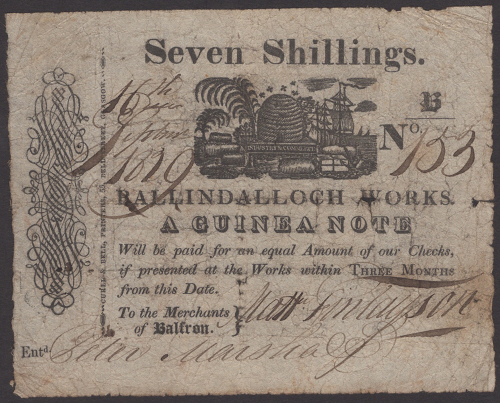
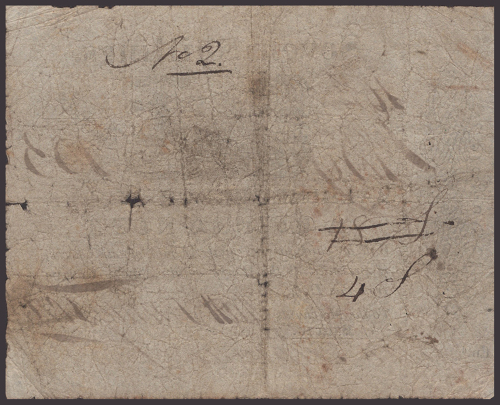
Scotland, BalFron (Lanarkshire), Ballindalloch Cotton Works, a 7 Shilling check, 16 September 1829, serial number B153, reverse no. 2, Matthew Finlayson signature, beehive vignette at upper centre (Hodge Safety in Numbers, Table 1, 2.11, this item; PMS PR 31). Various splits and pinholes across body of note, ink annotations on reverse, very good, rare, being one of fourteen specimens noted by the vendor £300-£400
Philip Wells, Banking Memorabilia, Carlisle, 30 September 2008, lot 163
This and the following lot represent a curious and slightly obscure closing note for the Merchant issues of the early nineteenth century. The production of countermarked dollars by the Ballindalloch Works probably came to an end c. 1810, whilst the series as a whole appears to have ceased in the late 1820s, shortly before these checks began to appear.
Two denominations were issued, both represented in the this collection: Five and Seven Shillings. The choice of paper must reflect not only the general silver-coin famine seen throughout these islands at the time, but more than that, the dire financial situation of the issuing authority.
Each check carries an issue date, hand-inked on after printing. Notice is given below that once issued to workers and spent amongst the ‘the Merchants of Balfron’, said checks were to be returned to the Works and exchanged within three months of the given date. All of the surviving notes appear with dates between September 1829 and March 1830.
The same notes also carry what appear to be serial numbers, ranging from 100-200. Quite confusingly, however, these numbers do not appear in a simple sequential order, and appear to show no strict relationship to the dating of the notes. Indeed, a sample of just 20 notes provides one duplicated serial number. Macmillan put forward the proposal that ‘the numbers might correspond with pages in a ledger.... when a note was returned... .a record (would be) made on the relevant page’; a charming theory, which may help explain the irregularities of this intriguing series.
The remarkable circumstances by which the current note (and indeed, perhaps all known specimens) survived was explored by the vendor in an post on the BNS Blog. At the centre of it are two court cases. The first brought by John Reid Miles, teacher at the Cotton Works School, against the Work’s upper management for assault. The second was brought a year later in November 1830, again by Miles against the Works. On this occasion Miles’ complaint was that the Works refused to reimburse him for thirty six outstanding checks, presumably due to the animosity between the parties. Of particular importance for our purposes is the fact that the records give explicit details of one check; a Seven Shilling piece, with the log number 153. That is almost certainly one and the same as the that piece offered for sale here. This court case highlights why these checks have survived; they were all presented to the court (36 in total) and individually numbered on the reverse. 18 examples of the Seven Shilling check are known.
For further information see E. Hodge, Ballindalloch Works Notes: Safety in Numbers?, Coin News, November 2010, p. 69-72 and E. Hodge, Ballindalloch Works Checks: Contemporary Documents Discovered, British Numismatic Society Blog post 009, 12 July 2018
Share This Page