Preview Catalogue


 Create new list
The Alloa colliery, owned by John Francis Erskine of Mar, was run by his mine superintendent, Alexander Bald (†1823). Erskine was a relatively enlightened employer for the times, In the early years of the 19th century he abolished the practice of miners’ wives carrying the mined coal to the surface - substituting iron narrow gauge railways and carriages instead.
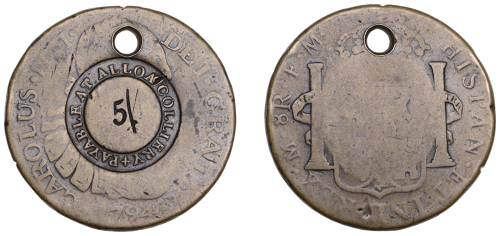
Scotland, Alloa (Clackmannanshire), Alloa Colliery, a contemporary base metal counterfeit of MEXICO, Charles IIII, 8 Reales, 1794fm, Mexico City, obv. countermarked + payable at alloa colliery around 5/ incuse, 23.16g/12h (Manville 5; Hodge 005aS.014a, this coin; KM. CC1). Holed at 12 o’clock, host about fine, countermark nearly very fine £500-£700
Glendining Auction, 23 February 1983, lot 107; Glendining Auction, 6 June 1991, lot 1029; N. Brodie Collection, DNW Auction 55, 8 October 2002, lot 226.
21 known with 11 in institutions. The ‘population’ figures given here are taken from the latest edition of An individually numbered list of all known Merchant Countermarked Silver Coins used in Great Britain, c. 1780-1830 and are correct as at April 2024.
All the existing countermarked issues of this business occur on base metal counterfeits, possibly made in Birmingham. If they circulated as intrinsic coins, this would suggest a period of between 1800-1810. However, it is possible that these pieces did not pass as genuine coins but were issued as a purely token coinage, only acceptable in the Colliery and its environs. If so, these are the only instance of this arrangement in the whole ‘silver’ series [Manville pp.12-13].
Share This Page