Auction Catalogue




 Create new list
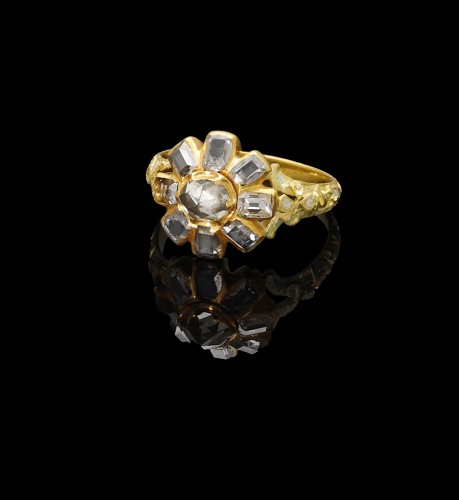
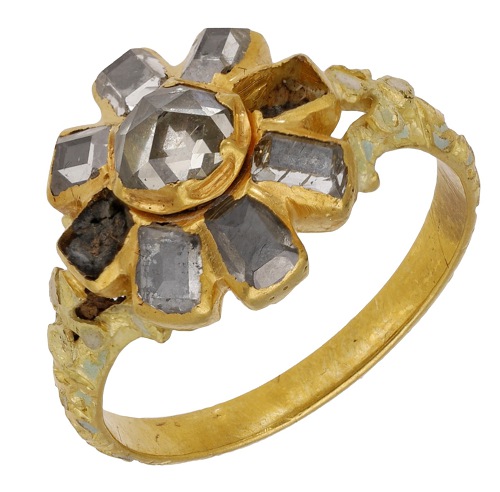
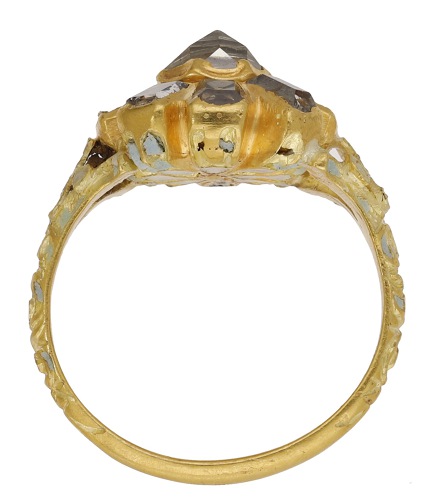
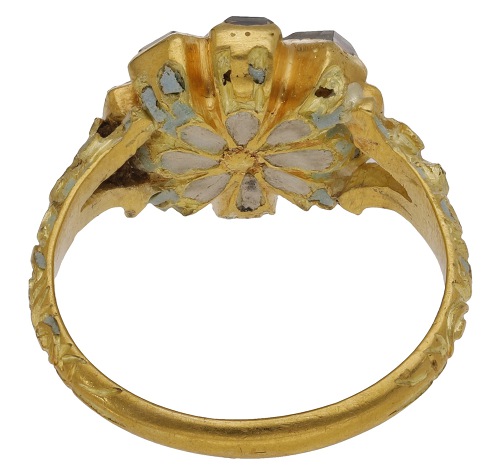
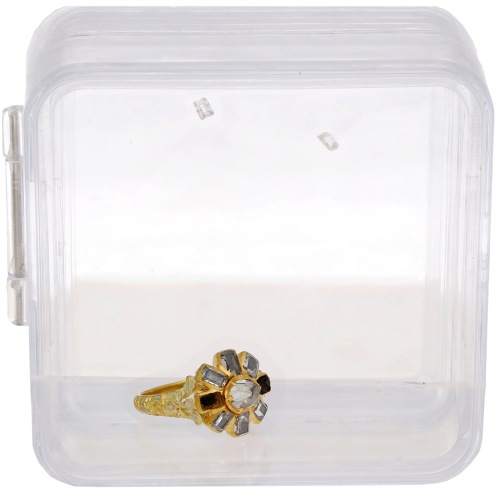
A late 16th - early 17th diamond and enamel ring, the flowerhead bezel composed of a cluster of eight ‘hogback’ diamonds (two loose) around a central rose-cut diamond, the underside of the bezel decorated with a flowerhead in turquoise and white enamel, between shoulders with applied quatrefoil flowerheads to a scroll and foliate engraved band with traces of further turquoise and white enamel, ring size K, bezel diameter 13.2mm. £15,000-£20,000
This lot is a detectorist find and is registered with the The Portable Antiquities Scheme. The find number is WMID-15FCDD.

View Find on
PAS Website
This ring was a detectorist find, discovered in the parish of Wormington, near Evesham, Gloucestershire, in November 2024. It is recorded on the Portable Antiquities Scheme database, ref: WMID-15FCDD, and disclaimed as Treasure, ref: 2025 T300.
Two diamonds are loose from their mounts. One diamond came loose and fell into his hand as the finder, Mr Jones, lifted the ring from the earth. It was clear a second setting was also vacant. Mr Jones had the forethought to collect all the soil around the find site. Having previously attempted gold panning, he had suitable equipment to hand - he washed and sieved the retrieved soil and found the missing diamond.
According to a PMI test on the XRF Analyzer, the gold is testing as 19.2ct. This exact gold standard was set by Edward I in 1300; goldsmiths were forbidden to work gold of less than “the Touch of Paris”, being 80% pure gold (or 19.2ct).
Early 17th century baroque taste required grand rings to make an impression from a distance. Fashions in diamond rings moved from solitaires towards groups of small stones arranged in decorative patterns: rosettes, pansies, crosses, fleur-de-lys, etc. For similar examples, see the portrait of Queen Isabelle of Spain, by Rodrigo de Villandrando, c. 1620, (Museo del Prado, Madrid) and the portrait of Elizabeth van de Aa, by Thomas de Keyser, 1628, (Musee de l'Hotel Sandelin, Saint-Omer, France).
Herbert Tillander notes in the 16th century ‘hogback-cut’ diamonds often served “as ‘petals’ of Rosettes....The pavilion was often given four facets and a culet, as in a Table Cut, and the ridge of the crown could also be flattened into a narrow Table facet.”
This ring was discovered in Wormington, near Evesham, situated 4 miles from Broadway on the London to Worcester road. Two important manor houses, extant in the 16th century, were situated within 5 miles of Wormington. The first, Snowshill Manor, was given by Henry VIII to Catherine Parr upon their marriage in 1543. The estate passed to Francis Bulstrode MP, and in 1561 was purchased by Henry Willoughby. The second, to the west, is Wickhamford Manor, originally belonging to the Abbey at Evesham. Seized during the Dissolution of the Monasteries, in 1562 Elizabeth I granted it to Thomas Throckmorton, MP. In 1594 Wickhamford Manor was purchased by Sir Samuel Sandys (d. 1623), MP, son of the Archbishop of York. The Sandys family already owned Ombersley Court, north of Worcester. Samuel Sandys was married to Mercy Culpepper, the daughter of Thomas Culpepper, a once friend of Henry VIII (executed for his attempted seduction of Queen Catherine Howard). Samuel and Mercy are interred together in a grand marble tomb with effigies, in the church of St. John the Baptist, Wickhamford.
Literature:
Scarisbrick, D., Rings: Symbols of Wealth, Power and Affection, pub. Thames & Hudson, 1993.
Tillander, H., Diamond Cuts in Historic Jewellery 1381-1910, pub. Unicorn Publishing Group, 2025.
Ogden, J. Jewellery Technology in the Ancient and Medieval World, pub. Brynmorgen Press, 2023.
Share This Page