Auction Catalogue




 Create new list
The particularly fine and poignant Great War Bristol F.2b Fighter Ace’s campaign group of three awarded to Second Lieutenant R. L. Curtis, 48 Squadron, Royal Flying Corps, who initially served as a ‘Boy Soldier’, underage in the ranks of the 18th (Service) Battalion (1st Public Schools), Royal Fusiliers in France.
Having trained as a pilot, Curtis went on to claim at least 15 Victories over the Western Front, 16 June - 15 September 1917, scoring ‘doubles’ in a day on three separate occasions and becoming one of the most successful Bristol Fighter pilots of 1917. He was a squadron contemporary of Keith Park, and indeed shared an enemy aircraft shot down with him. The accolades that Park went on to win were not to be for Curtis - who was shot down and mortally wounded by the German ‘Ace’ and Blue Max Winner Oberleutnant Hermann Göring, commander of Jasta 27, 21 September 1917. Aged just 19, Curtis became Göring’s 14th Victory out of a total of 22
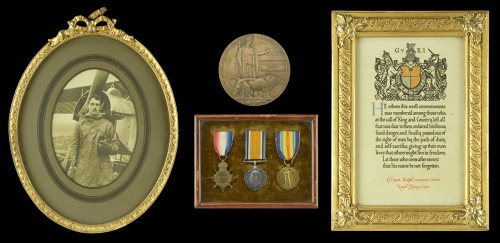
1914-15 Star (6665 Pte R. L. Curtis. R. Fus.); British War and Victory Medals (2. Lieut. R. L. Curtis.) medals housed in a small glazed display case; Memorial Plaque (Ralph Luxmore Curtis); Memorial Scroll ‘2/Lieut. Ralph Luxmore Curtis Royal Flying Corps’, with portrait photograph of recipient, last two items contemporarily and attractively framed in gilded wooden frames by H. W. Hole, Picture Frame Maker and Fine Art Dealer, 60 South street, Romford, all generally good very fine (lot) £4,000-£5,000
Ralph Luxmore Curtis was the son of William and Amy Curtis, and was born in Rainham, Essex in March 1898. The family were farmers, and Curtis attended Chigwell School. Curtis initially served during the Great War underage in the ranks of the 18th (Service) Battalion (1st Public Schools), Royal Fusiliers in France from 14 November 1915. He was commissioned into the Royal Flying Corps in September 1916, and carried out his initial training as a pilot before gaining his Aviator’s Certificate at Hendon, 17 February 1917.
Curtis was confirmed in the rank of Second Lieutenant, and posted for operational flying as a pilot with 48 Squadron (Bristol F.2b’s) in Bellevue, France in May 1917.
Curtis seems to have been a natural, claiming 15 ‘Victories’ over his first three months in the air, 16 June - 15 September 1917. His first Victory came with the experienced Lieutenant L. W. Allen, M.C. as his observer/gunner (this was to be Allen’s 10th and final victory). Having proved himself more than capable, Curtis then went on to shoot down the vast majority of his total with Second Lieutenant D. P. F. Uniacke as his observer/gunner - including three ‘doubles’ in a day (on 16 August, 22 August and 5 September). His record as follows:
16 June 1917: Alb. DIII (Destroyed), over Fresnes le Montauban
3 July 1917: C. (Out of Control), over Queant
5 July 1917: Alb. DV (Out of Control), over Bapaume
7 July 1917: Alb. D (Destroyed), over Vitry
28 July 1917: Alb. DIII (Out of Control), over Ghistelles
16 August 1917: Alb. DV (Destroyed in Flames), over St. Pierre Cappelle
16 August 1917: Alb. DV (Out of Control), over St. Pierre Cappelle
20 August 1917: Alb. DV (Out of Control), over Ghistelles
22 August 1917: Alb. DV (Destroyed), over Ostend
22 August 1917: Alb. DV (Out of Control), over Ostend
2 September 1917: Alb. DV (Out of Control - Shared with Lieutenant K. R. Park and his observer/gunner Second Lieutenant A. D. Light), 5 miles East of Dixmude
5 September 1917: DFW. C (Out of Control), over Middlekerke
5 September 1917: Alb. DV (Destroyed in Flames), off Westende (This was believed to be Leutnant Franz Pernet of Jasta Boelcke, and stepson of General Erich Ludendorff, although other sources credit K. R. Park with Pernet’s death)
14 September 1917: Alb. DV. (Destroyed), over Ghistelles
17 September 1917: C. (Out of Control - Shared with Sergeant J. Oldham and 2 AM W. Walker), over Leke.
Royal Flying Corps Communiques 1917-18 (in which Curtis is listed as ‘R. V. Curtis’ throughout) gives a flavour of Curtis’s combats:
16 August 1917:
‘2nd Lts R V Curtis and D Uniacke, 48 Squadron, dived at a hostile two-seater but lost sight of it and found themselves in the midst of Albatross scouts, while several more were lower down. One which they attacked crashed in a field and burst into flames...’
20 August 1917:
‘Sixteen Albatros scouts were met at 17,000 feet by Bristol Fighters of 48 Squadron. One engaged by Capt. J Milne and 2nd Lt W O’Toole crashed near Ghistelles aerodrome, and the same pilot and Observer drove down a second EA out of control and on fire. 2nd Lts R V Curtis and D Uniacke drown down a third EA out of control....’
22 August 1917:
‘Five Bristol Fighters of 48 Squadron engaged 20 EA over Ghistelles aerodrome and in the the ensuing fighting two EA were seen to crash, one was shot down in flames, one was forced to land near the aerodrome, and three others were shot down out of control. 2nd Lt J Binnie and Cpl V Reed shot the EA down in flames; Lt A D Coath and Lt A D Light destroyed one and drove one down out of control, while 2nd Lts R V Curtis and D Uniacke destroyed the third.’
14 September 1917:
‘While on photographic work 2nd Lts R V Curtis and D Uniacke, 48 Squadron, were attacked by three EA, one of which they destroyed and drove the others down. Another EA was destroyed by 2nd Lts K Park and Owen of the same squadron...’
One of Curtis’s squadron contemporaries was Lieutenant K. R. Park, with whom he shared an aircraft shot down out of control - Park later being Air Chief Marshal Sir Keith Park, G.C.B. K.B.E, M.C., D.F.C., D.C.L.
Over the course of the three months, Curtis had become one of the most successful Bristol Fighter pilots of 1917. But he and Uniacke’s luck was to come to an end, 21 September 1917. On the latter date Curtis and his observer Uniacke engaged in aerial combat with Oberleutnant Hermann Göring, commander of Jasta 27, over Sleyhage, near Roeselare, West Flanders, also known as Roulers. Curtis was piloting Bristol F.2b A7224 - an aircraft in which he had gained 6 Victories flying. At 09:05, their Bristol Fighter was shot down by Göring - becoming his 14th Victory.
Uniacke was captured and became a prisoner of war, and Curtis died that day in a German dressing station from the wounds that he had sustained in the combat. Curtis was initially interred at Hooglede Ost German Military Cemetery in Hooglede, West Flanders. In 1924, his remains were transferred to Harlebeke New British Cemetery in Harelbeke, West Flanders, Belgium. Second Lieutenant Curtis is also listed on the Rainham War Memorial, a clock tower monument in the centre of the town of Rainham, which commemorates the fallen of the Great War.
Share This Page