Preview Catalogue


 Create new list
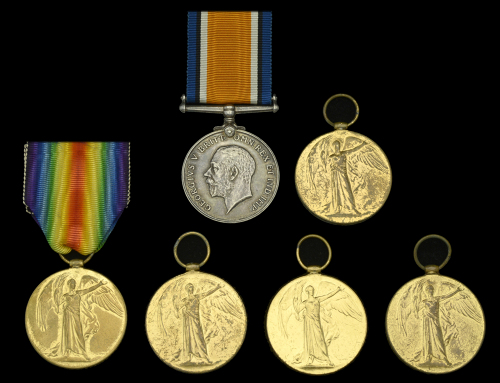
Pair: Private A. H. Jones, Royal Air Force, who was wounded whilst serving with 99 Squadron, mostly likely during the infamous Saarbrucken Raid on 31 July 1918
British War and Victory Medals (53100 Pte. 1. A. H. Jones. R.A.F.) good very fine
Victory Medal 1914-19 (4) (5802. 1.A.M. N. V. Brades. R.A.F.; 18224. 1.A.M. H. J. K. Carty. R.A.F.; 22033. 2.A.M. J. W. Johnson. R.A.F.; 222170. 2.A.M. C. M. Williams. R.A.F.) generally very fine and better (6) £80-£100
Arthur Hatchett Jones was born in Shoreditch on 21 May 1978 and lived at Clapham Common, London. He enlisted into the Royal Flying Corps on 4 January 1917, transferring to the Royal Air Force as a founder member on 1 April 1918, and served in France from 20 April 1918 to 11 February 1919. It was during this period whilst serving with 99 Squadron (according to the Absentee Voters List) in France as 2nd Private, that he was wounded according to the casualty report dated 16 August 1918. Other names mentioned on the same report seemed to have been involved with the disastrous air raid on Saarbrucken in which seven out of nine de Havilland DH9 Bombers were shot down on 31 July 1918. 99 Squadron went on to carry out 76 bombing raids, dropping 61 tonnes and destroying 12 German planes during the Great War. Jones was on the Reserve from 17 March 1919 and was finally discharged on. 20 April 1920.
Nelson Victor Brades was born in Eton, Buckinghamshire, in 1897 and joined the Royal Flying Corps on 1 June 1915, served in France from 7 March 1917 to 28 June 1919. On 1 April 1918 he was serving with 49 Squadron until 5 May 1919, and then in 79 and 29 Squadrons.
Henry James Rees Carty was born in Westminster on 10 June 1895, a Civil Servant in the Ministry of Health, and joined the Royal Flying Corps on 14 January 1916. Promoted Air Mechanic 1st Class 1 February 1917, he served in France from 19 March 1916 to 25 June 1917, and in Egypt from 27 September 1917 to 5 February 1919. Posted to the reserve on 5 March 1919, by 1955 he was the Higher Executive Officer in the Ministry of Health, and died in Worthing in 1975.
James William Johnson was born in Exmouth on 15 February 1891, and joined the Royal Naval Air Service on 16 October 1916 serving in H.M.S. President II (Crystal Palace and Cranwell) until 5 June 1917 when he was sent to Dunkirk, France serving with No. 1 Naval Aircraft Park (within this period he was now part of the Royal Air Force) and then from 3 November 1918 with 11 Aircraft Park until 3 March 1919. He was posted to the reserve on 4 April 1919.
Charles Morgan Williams was born in Henllys, Newport, Monmouthshire, on 24 August 1885 and served with the Royal Naval Air Service in H.M.S. President II: Crystal Palace and R.N.A.S. Killingholme (A Seaplane Base in the Humber Estuary that would hunt for enemy submarines, protect energy resources such as oil infrastructure and protect Naval Convoys) from 19 October 1916 to 31 March 1918 and then with the Royal Air Force from 1 April 1918 until 8 August 1918. He was posted to H.M.S. Pegasus from 28 August 1918, which was used for pilot training and ferrying aircraft to ships equipped with flying off platforms, and then to the reserve on 22 March 1919. He was discharged on 30 April 1920.
Share This Page