Auction Catalogue




 Create new list
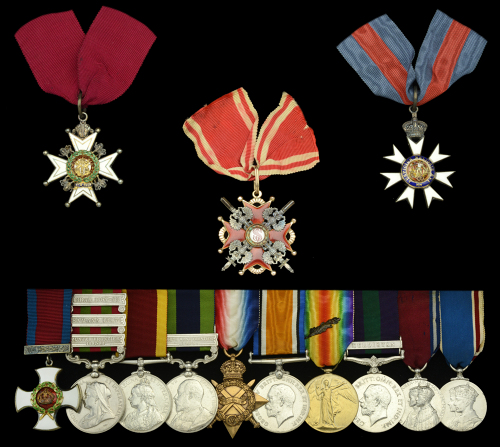
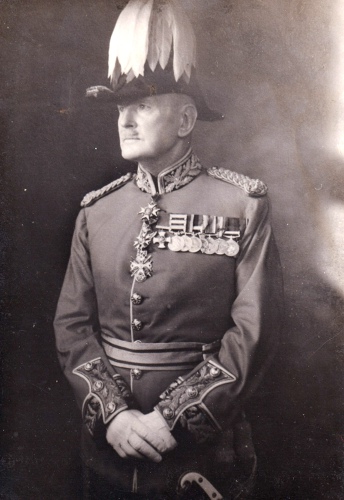
A very fine Great War C.B., C.M.G., Edward VII Waziristan 1902 D.S.O. group of thirteen awarded to Brigadier-General C. H. Davies, 53rd Sikhs, Indian Army
The Most Honourable Order of the Bath, C.B. (Military) Companion’s neck badge, silver-gilt and enamels; The Most Distinguished Order of St. Michael and St. George, C.M.G., Companion’s neck badge, silver-gilt and enamels; Distinguished Service Order, E.VII.R., silver-gilt and enamels, lacking integral top riband bar; India General Service 1895-1902, 3 clasps, Punjab Frontier 1897-98, Samana 1897, Tirah 1897-98 (Captn. C. H. Davies. 3d Sikh: Infy.); China 1900, no clasp (Captn. C. H. Davies 3d Sikh Infy.); India General Service 1908-35, 1 clasp, North West Frontier 1908 (Major C. H. Davies D.S.O. 53d Sikhs); 1914-15 Star (Lt. (sic) C. H. Davies D.S.O., 53/Sikhs F.F.); British War and Victory Medals, with small M.I.D. oak leaves (Brig-Genl. C. H. Davies.); General Service 1918-62, 1 clasp, Kurdistan (Brig. Gen. C. H. Davies.); Jubilee 1935; Coronation 1937; Russia, Empire, Order of St Stanislas, Military Division, Second Class neck badge, with silver-gilt crossed swords, by Edouard, St. Petersburg, 48mm, gold (56 zolotniki) and enamel, maker’s mark on reverse, gold mark and 1908-17 kokoshnik mark on suspension ring and elsewhere, chips to enamel wreaths of D.S.O., light contact marks, otherwise generally very fine or better (13) £4,000-£5,000
C.B. (Military) London Gazette 3 June 1919.
C.M.G. London Gazette 25 August 1917 (Mesopotamia).
D.S.O. London Gazette 3 July 1903: ‘In recognition of services on the occasion of the capture of Gumatti Fort during the operations against the Darwesh Khel Waziris in November 1902.’ One of two D.S.O.’s awarded for this action.
M.I.D. London Gazette 21 June 1916, 4 Juky 1916, 19 October 1916, 15 August 1917, 22 January 1919, and 5 June 1919.
Order of St Stanislas, 2nd Class with Swords London Gazette 15 May 1917.
Charles Henry Davies was born on 20 November 1867, at Dibrugarh, India, son of the late Major-General Frederick John Davies (died 1901) of Teignmouth. He was educated at the United Service College, Westward Ho! and at Newton College, Newton Abbott, and joined the Army on 5 February 1887, as a Second Lieutenant in the Cheshire Regiment. He became Lieutenant in the Indian Staff Corps 1 September 1889, and Captain in the Indian Army 5 February 1898. He served with the 3rd Sikh Infantry on the North-West Frontier, 1897-8, taking part in operations on the Samana and in the Kurram Valley during August and September 1897 (Medal with two clasps); and in the Tirah, 1897-8, including the action at Dargai and the capture of the Sampagha and Arhanga Passes, the reconnaissance of the Saran Sar and the action of 9 November 1897; the operations against the Khani Khel Chamkanis; the operations in the Bazar Valley, 25 to 30 December 1897 (clasp). He received a Medal for service in China, 1900, and served in 1902 in the operations against the Darwesh Khel Waziris, North-West Frontier. In this campaign he was wounded slightly, and for his services was mentioned in Despatches [London Gazette 5 June 1903], and created a Companion of the Distinguished Service Order [London Gazette 3 July 1903]: "Charles Henry Davies, Capt., Indian Army. For operations against the Darwesh Khel Waziris." He was promoted Major 5 February 1905; served in the Zakka Khel Expedition in 1908; in the Mohmand Expedition, including the engagement at Kargha, 1908 (Despatches; Medal with clasp). He became Lieutenant-Colonel 5 February 1913. He served in the European War, in Mesopotamia, 1914-18. He was given the Brevet of Colonel 3 June 1916; was promoted Temporary Brigadier-General on becoming Brigade Commander, 28th Infantry Brigade, Indian Expeditionary Force "D," Mesopotamian Expeditionary Force, 6 July 1916. He was wounded; was created a C.M.G. in 1917 and a C.B. in 1919. Brigadier-General Davies married, 5 September 1894, at Teignmouth, Devon, Beatrice Mary, fourth daughter of the late Christopher Sparrow, of Bitton, Teignmouth, and Urmston Lodge, near Manchester, and they have one son, Frederick Arthur Davies (Second Lieutenant, Queen's Own Corps of Guides). Brigadier-General Davied died on 2 January 1955, aged 87, and is buried in St Neot, Cornwall.
Share This Page