Auction Catalogue




 Create new list
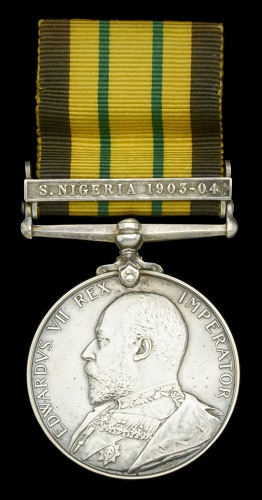
The rare A.G.S. ‘S. Nigeria 1903-04’ awarded to W. E. B. Copland-Crawford, who was Political Officer for Major I. G. Hogg’s punitive expedition against the secret society known as the “Ekumeku” or “Silent Ones” in Southern Nigeria, 1903-04. Early ‘in 1904 there was a rising in the hinterland north of Asaba on the Niger River. The bulk of the local military force was engaged elsewhere, but on the report that two missionaries were cut off, Crawford assembled twenty soldiers and twelve civil police and marched to the rescue. The endangered missionaries escaped to Asaba, so William established a defensive position around the Roman Catholic station at Issele-Oku and undoubtedly saved it. His action checked the whole rising, until more forces arrived to deal with it. The mission station which he defended was popularly renamed “Fort Crawford”.’
Africa General Service 1902-56, 1 clasp, S. Nigeria 1903-04 (W. E. B. Copland-Crawford, S. N. Regt) mounted for wear, good very fine £1,000-£1,400
This lot is to be sold as part of a special collection, Medals from an Africa Collection.

View
Collection
The Richard Magor Collection of Medals Relating to India and Africa, and other Fine Awards, Dix Noonan Webb, July 2003
W. E. B. Copland-Crawford is recorded in The Colonial Office List as a District Commissioner, afterwards Divisional Commissioner, Nigeria for the period 1903-04. The clasp ‘S. Nigeria 1903-04’ was awarded to all of those who served under the command of Brevet Major I. G. Hogg, D.S.O., 4th Hussars, in the punitive expedition against the towns of Osea, Oriri and Ndoto between December 1903 and January 1904. Around 330 members of the Southern Nigeria Regiment were entitled - to which Copland-Crawford was attached on the medal roll.
William Edward Boyd Copland-Crawford was born in Edinburgh, Scotland in June 1861. He was the son of General R. F. Copland- Crawford, R.A. of Wembley. Copland-Crawford was employed as a District Commissioner in Southern Nigeria in 1900. Hogg’s punitive expedition is described as follows in the London Gazette 25 August 1905:
‘Operation No. 6 was undertaken with a view to suppressing a rising among the natives of the Asaba Hinterland. Under pressure of a secret society known as the “Ekumeku” or “Silent Ones”, several mission stations had been destroyed and numerous friendly natives murdered.
A force (6 Officers, 4 British Non-Commissioned Officers, 215 rank and file, 1 7-pr. gun, 2 Maxims, W. E. B. Copland-Crawford, Political Officer, assisted by J. Davidson and W. S. Boyle) left Asaba on the 17th January, commanded by Captain I. G. Hogg, 4th Hussars. Severe fighting took place, Colour-Sergeant W. Mendham being killed in an attack on the town of Ukunzu on the 28th January. On the 11th February Captain Hogg’s command was reinforced by 1 Officer, 2 British Non-Commissioned Officers, 90 rank and file, 1 2.95 gun, under Local Captain H. P. Gordon, 4th Battalion, Connaught Rangers.
On the 14th and 15th of February a final stand was made by the hostile natives in the town of Okuruku; stubborn resistance was met with, and the enemy was not completely routed until the King’s compound, about a mile distant from the town, had been destroyed. This was effected after some 3 hours’ fighting. By the 25th of April over 300 of the “Ekumeku” Society had been captured, and have since been tried by the Courts.’
The High Commissioner for Southern Nigeria praised Copland-Crawford for his conduct during the period thus:
‘The Divisional Commissioner, Mr Copland-Crawford, showed marked courage in at once advancing to the Issle pending the return of Captain Hoggs’ force from the Ishan Country, thereby ensuring the loyalty of that place and disconcerting the plans of hostile natives. This officer has been indefatigable in his efforts to expedite the re-establishment of peace and order in the disturbed areas, and in bringing to justice those responsible for the outrages which have taken place.’
More detail as to what the High Commissioner was referring to, is found in The Copland-Crawfords of Wembley by R. E. Brock:
‘Early in 1904 there was a rising in the hinterland north of Asaba on the Niger River. The bulk of the local military force was engaged elsewhere, but on the report that two missionaries were cut off, Crawford assembled twenty soldiers and twelve civil police and marched to the rescue. The endangered missionaries escaped to Asaba, so William established a defensive position around the Roman Catholic station at Issele-Oku and undoubtedly saved it. His action checked the whole rising, until more forces arrived to deal with it. The mission station which he defended was popularly renamed “Fort Crawford”. He recalled also an African newspaper which wrote that he had dotted Nigeria with cricket grounds and turned the sons of cannibals into country players.’
Copland-Crawford provided an 8 page report dated 25 April, which can be found in C.O. 520/24 and is titled Report on the Rising of the Ekumeku Society in Asasba Hinterland 1904.
Copland-Crawford was appointed Assistant Provincial Commissioner in 1911, and as 2nd Class Resident in 1917. He retired in August 1920, and lived in Highcliffe, Louisa Terrace, Exmouth, Devon in later life. Copland-Crawford died September 1941, and is buried in St. Margaret and St. Andrew Churchyard, Littleham, Devon.
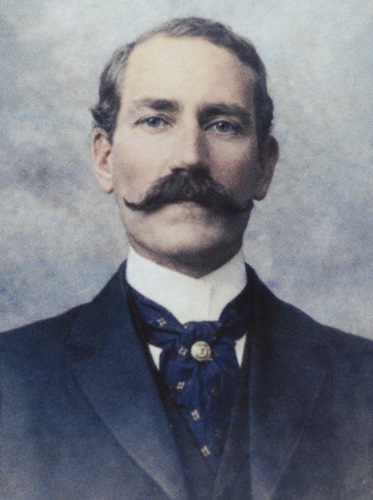
Sold with copied research, including a photographic image of the recipient.
Share This Page